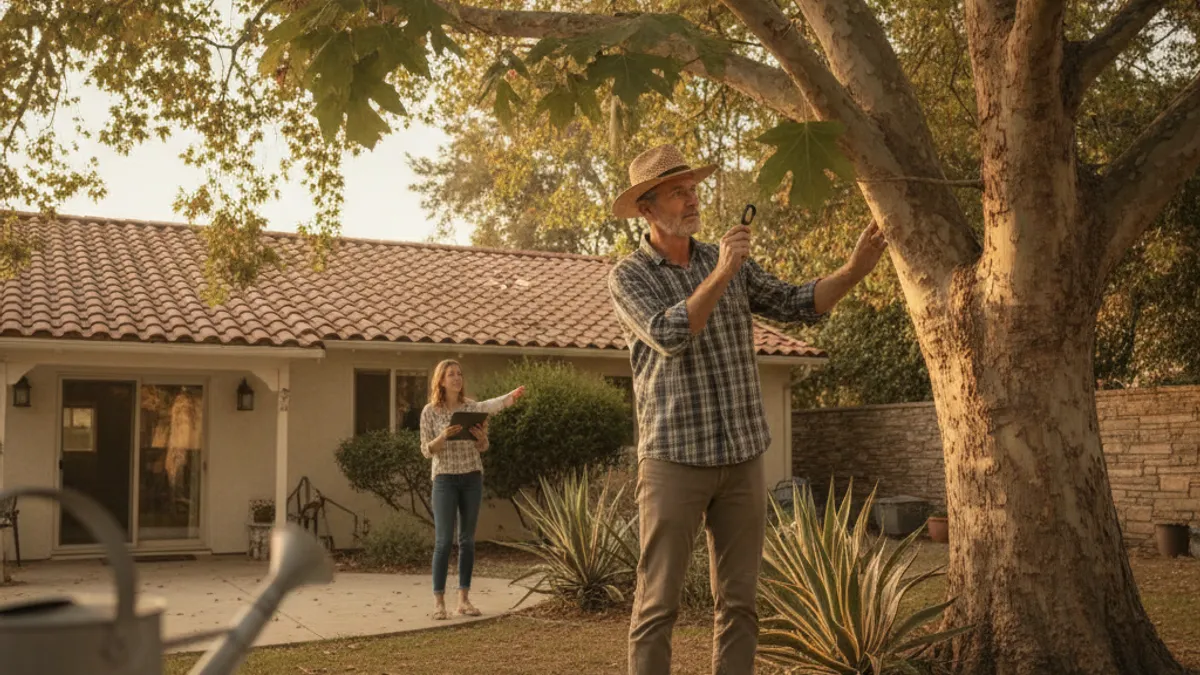
Identify the tree in a San Diego yard from more than one visible trait: leaves, bark, flowers, fruit, and overall form. Species changes how you water, how you prune, and which tree protections to check. The jurisdiction decides who has authority. Photos from the sidewalk help. Confirm identity with enough certainty before you plan the work.
Stay on the ground. Do not climb, peel bark, or pick live samples from an unsafe tree. Photograph the whole tree, bark on the trunk, leaves you can reach or that have fallen, plus buds and fruit when they are present. In a mixed yard, fallen fruit may belong to a different tree.
Types of trees in San Diego: a species index
Use the group that matches what you can see, then open the species guide. These are common landscape groups, not a complete county list.
Flowering trees: purple, yellow, pink, and white
Color alone is a weak key. Compare leaf pattern and fruit too. The full color-and-litter roundup is in flowering trees in San Diego.
Lavender-blue tubular clusters on fernlike, twice-divided leaves point to jacaranda. Flattened woody pods and a spreading shade canopy fit that tree. The San Diego Zoo describes plantings along Fern Canyon Trail and at the Safari Park parking lot. Flower litter is real. A purple wash on the street is still not proof by itself.
Pink or cream showy flowers, palmate leaves, and a young green trunk studded with conical spines point to silk floss, not jacaranda. Some cultivars lack spines, so identify the actual tree. Tipu flowers orange-yellow on pinnate leaves. That foliage is coarser than jacaranda’s twice-divided leaflets.
Opposite leaves, mottled peeling bark, and white, pink, red, or lavender summer flowers on a smaller tree point to crape myrtle. Size and color follow the cultivar. Do not top it to force a smaller tree.
Large fragrant white flowers on glossy evergreen leaves with brown undersides can be southern magnolia or the compact Little Gem cultivar. A white flower alone cannot confirm that named cultivar. Orange or red winter or spring flowers on thorn-bearing branches can be a coral tree such as Erythrina afra. Other Erythrina species differ, so use the botanical label when it matters.
Palm trees in San Diego
Separate fan from feather, then look for a crownshaft. Our guide to palm trees in San Diego covers Mexican fan, queen, king, and Canary Island date palms.
Queen palm (Syagrus romanzoffiana) has a single gray trunk, arching feather leaves with leaflets in several planes, and no crownshaft. It is not self-cleaning. Dead fronds can need removal. Living, nutrient-poor leaves can still be worth keeping.
King palm (Archontophoenix cunninghamiana) has a slender ringed trunk and a cylindrical crownshaft. Leaflets sit mainly in one plane. A. alexandrae is also sold as king. Silvery leaflet undersides help separate that species.
Mexican fan palm (Washingtonia robusta) has fan leaves and a tapered trunk. A dead-leaf skirt may persist, then later shed. California fan palm (W. filifera) is thicker and grayer. Hybrids complicate both. Fan-shaped does not automatically mean Washingtonia.
Canary Island date palm (Phoenix canariensis) has a massive trunk, diamond leaf-base scars, feather leaves, and basal leaflets modified into spines. It has no crownshaft. Phoenix hybridizes, so appearance cannot settle every specimen. Species matters here because Fusarium wilt of Canary Island date palms can move on contaminated tools, and South American palm weevil is established in San Diego County on this host.
Native trees of San Diego
Native, evergreen, and drought-tolerant are three different ideas. The native roundup is in native trees of San Diego.
Coast live oak is an evergreen oak with leathery leaves that can look cupped, and hair tufts at the vein junctions on the underside. Hair anywhere on the leaf does not confirm it. Goldspotted oak borer is present in San Diego County and in other Southern California counties. Crown thinning or bark staining is not a diagnosis. D-shaped exit holes are a more specific clue, and even that needs a qualified look. See goldspotted oak borer.
California sycamore has lobed deciduous leaves, mottled peeling bark, and spherical seed clusters. It is a riparian native with a high-water profile. Native does not mean it wants a dry, tight residential lot.
Torrey pine holds needles in bundles of five. Native stands occur on coastal San Diego County and Santa Rosa Island. Five needles plus cones and crown are a clue. They do not prove every five-needle pine near Del Mar is Torrey, and a nearby planted tree is not automatically wild origin.
Drought-tolerant and evergreen trees
A tree that stayed green through a dry summer still may be a thirsty species on leftover irrigation. Compare the drought-tolerant group instead of assuming rainfall is enough.
Narrow leaflets in many pairs, a weeping habit, and reddish fruit clusters point to California pepper. It is South American, despite the common name. Leaflets in threes on a dense evergreen crown point to African sumac. Those two get swapped from the street. These shapes also show up in privacy tree searches. Evergreen screening is a design choice, not proof of native status.
Silvery narrow leaves on a gnarled, often multi-trunk tree can be olive. Confirm fruit and bark before you treat it as a low-water automatic.
Trees that need extra care in the quote
Some common yard trees need a clearer work plan because roots, pests, or wood handling change the job. That is not a ranked worst list, and species alone does not decide removal or a permit.
Eucalyptus is many species. Bark color is a poor single test. Compare juvenile versus adult leaves, plus buds and fruit. Smooth shedding bark, a single large warty bud, and a ribbed woody capsule can point toward blue gum. Clustered beaked buds and smaller capsules with protruding valves can point toward river red gum. Deeply furrowed dark ironbark on trunk and branches is a different tree again. Ask for the botanical name before irreversible work.
Ficus in landscapes is not one plant. Ficus microcarpa has simple glossy oval leaves, smooth gray bark, and a large canopy, and it may grow aerial roots. Ficus benjamina has drooping branchlets and long tapering leaf tips. Root conflict needs the actual tree and the actual hardscape, not a species reputation.
Weeping willow wants moisture and room for roots. It is a poor match for a dry, tight lot, which is why we wrote what to plant instead. Species that can naturalize are in the invasive tree species guide. Cal-IPC ratings describe ecological impact. They are not a city removal order.
If you are replanting after a removal, the best time to plant trees in San Diego covers seasonal timing by plant type.
Start with the leaves, then add bark and fruit
Needle-like leaves in bundles point to a pine. Bundles of five are one Torrey clue, used with cones and location. These broadleaf groups are the next comparisons.
Fernlike twice-divided leaflets fit jacaranda better than silk floss. Palmate leaflets fit silk floss. Pinnate leaflets fit tipu. Three leaflets fit African sumac. Many small leaflets fit California pepper.
Glossy oval simple leaves can be a ficus. Long tapering tips plus drooping branchlets fit F. benjamina better than Indian laurel fig. Lobed leaves plus peeling mottled bark and seed balls fit sycamore. Aromatic eucalyptus leaves vary by species and age. Do not crush foliage on a live, unsafe tree. Use fallen leaves on the ground if you check scent at all.
Bark is the second pass, especially when the canopy is high. Smooth patchy eucalyptus bark can still have a rough base. Deeply furrowed dark bark is common on mature oaks, not unique to them. Mottled camouflage bark fits sycamore. A tall branchless trunk is not enough to call it a palm. Confirm fan or feather fronds and the crown structure.
If the tree drops avocados or figs, start with that fruit, then still confirm the botanical name before large cuts. Seed pods, capsules, and berry clusters separate several look-alikes that share one flower color from the street.
Evergreen or deciduous is not native or drought-proof
A winter-bare canopy can be jacaranda, sycamore, crape myrtle, or a deciduous fruit tree. Coast live oak, many eucalypts, olives, and most palms stay green. That split only shortens the list. It does not tell you the tree is native, invasive, or low-water.
Why the name matters before you prune, water, or check protections
Water need follows species and site. California sycamore wants real moisture and root room. A desert-adapted tree on the same block may not. A brown canopy can be drought, salt, or wet roots. Identity tells the inspector which of those is plausible.
Pruning follows living tissue and structure. Queen palms are not self-cleaning. Crape myrtles flower on new wood and should not be topped. Citrus and avocado often need little pruning. Canary Island date palms need a disease-aware tool plan. None of that is a countywide calendar.
Permits follow jurisdiction, right-of-way, lot size, and protected designation. A Torrey pine, an oak, or a ficus can each be public, private, or easement trees. Species identity does not waive a City street-tree permit or a County clearing review. It does tell you which questions to take to Planning or Public Works.
If discoloration or dieback might be disease rather than a species trait, use common San Diego tree diseases as a symptom map, not a remote diagnosis.
Frequently asked questions
What’s the easiest way to identify a tree by its leaves?
Use more than one trait. Needles in fives can be a pine clue. Fernlike twice-divided leaves fit jacaranda. Three leaflets fit African sumac. Many leaflets fit California pepper. Palmate leaves plus a spiny trunk fit silk floss. Then add bark, buds, and fruit.
Is my tree a eucalyptus or a pepper tree?
Compare leaflet count, fruit, and bark from the ground. California pepper has many small leaflets and reddish fruit clusters. Eucalyptus is several species, and menthol scent on a fallen leaf is only a hint. Confirm buds and capsules before you treat it as one eucalypt.
Can an arborist identify my tree from a photo?
Ground photos of the whole tree, bark, leaves, buds, and fruit can help identify a tree. They also help a pro prepare. Incomplete features or condition still need an on-site look before irreversible work.
Why does species matter before pruning?
Cuts, living foliage, pests, and permit paths differ by tree and by parcel. An oak, a queen palm, and a crape myrtle do not share one method. A wrong name leads to the wrong work.
If you have two likely names and the next step is a cut, call for a licensed local pro to look at the actual tree. Branch Pro San Diego connects you with licensed, insured independent tree service professionals. You hire and pay the pro directly. Call (858) 400-4423. How to hire a certified arborist in San Diego explains how to verify the named person.