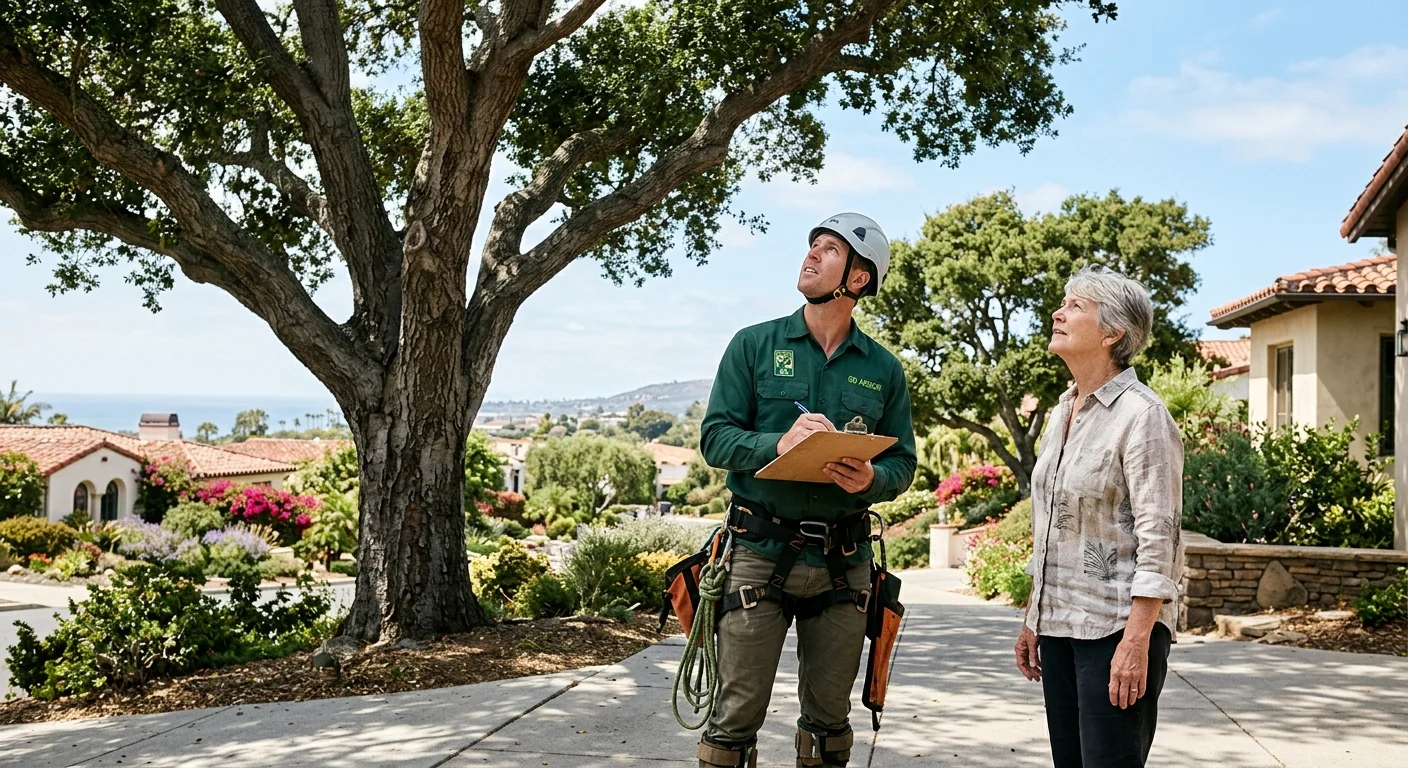
An ISA Certified Arborist credential belongs to a named person. It is not a California contractor license, and it is not a company badge. Before you hire tree-care help in San Diego County, write down that person’s name and confirm the credential. Then confirm the contractor license and coverage required for the actual paid scope.
What should a San Diego arborist visit actually cover?
A useful visit answers a defined question about the tree in front of you. That might be condition, a pruning objective, a keep or remove choice, or whether you even need a written report.
The assessment covers what you can see from the ground, and it states those limits. Trunk flare, lean, visible cavities, dead limbs, root heave, and clearance from the house are fair observations. Hidden decay, a future failure date, and HOA or city acceptance are not things a walkaround settles. Someone can be skilled with trees and still be the wrong license class for the cutting that follows. Keep those jobs separate on paper.
If you already know the work, start with tree pruning or tree removal. If you need an assessment first, use an arborist consultation.
How do I verify ISA certification for a named person?
Ask for the individual’s full name as it appears on the credential. ISA certification is personal. A truck door or website logo does not transfer it to everyone on the crew.
Search the ISA credential directory for that name. A person may omit a public listing. An absent listing does not, by itself, prove they are uncertified. Ask them to show a current ISA digital certificate for that same named person.
Match the name on the certificate to the person who will inspect your tree. If someone else would write a report or do the cutting, verify that person too.
When do I need a California contractor license as well?
Looking at a tree and talking through options is not the same job as cutting, removing, grinding a stump, or other paid tree service.
For tree service contracts of $1,000 or more, California requires a contractor license. That figure is the whole job: labor, materials, and other items together. People who advertise as contractors, hire others, or split work to stay under the line do not get the small-job exemption. Work that needs a building permit needs a license at any price.
For tree and palm work, look up an active C-49 license, or an active C-61/D-49 issued before January 1, 2024. A legacy D-49 that is still active is a valid classification for that holder. Confirm status, classification, and expiration on the CSLB license lookup.
A certificate of insurance describes coverage. The policy and its conditions control. Ask that the certificate match the named company and the job dates.
California currently lists D-49 among classifications that cannot use a no-employee workers’ compensation exemption. C-49 is not on that current exclusion list. That is not a reason to skip coverage. Ask who will be on site and what CSLB shows today.
Active California contractors must maintain a $25,000 license bond, or a cashier’s check deposited in lieu of that bond. That bond is not general liability insurance. Workers’ compensation, the bond, and how to read a certificate are easy to mix up. Our 24-hour tree service verification guide walks through those records.
What belongs in a written quote?
Compare the work objective, the method, and the records you will receive.
Ask them to write:
- The tree location and the question you want answered
- What they will inspect from the ground, and what they will not claim to know
- Whether a written report is included, who it is for, and what question it answers
- Whether the same company would also bid the pruning or removal
- Who obtains any city, county, or utility approval if the job needs one
- How debris, chips, and the stump are handled if work follows
A written report is useful when a city, lender, or association asked for one. It is not required for every visit. Agree on it before anyone starts. A report records observations and limits. It does not guarantee a board, insurer, or permit counter will accept it.
If the same firm would both advise you and remove the tree, say so on the quote. You can still hire them. You can also get a second quote from a company that would not do the removal.
Species and site still matter. A coast live oak inland, a Torrey pine on the bluffs, and a queen palm in a South Bay parkway do not get the same pruning or pest questions. Ask how they would handle the tree you actually have. For decline and pests, see tree health diagnosis. For a longer consult checklist, see when an arborist consultation is worth it.
What can I check from the ground before anyone arrives?
Stay on stable ground. Do not climb, sound the trunk, or walk under a tree that is already failing.
From a safe place you can note species clues, lean, hanging limbs, soil heave, and how close the crown sits to the roof or a service drop. Photograph those conditions without approaching damaged buildings or lines.
If a tree is on or beside a downed line, stay away. Call 911 and SDG&E at 1-800-411-7343. SDG&E decides whether the line can be de-energized, covered, or moved. If a standing tree is into overhead lines, call SDG&E before any cutting. If someone is hurt or the scene is unstable, call 911 first. A tree-service quote comes after the utility and emergency responders.
Permit rules follow the parcel, the tree’s location, and the job, not a nickname. A City of San Diego street tree is a City process. An unincorporated parcel goes through the County. City pages for San Diego, Escondido, and Carlsbad are starting points. Then confirm with that city. Tree removal permits in San Diego covers the larger permit map.
Frequently asked questions
What is a certified arborist?
An ISA Certified Arborist is a person who holds that ISA credential. It shows professional tree-care study. It is not a California license to contract for tree work, and it is not a pathology or engineering title.
How do I verify an arborist’s ISA certification in San Diego?
Use the name of the individual. Search ISA’s directory, and ask for a current digital certificate if they are not listed. Then look up the company that would perform paid work on CSLB.
Do I need a certified arborist or a licensed tree service?
You may need one person, the other, or both. Credentialed assessment and licensed production work are different tasks. Match the person to the question, then match the license to the contract.
Do I need a written arborist report?
Only if you and the inspector agree you need one, or an agency asked for it. Agree on price and scope with the provider. A written report or formal plan is not required for every visit. No one can guarantee a board, insurer, or permit counter will accept it.
What should I watch for when comparing quotes?
Watch for a missing name, a scope that is only verbal, and a removal bid bundled with an assessment that never states the company’s interest in the work. Ask for the method, the objective, and the records you will receive.
When to call us
Call when you want a licensed local pro for a defined tree question or the work that follows. Branch Pro San Diego matches you with independent, licensed, and insured tree service professionals. You contract with them and pay them directly.
Call (858) 400-4423. If you still need the species, start with how to identify the tree in your San Diego yard.