A coast live oak on a Green Valley slope can look full from the street and still be failing at the root flare. Inland heat, clay, and tight HOA lots make that gap common in Poway. A trim that ignores the cause can strip the foliage the tree still needs.
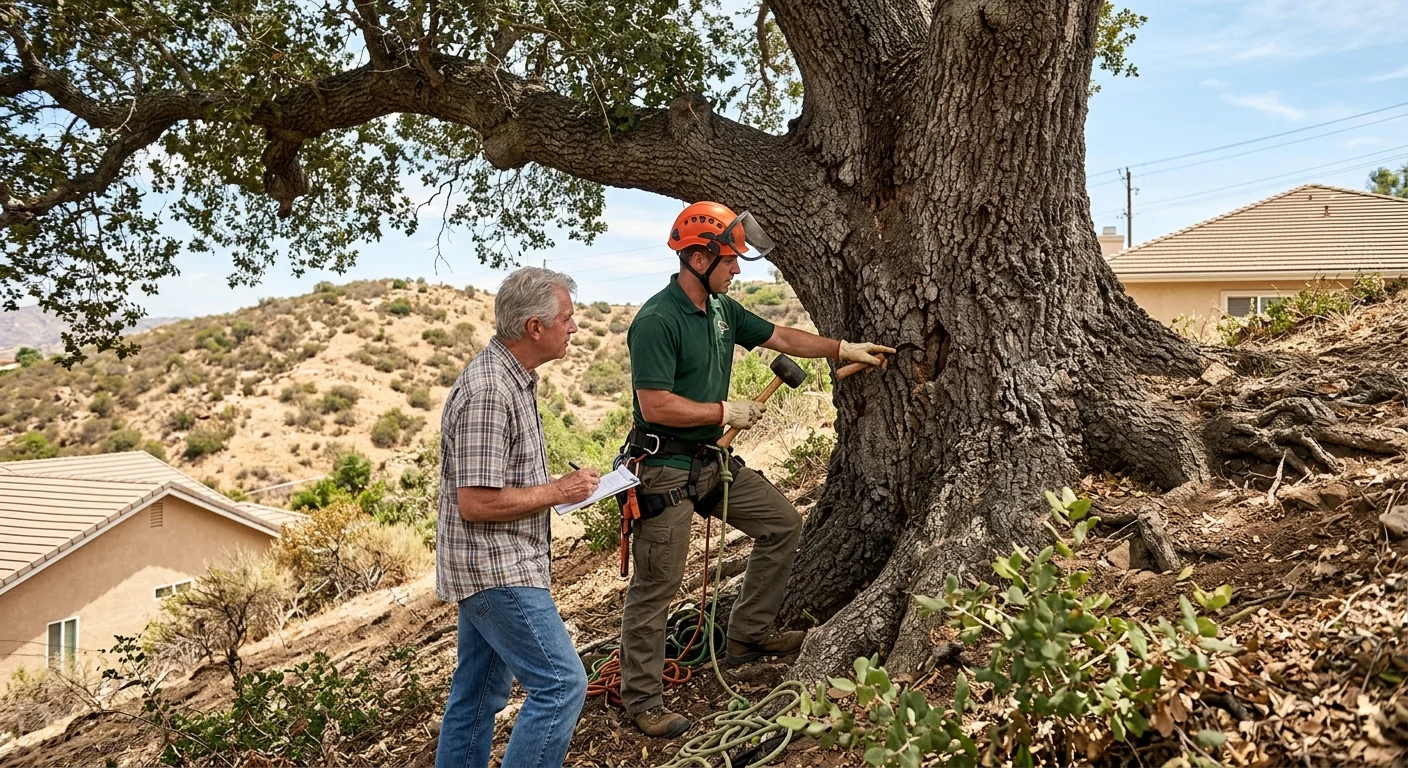
Start with the tree symptom, not the cut
Routine shaping is for a tree with a known, limited objective. An arborist consultation is for a tree whose cause is not obvious yet. A search for arborist Poway CA usually means you are in that second group.
Stay on the ground and name what you see. One-sided thinning that does not match the rest of the canopy is a reason to pause. So is a new lean, heaved soil, or a raised root plate. Cracks, cavities, or dark staining on the trunk belong in the notes. Mushrooms at the base are a clue for a qualified person, not a home diagnosis. Sudden summer leaf drop is different from normal fall color on a pistache or sweetgum. Dead wood over a roof, driveway, or play area is a target problem, even if the rest of the crown still looks green. Irrigation that soaks the trunk while the drip line stays dry is a site problem, not a species problem.
Don’t treat every thinning oak as goldspotted oak borer. UC ANR describes D-shaped exit holes as a more specific clue than crown dieback or bark stain, and even that is not something to settle from a phone photo. Coast live oak, canyon live oak, and Engelmann oak are the native oaks Poway’s tree chapter names. They also sit in the county’s GSOB range, where the pest is contributing to ongoing oak mortality. Keep suspect oak wood on the property until a qualified person says how it should be handled.
If a limb is hanging, stay back. If a line is down, call 911 and SDG&E at 1-800-411-7343 from a safe place. Ordinary tree work waits until the utility says the site is clear.
A tree health diagnosis is a different scope from a trim quote. Ask for written findings first. Then decide whether pruning, support, treatment, or tree removal in Poway and Rancho Bernardo is the work.
How Poway heat, slopes, and HOA lots change the assessment
Poway sits inland of the marine layer. Summer heat and dry wind hit trees harder here than they do on the coast. Lots along the Pomerado corridor, in Green Valley, and near the Lake Poway edges often sit on slopes. Clay holds water when it is wet and opens when it is dry. Roots that felt locked in after winter rain can lose grip after a long dry stretch.
The independent arborist should walk the actual grade, not just the street view. A tree upslope of a house loads differently than one in a flat Old Poway yard. Access for a later crew matters too. Narrow HOA tracts, stacked parking, and shared slopes change how a limb would be lowered if work is later approved. A Pomerado-facing eucalyptus over a driveway is a different job than a backyard oak above a canyon edge.
HOA rules are not the city permit. Tract landscaping, view corridors, and required street trees live in the governing documents. City of Poway Development Services issues private-tree removal permits. Municipal Code section 12.32.150 requires a permit for native or heritage trees, and, on commercial or industrial property, for living trees over three inches in diameter. Native species in that chapter are coast live oak, canyon live oak, Engelmann oak, and California sycamore. Heritage status is a City Council designation. Not every large tree is heritage. Public trees go through Public Works and the city’s Urban Forestry program. Confirm the parcel, the tree’s location, and the species with those offices before anyone cuts. A mailing address is not enough if the lot sits on a boundary.
Fire rules are a third track. Poway Fire Department maps fire-hazard zones and runs a local wildfire defensible space program. Existing homes in a locally designated Very High Fire Hazard Severity Zone fall under Government Code 51182. That is not a copy-paste of every State Responsibility Area rule. Statewide Zone 0, the first five feet around a structure, is described in CAL FIRE guidance, and as of early September 2026 the Board of Forestry package was still in state review. It is not a license to strip every plant in that band. Confirm current requirements for your address with Poway Fire. CAL FIRE’s Ready for Wildfire page is a starting map, not a substitute for the local department.
Inland heat and Santa Ana exposure are also why a later Poway trim is not the same job as a coastal one. The assessment has to name the site, not a generic inland valley.
What roots, trunk, and canopy should be documented
Photos from a safe place help the independent arborist prepare. They are not a diagnosis. Stay off ladders. Don’t peel bark, tap cavities, or walk out onto a suspect limb.
From the ground, capture the whole tree with the house, slope, and targets in the same frame. Include the root flare if it is visible, and any soil mounded or dropped around it. Show irrigation heads, turf, and mulch piled against the trunk. Photograph trunk seams, included bark, cavities, and staining. Shoot the canopy from more than one side, including dead tips and one-sided decline. Nearby hardscape cracks belong in the file. A crack next to a root is a reason to investigate. It is not proof the tree caused a foundation failure. A licensed plumber or an engineer speaks to pipes and structure. The arborist speaks to the tree.
Ask for writing, not a one-line “trim.” Useful notes name species, diameter at a stated height, defects, what sits under the canopy, and options with remaining risk. ISA’s Trees Are Good materials treat support systems, pruning, and removal as separate choices. A crown cable does not fix a moving root plate.
If construction, trenching, or a new patio is planned, say so on the visit. Root cutting and compaction can show up years later. UC IPM’s construction guidance is the reason to assess before the trench, not after the tree declines. DigAlert covers San Diego County for public utility marks. Those marks usually run to the meter, not through every private irrigation line or sewer lateral, and they do not give depth.
For oaks, don’t treat every stain as GSOB. For eucalyptus, don’t treat peeling bark as a death sentence. For palms, one-sided frond death has several causes. The written report should separate what was observed from what still needs a lab or a pest professional.
When trimming should wait for written findings
Cuts have a purpose or they are just smaller foliage. ISA’s mature-tree guidance treats 25 percent as a general upper guideline, and less on a mature tree. It is not a yearly quota. Heavy thinning does not water a drought-stressed tree. Lion-tailing, topping, and stripping interior wood make the next wind worse.
Wait for written findings when the tree is a named native or a possible heritage tree. Wait when decline is one-sided, sudden, or paired with root-plate movement. Wait when an HOA, an insurer, or a neighbor is already in the conversation. Wait when work would occur while birds could be nesting. CDFW describes February through August as typical for many species, with nesting possible in other months. A consulting biologist’s survey is the agency’s recommendation if work cannot wait. Wait when the tree sits near lines. SDG&E, not a trimmer, decides whether a service drop can be de-energized or moved.
Routine deadwood over a lawn, with a sound trunk and no lean, can still be a trim scope. The independent arborist and the later crew may be different people. Agree which findings travel into the work order. Don’t let a verbal “take it down” replace a permit check.
If removal is the recommendation, stop and confirm Poway’s path before you hire. A homeowner calling a tree dangerous does not create a self-certified waiver. For public trees, a private quote is not permission. After findings are in, tree service in Poway is the local match for licensed crews, not a substitute for the written assessment.
How to verify the arborist’s current credential
ISA Certified Arborist is a professional credential held by a person. It is not a California license, and it does not by itself authorize paid tree work. The person can share a digital certificate. ISA’s Find an Arborist directory is useful. A missing listing does not by itself disprove certification, because participation can be omitted.
Paid tree work of $1,000 or more, including labor and materials, generally requires a California contractor license. The current classification for tree and palm work is C-49. Contractors who held C-61/D-49 before January 1, 2024, may still work under that classification if the license is active. Check the name, classification, and status on the CSLB license lookup.
A C-49 holder is not automatically exempt from workers’ compensation, and is not automatically required to carry it if they truly have no employees. Read the CSLB workers’ compensation record and ask how the job will be staffed. Coverage is required whenever the contractor has employees. Every active contractor must also show a current $25,000 license bond or a lawful deposit in lieu of that bond. That bond is not general liability insurance. A certificate of insurance is not the policy. Coverage follows the policy terms.
Ask for the license number before the visit. Match it to the person or company on the contract. If pesticide treatment is later proposed, that is a separate DPR pest-control business license, not a tree-surgery add-on.
Our guide to hiring a certified arborist walks through those checks in order. Branch Pro San Diego matches you with licensed, independent local tree companies. We do not diagnose trees, hold a C-49, or send our own crews.
Frequently asked questions
How much do arborists charge per hour in Poway?
No California agency publishes an official hourly rate or evaluation fee. Aggregator ranges are not primary sources. Ask the independent arborist for the evaluation price in writing, what the report includes, and whether later pruning or removal is a separate contract.
How much does it cost to cut down a 30-foot tree?
Height is only one factor. Species, lean, targets, access on a sloped lot, and permit status change the job. There is no verified countywide price for a 30-foot removal. Get a written scope from the licensed company after the tree has been assessed.
Who is a reputable arborist in Poway?
Don’t hire from a slogan. Verify the live CSLB record, the named person’s ISA credential if they claim one, and insurance documents against the actual policy. Then compare written findings.
Does Poway require an arborist report for every trim?
A countywide report rule for every private prune could not be confirmed from the city’s published tree chapter. Reports become useful when a native or heritage tree, an HOA, an insurer, or a disputed neighbor tree is involved. Confirm with Development Services for your address and species.
When to call us
When a Poway tree needs an assessment before anyone climbs, start with a licensed local match, not a guess from the sidewalk. Call us at (858) 400-4423 and we’ll connect you with a licensed local tree company.