The palm over your Vista driveway is the job, not a countywide schedule. A tall queen palm on a Shadowridge hillside drops onto tile and a tight side yard, while a lower palm near the 78 sits in a different breeze and drop zone. Name the species, the targets, and the access before anyone climbs.
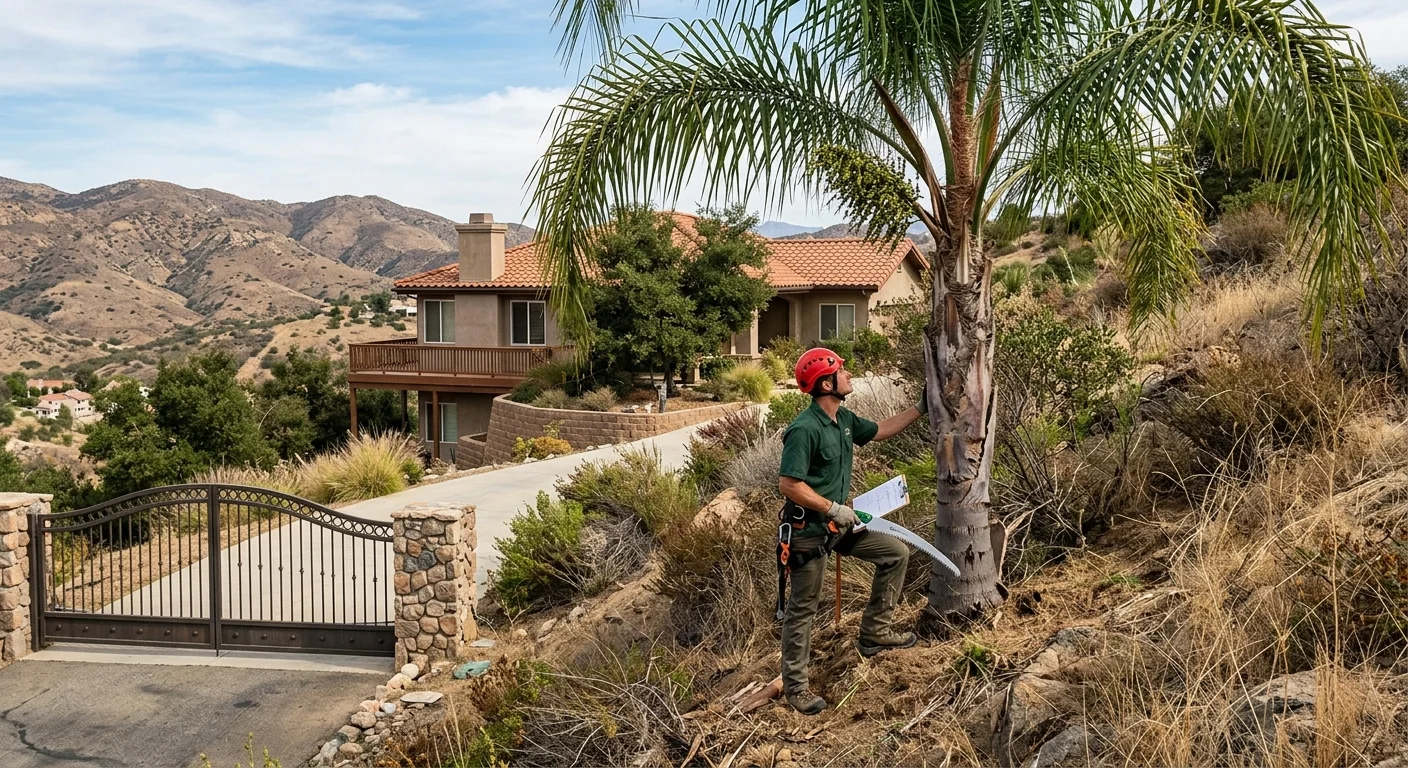
Start with the palm, the property, and the trimming goal
Confirm what you have before you describe shedding. Queen palms (Syagrus romanzoffiana) keep dead fronds until someone takes them off. University of Florida’s queen-palm profile is plain: they are not self-cleaning. Some crownshaft palms drop old leaves on their own. That falling material is still a site risk. Mexican fan palms (Washingtonia robusta) can hold a dead-leaf skirt. California fan palm (Washingtonia filifera) is the native California species. Cultivated hybrids blur the look. A ground photo of the trunk, crown, and fruit beats a guess from the street.
Then look at the lot. Vista yards put palms against roofs, pool cages, and gated side paths. Write a trimming goal in plain words: dead fronds off the walk, seed pods off the patio, clearance off the eaves. Cosmetic trunk skinning and “pineapple” boot cuts are a different request. They wound the trunk. ISA’s palm guidance centers on dead and dying fronds, plus fruit or flower clusters when those create site risk. Healthy foliage stays. The growing point at the top must be protected.
Branch Pro San Diego is a referral service. We match you with a licensed independent company for palm tree trimming and removal. The climber you approve does the cutting. We don’t own trucks, and we don’t climb.
Keep other tree trimming on a separate line if you also have oaks, peppers, or eucalyptus. Palms are not shade trees. The cuts, the drop, and the haul-away are different work.
A useful request names each palm, about how tall it is from the ground, what you can see from a safe place, and the result you want quoted. Stay off ladders. Stay off the trunk. If a frond is already on a roof or a line, describe it from the yard. Don’t go up after it.
How inland Vista heat differs from a true coastal palm
Vista sits in inland North County. Shadowridge and the higher tracts take more heat and a thinner marine layer than lots closer to SR-78. Encinitas and Carlsbad get salt spray on foliage. Most Vista yards do not. Inland salt injury, when it shows, more often comes from irrigation water, fertilizer salts, or soil salts. UC IPM treats salt, drought, and excess water as lookalikes. Brown frond tips alone are not a diagnosis.
Heat dries dead tissue faster. It does not create a published Vista pruning calendar. University of Florida’s pruning-palms guide is clear: there is no single intrinsically best pruning season. Dead leaves, fruit stalks, cold damage, and the palm’s condition drive the decision. Overpruning cuts the leaf area the palm uses to make energy. Nutrient-stressed, partly living leaves may need to stay. For countywide timing, read palm tree trimming season in San Diego. For method, read how to prune a palm tree.
Santa Ana winds still reach Vista. Dry gusts move hanging fronds and heavy seed clusters. That is a reason to look up from a safe place. It is not a reason to strip a green crown. Aggressive high cuts do not buy a longer interval. ISA notes that overpruning can slow growth and attract pests. Don’t import a coastal “hurricane cut” habit onto an inland tract.
If the palm is a Canary Island date palm, one-sided leaflet death has several possible causes. Fusarium wilt of that species has no established cure, and dirty tools can spread it. That is not a home diagnosis from a photo. South American palm weevil is established in San Diego County and damages Canary Island date palms. Report a suspected weevil to the county agricultural commissioner. Keep ordinary trimming talk separate from pest or disease work.
Map gates, roofs, pools, and street access before the scope
Walk the same path the crew will use before you approve a scope. Gated Shadowridge tracts need gate width, a lock plan, and a place to stage a chipper without blocking the street. Lower lots near the 78 can sit tighter to neighbors, parkway strips, and parked cars. Write down what you see.
Street parking and the truck approach come first. Then gate height, HOA rules if you have them, and the side-yard width to the trunk. Note roof, solar, and eaves under the crown. Note pool, spa, and screen cages in the drop zone. Note overhead lines from the ground. The independent company plans the climb and the drop. You still have to show them the bottlenecks.
If the palm sits in or over the public right-of-way, check with the city before anyone cuts. Vista’s Urban Forest program says right-of-way trees need the city’s no-fee removal permit. Private ownership and right-of-way location can coexist. The city also describes trimming privately owned trees in that strip. A Vista mailing address does not settle jurisdiction. Some addresses that say Vista sit on unincorporated county land. Start with the exact parcel and Vista’s tree and urban forest management page.
Lines are not a homeowner trim. Keep people and tools away from downed or strained conductors. Call 911 and SDG&E at 1-800-411-7343. The utility decides whether lines can be de-energized, covered, or moved. Ordinary palm work waits on that call.
A written scope should name how debris leaves the lot. Tight side yards and pool fences change haul-away. So does a chipper that cannot fit the gate. Ask where fronds will land, who moves patio furniture, and who is responsible if a pod hits a screen. Those are job details, not extras you discover after the saw starts.
Separate frond work, seed pods, hauling, and excluded cuts
Ask for line items, not a vague “palm cleaning.”
Dead and hanging fronds are one item. Flower and fruit clusters are another. Queen palm fruit is messy and can seed into beds. Removing clusters is a maintenance choice, separate from frond work. Limited live-frond clearance is a third item, and only where a roof, walk, or similar target actually needs it. ISA allows limited clearance exceptions. It does not tell you to take every living frond below a clock line.
Haul-away versus stacked debris belongs in the same writing. So do exclusions: trunk skinning, spike climbing, boot stripping, topping, removal, and stump work. Spikes permanently wound palm trunks. Those wounds do not close. Ask how the climber will get up the tree.
If the quote says “clean the palm” and nothing else, send it back. You want named palms, named cuts, and named exclusions. A Canary Island date palm also needs a tool-cleaning plan between trees. UC IPM’s palm-disease guide calls for physical cleaning of debris and substantial disinfection before each palm. It does not support a home wipe recipe, and it does not make a green crown proof that the trunk is sound.
Don’t mix fire-clearance brush work into a palm trim unless that is the actual request. Vista parcels sit in different fire jurisdictions. Statewide Zone 0 rules were not in force as a universal “remove every plant in the first five feet” law when this page was written. Confirm the address with the fire authority that covers it. CAL FIRE’s defensible-space page is a starting point, not a permit.
What to confirm with the independent palm pro before approval
California requires a C-49 Tree and Palm Contractor license for tree and palm contracts of $1,000 or more, counting labor, materials, and other items. A valid legacy C-61/D-49 issued before 2024 can still be the lawful classification. Advertising as a contractor, employing others, needing a building permit, or splitting jobs to stay under the threshold knocks out the minor-work exemption. Check the named company on the CSLB license lookup. Confirm active status and classification before you approve.
ISA Certified Arborist is a personal credential, not a state license. You can ask the person on site to show it. An absent ISA directory listing does not by itself disprove a credential. The matched company is the licensed contractor. Branch Pro San Diego is not.
Ask what species they identified. Ask which fronds and clusters come off, and which live foliage stays. Ask the access plan for gates, pool, and roof. Ask whether haul-away is in the price or extra. Ask how tools are cleaned between palms. If they have employees, read the workers’ compensation record on CSLB. Every active California contractor must carry a $25,000 license bond, or a lawful deposit in lieu of that bond. CSLB shows whether that record is current. A certificate of insurance is not the policy. Coverage follows the policy, not the paper summary.
The pros we connect you with are licensed and insured. You still contract and pay the independent company directly. Compare written scopes side by side. Then decide.
For other work around town, start at tree service in Vista. Keep palms on their own scope so a shade-tree crew is not quoting a crownshaft by habit.
Frequently asked questions
Are any palm trees native to California?
Yes. California fan palm (Washingtonia filifera) is native to California. Mexican fan palm (Washingtonia robusta) is native to northwestern Mexico. Most Vista yard palms are planted ornamentals: queen, king, Mexican fan, Canary Island date, and others. Identify the actual tree before you describe how it sheds.
What’s the average cost to cut down a palm tree?
No .gov or .edu source publishes an official Vista or San Diego palm-removal average. Anyone quoting a countywide number is guessing. Price belongs in a written proposal for your palms, height, access, haul-away, and whether the job is trim or removal. Confirm inclusions and exclusions before you approve.
How many feet can I trim without a license in California?
California does not set a homeowner height limit in feet. Contractor licensing for this work turns on Business and Professions Code section 7048: contracts of $1,000 or more, with the full list of conditions. Work that needs a building permit needs a license regardless of cost. Climbing a tall palm with a saw is still a bad plan even under the dollar line. Hire a licensed independent company for work at height, near roofs, or near lines.
How do I prune my palm tree correctly?
Keep the growing point intact. Take dead and dying fronds and, if needed, fruit or flower clusters that create site risk. Leave healthy foliage. Don’t spike the trunk. Don’t skin live trunks or sculpt boots as a default. Don’t treat a green crown as a DIY project from a ladder. Ground-level photos and a written objective are the right start. The independent professional decides access and the actual cuts.
Do Vista right-of-way palms need a city permit?
Right-of-way trees in the City of Vista need the city’s no-fee removal permit. Private ownership of a tree in that strip does not cancel the city’s process. The city describes trimming privately owned trees there. Confirm the parcel, the tree’s location, and the scope with Public Works before you hire. A backyard palm on private land is a different question. Don’t assume. Ask the city with the address.
When to call us
Call when a Vista palm is dropping onto a roof, a pool, a walk, or a line, or when you want dead fronds and seed pods taken off without guessing at the species. The independent company does the climb. Call us at (858) 400-4423 and we’ll connect you with a licensed local tree company.