A nursery tag that says parvifolia eucalyptus is a clue, not a work plan. San Diego yards mix that label with silver-dollar types, red box, florist greenery, and much larger gums. Name the tree in front of you before anyone trims it or takes it out.
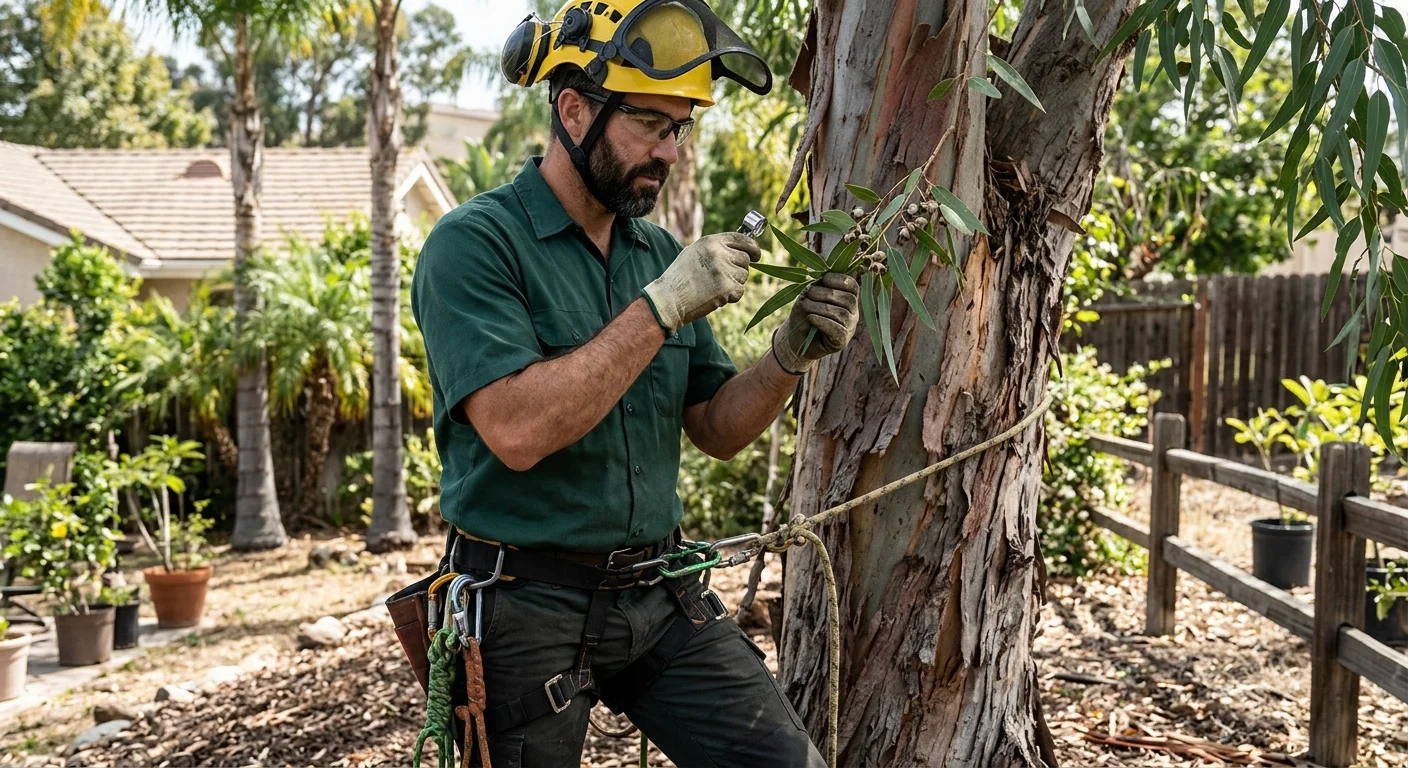
Confirm the species before planning any tree work
People search parvifolia eucalyptus for two different plants. One is a landscape tree. The other is cut greenery sold in bunches. Treat the yard tree as its own question.
Botanical references use Eucalyptus parvula for the living tree, with small-leaved gum as the usual common name. Nurseries and older lists still print Eucalyptus parvifolia. That older name also belongs to a fossil, which is why current flora work prefers E. parvula. If a tag, invoice, or HOA letter says parvifolia, ask the independent arborist to write the botanical name they are actually using.
Small-leaved peppermint shows up in the same search cluster. Peppermint is a bark group in eucalypts, and it is a weak ID on its own. Put the label in your notes. Build the ID from leaves, bark, buds, and seed cups together.
This species is Australian. A countywide planting count for San Diego could not be verified from the sources this page is allowed to use. The U.S. Forest Service 2017 urban forest inventory for the City of San Diego does not list it among the five most common trees. Walk the actual specimen. Do not assume every small-leaved gum in a coastal or inland yard is this species.
Eucalypts are flowering plants in the myrtle family, Myrtaceae. They make buds, flowers, and woody capsules. That places them with angiosperms. They are evergreen woody trees, so they keep a canopy year-round in a typical San Diego climate. They are not seasonal bedding plants that die to the ground and return on a calendar.
Start with ground-level photos and any paperwork you already have. A guide to identifying eucalyptus trees in San Diego walks through the same multi-part check for other gums on local lots. Ask the company you hire to put the botanical name on the written scope before eucalyptus removal or a large prune. A wrong name sends the wrong clearance, access, and wood-handling plan.
Compare bark, leaves, and seed structures with lookalikes
Use more than one trait. Bark color alone shifts with age, sun, and watering. Leaf color shifts too. Fallen cups under a mixed canopy can belong to the tree next door.
On a candidate parvifolia or E. parvula, look first at the small opposite juvenile leaves. They stay on many crowns for a long time and look bluish or gray-green. Adult leaves, when they appear, stay narrow. Smooth gray bark that sheds in long strips is the usual trunk story. Small woody capsules and clustered buds close the check. Photograph bark on the lower trunk, a typical leaf from both faces, any buds you can reach from the ground, and intact cups. Stay off the tree. Do not peel live bark or clip a high branch for a sample.
Silver-leaf eucalyptus, Eucalyptus cinerea, is the common mix-up on tags. Its juvenile leaves are larger, rounder, and more silver. Red box, Eucalyptus polyanthemos, keeps broad round or oval juvenile leaves, then moves toward elliptic or lance-shaped adult foliage, with bark that can stay fibrous or flaky on the trunk. Work through that side-by-side in Eucalyptus polyanthemos identification before tree work. Blue gum, Eucalyptus globulus, is a different scale of tree, with large warty buds and a much heavier crown.
Florist bunches labeled parvifolia eucalyptus are cut stems. They can look like the juvenile foliage of this species. They can also be another small-leaved eucalypt harvested for events. A bouquet does not identify the tree by your driveway in San Diego.
Australian flora pages publish native heights and flowering months. Those figures describe the species in its home range. They are not a mature-size promise for a Mira Mesa parkway, a Fallbrook wind corridor, or a tight Ocean Beach lot. If the work is consequential, ask for a botanical name on site. A photo ID from one leaf is a hypothesis.
Document canopy, trunk, and root-area changes without diagnosing
Once you have a working name, record what the tree is doing. Dates and photos help the independent pro more than a guess about beetles or drought.
From a safe place on the ground, note live crown density, dead tips, one-sided thinning, and recent leaf drop. Check the trunk for staining, cracks, cavities, and new holes. At the root flare, look for heaved soil, exposed roots, mushrooms, and grade changes from a patio or irrigation job. Stay clear of hanging limbs. If a line is down, keep away and call 911 and SDG&E at 1-800-411-7343.
UC IPM describes eucalyptus longhorned borers as larvae that feed under bark. Exit holes, oozing, and dieback are clues. They are not proof of internal decay or a tree that will fail. Redgum lerp psyllid is a different insect. It sucks on leaves and can leave honeydew and sooty mold. Species susceptibility differs, so a neighbor’s red gum is a poor stand-in for your tree. Tree health diagnosis is how those questions get answered on the actual canopy.
Summer branch drop can involve eucalyptus on hot, still days. UC Cooperative Extension describes limbs that look sound and still fail. There is no published prevention guarantee and no San Diego ranking that makes this species an automatic removal. Record the limb, the weather that day, and what sits under the crown.
Peeling bark is normal shedding on many smooth-barked gums. A new lean, a cracked union, or soil that has lifted is a reason to call for an assessment. It is still not a home diagnosis of root failure. Too little water and too much water can brown a canopy in similar ways. Check how the tree is irrigated, whether lawn watering recently stopped, and whether the root collar stays wet.
If crews will be in the crown from February through August, California Department of Fish and Wildlife treats that window as typical nesting season for many birds, with nesting possible in other months. A consulting biologist’s survey is the agency’s guidance when birds could be nesting. Do not move a nest to inspect it.
How placement on the lot changes the work discussion
The same species is a different job on a coastal cottage lot and on an inland canyon edge. Access, targets, and who controls the tree matter as much as the Latin name.
A City of San Diego street tree follows the City’s process. Urban Forestry handles no-fee permit requests for street-tree trimming, removal, planting, and root pruning after City inspection. Report City-maintained trees through Get It Done. A private contractor’s calendar does not authorize removal of a parkway tree. Power-line conflicts go to SDG&E. Other cities and unincorporated county land use different desks. Confirm the parcel, not the mailing city. An El Cajon address can sit on county land. Lake San Marcos is unincorporated, even when the mail says San Marcos.
On a private lot in La Jolla or Pacific Beach, salt air, marine layer, and tight setbacks drive clearance over roofs, pools, and neighbor lines. Inland in Escondido, El Cajon, or Poway, heat, irrigation changes, and Santa Ana exposure sit higher on the list. East County parcels in a State Responsibility Area or a mapped Very High Fire Hazard Severity Zone should confirm current defensible-space rules with the local fire authority. CAL FIRE’s Ready for Wildfire page explains Zone 1 and Zone 2. Statewide Zone 0 rules were still moving through review as of early September 2026. The first five feet is guidance to check locally. It is not a published order to strip every living tree from that band.
Overhead conductors change the crew, not just the prune. Unauthorized people must stay out of the electrical hazard. Ask SDG&E how the service drop or primary will be handled before private work is scheduled. A C-49 tree contractor license, or an active legacy C-61/D-49, covers tree work. It does not replace utility clearance qualifications.
Placement also sets debris and wood handling. Fresh eucalyptus wood can matter for borers. Keep suspect material on site until the independent company explains disposal. Burning needs a local fire permit, and some districts suspend it. San Miguel Fire & Rescue had permitted burning suspended as of May 1, 2026 inside its jurisdiction. Do not treat a burn pile as the default end of a removal.
When an independent arborist assessment may help
Call for a site assessment when identity is still open and the next step is irreversible. That includes a large prune, a removal, construction beside the roots, or a tree over a house, play area, or driveway.
ISA Certified Arborist is a professional credential for an individual. It is not a California license. Paid tree work at $1,000 or more in aggregate generally needs a C-49 Tree and Palm Contractor, and an active legacy D-49 issued before 2024 can still be valid. Check the person and the company on the CSLB license lookup. Ask how the job will be staffed, and read the workers’ compensation record. A certificate of insurance is not the policy. Coverage follows the policy terms.
Trees Are Good explains how to look up an individual credential. An absent directory listing does not by itself disprove certification. Ask to see the person’s current certificate if that credential matters to you. Branch Pro San Diego matches you with licensed, independent local tree companies. It does not hold the trade license, own the trucks, or perform the work.
A useful visit names the species in writing, records defects you can see from the ground, lists targets under the crown, and separates keep, prune, and remove as options. Agree the objective before anyone climbs. Mature pruning should have a purpose. ISA’s mature-tree guidance treats 25 percent as a general upper mark, and less on a mature tree, depending on size, species, age, and goal. That is a planning limit, not a yearly quota.
Frequently asked questions
Will a parvifolia eucalyptus come back every year?
It is an evergreen tree. The canopy stays unless drought, cold, pests, or cutting take it down. Some eucalypts can sprout from a stump or roots after a cut. Grinding lowers basal sprouts and still can leave live roots. Species and site decide what returns. Ask the independent company to match grinding depth and follow-up to whatever you want to plant or pave later.
Is eucalyptus a gymnosperm or an angiosperm?
Eucalyptus is an angiosperm. It flowers and sets seed in woody capsules. Pines and related conifers are gymnosperms. That split does not change a San Diego permit path. It does keep this tree out of pine bark-beetle rules that belong to true pines.
Is florist parvifolia the same plant as the tree in my yard?
Floral shops sell cut stems under the parvifolia name. Your landscape tree needs its own bark, leaf, bud, and fruit check. Ask for Eucalyptus parvula or the synonym E. parvifolia only after someone has seen the standing tree.
When to call us
Call when a possible parvifolia eucalyptus sits over a target, needs a named prune, or may come out, and you want a licensed local company to assess it. Call us at (858) 400-4423 and we’ll connect you with a licensed local tree company.