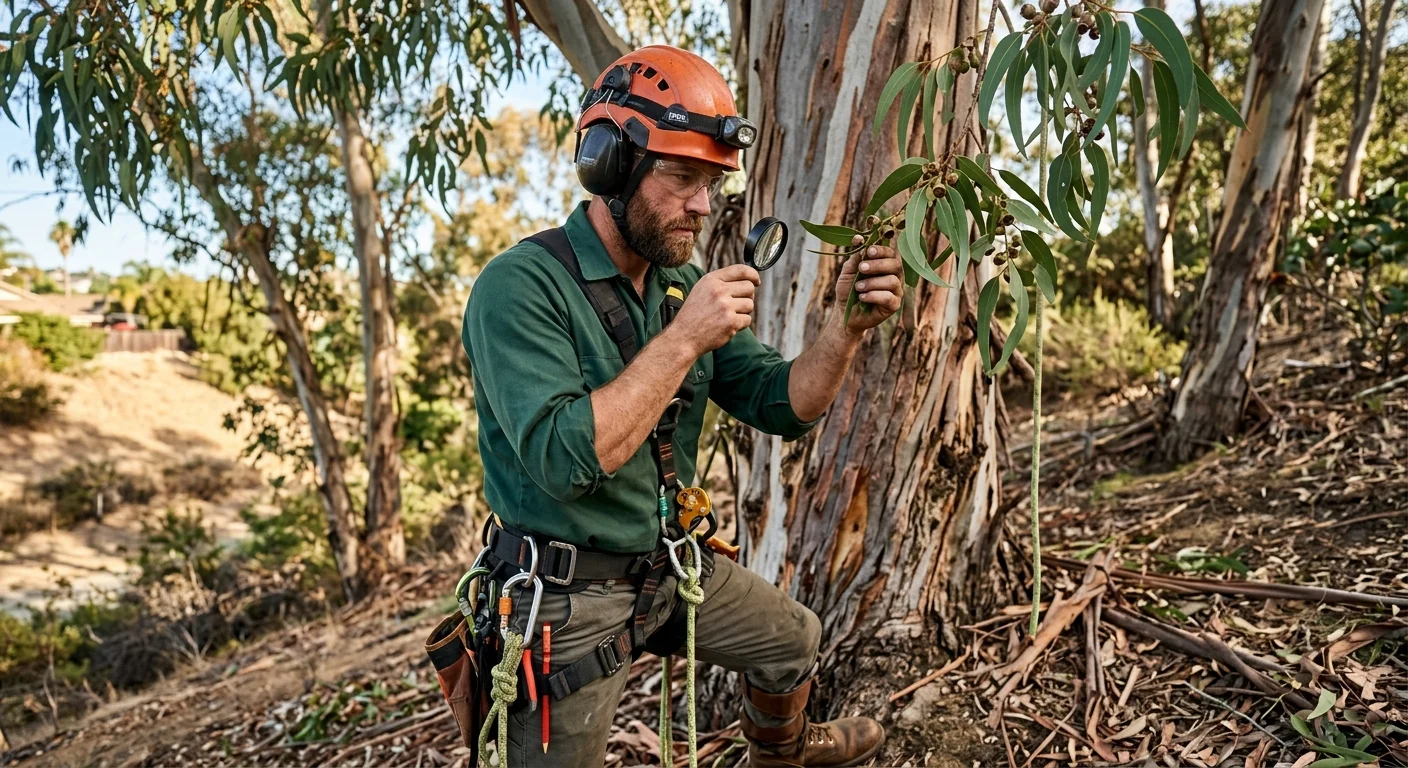
If someone is hurt or in immediate danger, call 911. If the tree is on a downed line, stay away. From a safe place, call 911 and SDG&E at 1-800-411-7343. Don’t climb for a closer look. Don’t peel bark or cut a live branch to make a sample. SDG&E decides whether lines can be de-energized, covered, or moved. If a standing eucalyptus hangs into overhead lines, call SDG&E first.
Eucalyptus polyanthemos is the red box, a eucalypt in the myrtle family. Confirm that name with more than one feature before anyone prunes or removes the tree. A nursery tag, a phone app, or the phrase silver dollar eucalyptus is a lead. It isn’t a finished identification.
PlantNET’s New South Wales flora treatment is the botanical description to compare against. Match juvenile and adult leaves, bark, buds, and fruit to that treatment.
How do you tell red box from other eucalypts?
Use four parts together: juvenile and adult leaves, bark, buds, and fruit. Bark color or one round leaf is a weak test.
Juvenile leaves are broadly round and a dull grey-green or waxy grey. Adult foliage can become broad-lanceolate, elliptic, or ovate. It doesn’t stay round on every mature crown. Some trees keep juvenile or intermediate leaves in the crown, so photograph more than one height you can see from the ground.
Bark isn’t one pattern for the whole species. PlantNET records bark that may be mostly smooth and shedding, or persistent, fibrous-flaky bark on the trunk and large branches. Subspecies differ. Subspecies polyanthemos can have smooth bark or flakes at the base.
Flowering structures are compound, with seven-flowered clusters. Buds are ovoid, club-shaped, or shortly spindle-shaped. Fruit is hemispherical, conical, or cylindrical, with a depressed disk and enclosed valves. White flowers are recorded for subspecies polyanthemos.
Silver dollar is a shared common name, not a unique identification. Round, grey juvenile leaves are the feature people mean. Other eucalypts can show a similar juvenile leaf. If someone identifies the tree only as silver dollar, ask which of the four features they used.
Fallen leaves or capsules under a mixed planting may belong to the neighbor tree. Label where each photo was taken.
Our guide to identifying eucalyptus trees in San Diego compares other named eucalypts. Ask for the botanical name in writing before species-specific pruning or removal. Homeowners seeking tree service in San Diego should still request that written identification before approving the work.
What should you photograph from the ground?
Stay on stable ground. Capture the whole tree from more than one open viewpoint. Then photograph attached leaves, both surfaces when you can, bark from the base into the main limbs, buds or fruit still on the stem, and the trunk flare. Include nearby houses, fences, driveways, and any overhead lines you can see without walking toward them.
A familiar object next to an already-fallen leaf can show scale. Don’t pick live material just for a picture.
Write which tree each image belongs to. On an Escondido grove or a National City driveway row, fruit on the ground can be assigned to the wrong stem.
Is species ID the same as a health diagnosis?
No. A correct name doesn’t explain a thin crown, a stain, a hole, or a lean. Keep a dated photo set of the canopy, major unions, the base, and the ground. Record irrigation or grading changes as observations, not causes.
Don’t probe cavities. Don’t diagnose borers from a photo of a hole. Species identification and pest or decay assessment are separate questions. Send the timeline with a request for tree health diagnosis when you want a professional to separate those questions.
How does placement change the work discussion?
A red box in a narrow North Park side yard raises access questions. A tree on a Tierrasanta canyon edge raises slope and target questions. Placement doesn’t change the botanical characters, but it changes the scope.
Note whether the tree stands alone or in a group. The eucalyptus grove management guide is the planning page when several stems share a lot.
If you see overhead lines in a wide photo, say so. Don’t approach conductors. Work near energized lines is for authorized personnel and the utility. If removal is on the table, see eucalyptus removal referrals.
Look from the ground for occupied nests. CDFW describes February through August as typical for many species, with nesting possible in other months. A consulting biologist can survey when birds could be nesting and may set a buffer, or work can wait until nesting is done. Don’t move nests.
Confirm whether the tree is private, in a right-of-way, or under another city’s program before anyone cuts. A mailing address isn’t a jurisdiction.
Who should confirm the name before irreversible work?
Ask for a written opinion that separates identification, observed condition, risk, and options. The identifier should say whether Eucalyptus polyanthemos is confirmed, probable, or still open, and which visible features they used.
An ISA Certified Arborist credential belongs to a person. It isn’t a California contractor license and doesn’t replace one. A missing directory listing doesn’t by itself disprove certification. The person can share an ISA digital certificate. Review that through the ISA credential directory. A referral from us doesn’t prove a named person holds that credential.
Check the company on the CSLB license lookup. An active C-49 fits tree and palm work. A legacy D-49 issued before January 1, 2024 can still be valid if CSLB shows it active. California requires a contractor license when the aggregate project price is $1,000 or more, including labor, materials, and other items. A project below $1,000 can be exempt only if the work is casual, minor, or inconsequential, no building permit is required, the person doesn’t advertise as a contractor, and they don’t employ another person to do the work. Splitting a larger job removes the exemption. Work that needs a building permit needs a license regardless of cost.
Bring the photo log, any old planting record, and the property sketch. Keep the common name paired with the scientific name if both are used on the work order.
Frequently asked questions
Is red box the same tree people call silver dollar eucalyptus?
Red box is the established common name for Eucalyptus polyanthemos. Silver dollar refers to round juvenile leaves that more than one eucalypt can show. Use leaves, bark, buds, and fruit together.
Can I identify the tree from bark alone?
No. Bark varies by subspecies and by height on the trunk. Combine it with foliage, buds, and fruit.
Should I cut a branch to take to a nursery?
No. Use ground-safe photos of attached parts. Cutting is work, and it can be unsafe.
When to call us
If people are in danger, call 911. If a line is down, stay back and call 911 and SDG&E at 1-800-411-7343. If a standing tree conflicts with a line, call SDG&E first.
Call us when you want a licensed independent professional to confirm a suspected red box, assess it, prune it, or remove it, and the site is safe for ordinary private work. Branch Pro San Diego matches homeowners with licensed, independent local tree professionals. We don’t perform the work.
Call us at (858) 400-4423 and we’ll connect you with a licensed local tree company.