Round, silvery eucalyptus leaves in a San Diego yard often get called silver dollar. That nickname points at Eucalyptus cinerea, also sold as Argyle apple, and at other gums with coin-shaped juvenile leaves. Confirm the species before anyone plans cuts, removal, or treatment.
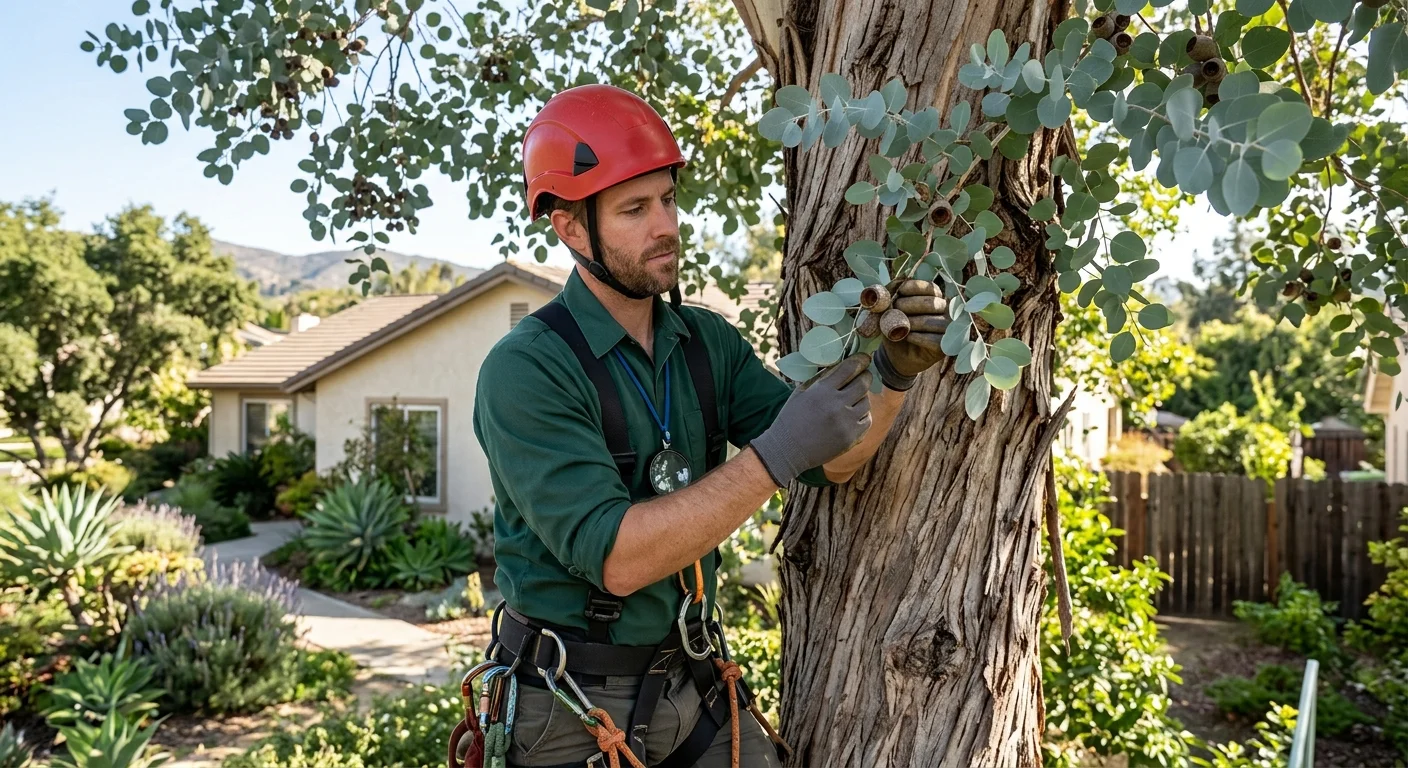
Confirm the species before planning any tree work
A common name travels farther than a botanical name. Silver dollar eucalyptus, Argyle apple, and silver dollar gum all get used for Eucalyptus cinerea. Florist bunches also sell mixed round-leaf stems under coin names. A tag that says silver dollar does not settle the tree on your lot.
That matters in San Diego because the work follows the actual tree. Species affects mature form, how long those round juvenile leaves persist, and which pests an inspector should even look for. It also changes whether you have a small ornamental or a large gum with heavy limbs. Red box, Eucalyptus polyanthemos, is the lookalike that trips people most often. It also carries round, dull, grey-green juvenile leaves. Read the polyanthemos identification notes before you treat every silver dollar crown as cinerea.
Do not use this page as a remote ID. Photograph from the ground. Stay off ladders. Do not peel bark or climb. Capture the trunk from soil to first limb, a close bark patch, juvenile and adult leaves still attached, any buds, and fallen capsules you can tie to that tree. Mixed stands drop fruit from neighbors. The eucalyptus identification guide walks through that multi-character habit for several types of eucalyptus.
Ask the independent company for the botanical name before irreversible work. In California, paid tree work of $1,000 or more, labor and materials included, requires an active C-49 Tree and Palm license, or an active legacy C-61/D-49 issued before 2024. Confirm the number on the CSLB license lookup. ISA Certified Arborist is a separate individual credential, not a state license. Trees Are Good explains what that credential is.
No source used for this page shows Eucalyptus cinerea as a common City of San Diego street tree. The U.S. Forest Service 2017 city inventory lists Chinese banyan, arroyo willow, Japanese cheesewood, Aleppo pine, and pygmy date palm as the five most common species by count. Eucalyptus still shows up in older groves, canyon edges, and private yards from coastal north county to East County. Treat the tree in front of you as the specimen.
Compare bark, leaves, and seed structures with lookalikes
EUCLID, the Australian identification work built from National Herbarium specimens, tells inspectors to use several characters together. Rough-bark extent, juvenile versus adult leaves, buds, and capsules matter more than leaf color. Bark color alone is a weak test.
Start with foliage. Juvenile eucalyptus leaves can be round, opposite, and waxy. Adult leaves on many species become stalked, alternate, and lance-shaped. If the crown still holds coin-shaped pairs, you are looking at retained juvenile or intermediate foliage. That happens on more than one species. It is a starting clue, not a finish.
Compare that with red box. PlantNET describes Eucalyptus polyanthemos juvenile leaves as broadly round and dull grey-green or glaucous. Adult foliage can become broad-lanceolate, elliptic, or ovate. It does not stay round forever. Buds sit in seven-flowered clusters. Fruit is hemispherical, conical, or cylindrical, with a depressed disk and enclosed valves. Bark ranges from mostly smooth and shedding to persistent fibrous-flaky bark on the trunk and large branches. Subspecies differ, so a smooth-versus-rough binary fails.
Blue gum is a different tree. EUCLID’s description of Eucalyptus globulus subsp. globulus notes a predominantly smooth trunk that sheds in broad strips, with rough bark that can persist at the base. Juvenile leaves are opposite, stem-clasping, blue, and waxy. Adult leaves are alternate, stalked, and glossy lance or sickle-shaped. The nominotypical subspecies usually carries a single large warty bud and a ribbed woody capsule without a fruit stalk. Other globulus subspecies carry buds in threes or sevens. Do not use a single bud as a whole-species test.
Lemon-scented gum is another florist mix-up. Kew and PlantNET treat the accepted name as Corymbia citriodora, with Eucalyptus citriodora as a synonym. PlantNET describes smooth pale bark that sheds in thin curls, narrow lanceolate or sickle adult leaves, white flowers, and buds typically in threes. Crushed leaves may smell like lemon, or they may not. Scent alone does not prove or exclude that species.
For the tree you think is Eucalyptus cinerea, record the same four parts. Note whether round juvenile leaves persist high in the crown. Note how far fibrous bark runs up the trunk and onto limbs. Count buds in a cluster if they are visible from the ground. Look at capsule shape and whether the valves sit inside the rim or stick out. A measured San Diego size range for cinerea could not be confirmed, so do not plan from an Australian catalog height. Ask the inspector to write the botanical name on the proposal. If they cannot, pause before eucalyptus removal or large live-wood cuts.
Penny gum is a florist nickname for round-leaved eucalyptus foliage. A flora match of that nickname to Eucalyptus cinerea could not be confirmed. Treat it as a sales name. Ask for the Latin name on the invoice.
Document canopy, trunk, and root-area changes without diagnosing
Once the name is in play, document condition without jumping to a cause. Take dated photos from the same spots. Note which side of the tree faces the ocean, a wall, or a sprinkler. Inland heat in Escondido or El Cajon is a different setting from a marine-layer lot in Encinitas or Ocean Beach. Write what you see. Leave the San Diego eucalyptus assessment to a qualified inspector on site.
UC IPM describes eucalyptus longhorned borers as two Phoracantha species whose larvae feed under bark. Holes, ooze, and dieback are signs to record. They are not proof of internal fungal decay or certain collapse. Freshly cut eucalyptus wood can attract borers. Keep cut wood away from living trunks and follow the company’s handling plan. UC IPM notes pesticides are generally ineffective once borers are in the tree. Stress reduction, species and site fit, wood sanitation, and natural enemies are the management emphasis in that guide. Irrigation amount varies by site and species. Avoid waterlogging and watering the trunk.
Redgum lerp psyllid is a different insect. UC IPM describes it as a phloem-sucking pest, not a wood-boring beetle. Honeydew, sooty mold, and leaf loss differ from borer galleries. Species susceptibility differs. Biological controls, water and site stress, and caution with excess nitrogen matter more than a generic spray. That UC page prefers allowed soil or bark methods over injection wounds where practical. No current pesticide recipe belongs on a homeowner checklist.
Summer branch drop is another observation, not a verdict. A 2022 UC Cooperative Extension article focuses on oaks and also names eucalyptus among affected trees. Limbs can fail on calm, hot days. Some apparently sound limbs fail. There is no generally accepted cause and no prevention guarantee. Do not order removal from two symptoms, a 45-degree union, or one past failure. An independent inspector assesses the actual limb, targets, and exposure.
Watch the root area from a safe path. Heaved soil, a new lean after wind, or a lifted plate is a reason to keep people back and call for assessment. A surface root near a sidewalk crack is a reason to investigate. It is not proof the tree wrecked the slab. Do not trench through structural roots. If powered digging is planned, contact DigAlert first. Member marks usually run to the meter and do not locate every private line.
If the tree is in a City of San Diego parkway, it may be a City-maintained street tree. Report those through Get It Done. City staff inspect. A private crew’s availability is not permission to cut a City tree. Power-line conflicts go to SDG&E. Downed lines: stay away, call 911 and SDG&E at 1-800-411-7343, and wait for the utility.
How placement on the lot changes the work discussion
A silver-dollar eucalypt in a wide inland setback is a different job from one over a Point Loma roof or a canyon-side deck in Alpine. Placement drives access, targets, permits, and whether pruning, monitoring, or removal even belongs in the quote.
Start with jurisdiction. A San Diego mailing address can sit in the City, in another city, or in unincorporated County land. Lake San Marcos is unincorporated. Hidden Meadows is a County island. Confirm the parcel, not the postmark. Public right-of-way trees follow that city’s process. Private-yard trees follow a different path, and some cities add heritage or native-tree rules. Encinitas heritage trees can sit on private land. Poway treats listed native species and designated heritage trees under its own code. Do not assume a backyard gum is exempt. Ask Planning or the city arborist with the address, tree location, and proposed cuts.
Fire rules depend on the fire authority for that address. California PRC 4291 sets 100 feet of defensible space in State Responsibility Areas and Very High Fire Hazard Severity Zones, limited by the property line. Local rules can be stricter. CAL FIRE describes Zone 0, the first five feet, as not legally required yet. Confirm current requirements with the local fire department. CAL FIRE’s wildfire prep page is the public starting point. Do not strip every living plant in the first five feet on the strength of a blog.
Overhead lines change the crew, not the species. Ordinary tree workers are not line-clearance electricians. If foliage is in conductors, stop and involve SDG&E. Do not prune to a guessed clearance from the ground.
Coastal lots deal with salt spray, tight side yards, and marine-layer moisture. Inland lots deal with heat, dry wind, and Santa Ana events. East County and backcountry parcels add defensible-space mapping. South Bay lots often sit closer to neighbors. Tell the company about gates, slopes, pool cages, tile roofs, and where chips can land. Those facts change rigging more than a nursery common name does.
Birds nest in eucalyptus. CDFW describes February through August as typical for many California species, with variation by species and place, and nesting in some areas year-round. If work must happen when birds could be nesting, a consulting biologist’s survey is the agency’s recommended path. Do not move nests.
When an independent arborist assessment may help
Call for a site visit when the botanical name is still open and the work would be hard to undo. Large live-wood pruning, removal over a house, or a suspected pest problem all qualify. Tree health diagnosis is a separate scope from cutting. Ask the company to write both on paper if you need both. An arborist consultation is the right ask when you need a named person to inspect, not a crew to start cutting.
An ISA Certified Arborist credential belongs to a person. It is not a contractor license and it does not travel with a company name. The ISA directory is voluntary. A missing listing does not disprove a credential. Ask the named inspector for a current certificate if that credential matters to you. Branch Pro San Diego is a referral service. We match you with licensed, insured independent local tree companies. We do not perform the work, hold the trade license, or issue the diagnosis.
Ask the written proposal to name the tree, the objective, and the cuts or removal method. Ask who pulls any required permit. The matched crew handles licensed work. You contract with that company directly. Confirm workers’ compensation and the contractor license bond on the CSLB record. Coverage follows the insurance policy, not a certificate summary.
If the tree can stay, the discussion is objectives: clearance, deadwood, structure, or monitoring. ISA mature-tree guidance treats 25 percent canopy removal as a general upper guideline, and less on mature trees, depending on size, species, age, and objective. It is not a yearly quota. Topping is a different practice from reduction to a suitable lateral. Do not coppice a large landscape eucalyptus because florist stems like juvenile leaves. That is a cutting-garden choice, not a safety plan for a tree over a driveway.
Frequently asked questions
Where in the US do eucalyptus trees grow?
Eucalyptus species are native to Australia and are planted as landscape trees in California, including San Diego County. That is a genus fact, not a map of Eucalyptus cinerea. The 2017 City of San Diego urban forest inventory does not place cinerea among the five most common species by count. If you have a gum in the yard, identify that specimen.
Is eucalyptus the same as penny gum?
Penny gum is a sales nickname for round, coin-like eucalyptus foliage. A confirmed scientific match to Eucalyptus cinerea could not be confirmed. Silver dollar eucalyptus and Argyle apple are the common names usually tied to cinerea in the nursery trade. Still ask for Eucalyptus cinerea on the tag. Other round-leaved species get sold under the same nicknames.
How fast does a silver dollar eucalyptus tree grow?
A measured San Diego growth rate for Eucalyptus cinerea could not be confirmed. Australian height figures are not a forecast for a local yard. Water, soil, pruning, and heat change size. Measure the tree you have and the room it has left. Do not plan a setback from a catalog maximum.
What are the side effects of eucalyptus?
This is a tree-service page, not medical advice. Eucalyptus oil and chewed leaves are a poison-control question if a child or pet is involved. Call a medical or veterinary poison resource for that. Skin irritation from handling foliage is a separate issue from structural risk. Do not ingest leaves or oil to test a species. Identification still belongs to bark, buds, leaves, and capsules, not a smell test.
When to call us
If a possible Eucalyptus cinerea is over a roof, a play area, or a City parkway, or if the species is still unconfirmed before heavy work, talk with a licensed tree company before anyone cuts. Call us at (858) 400-4423 and we’ll connect you with a licensed local tree company.