A live limb over a Clairemont tile roof, a Mission Hills driveway, or a Chula Vista fence line is a clearance job, not a fallen-tree call. The cut still has to miss the house. Name the limb, the target it can hit, and the reason for taking it before anyone climbs.
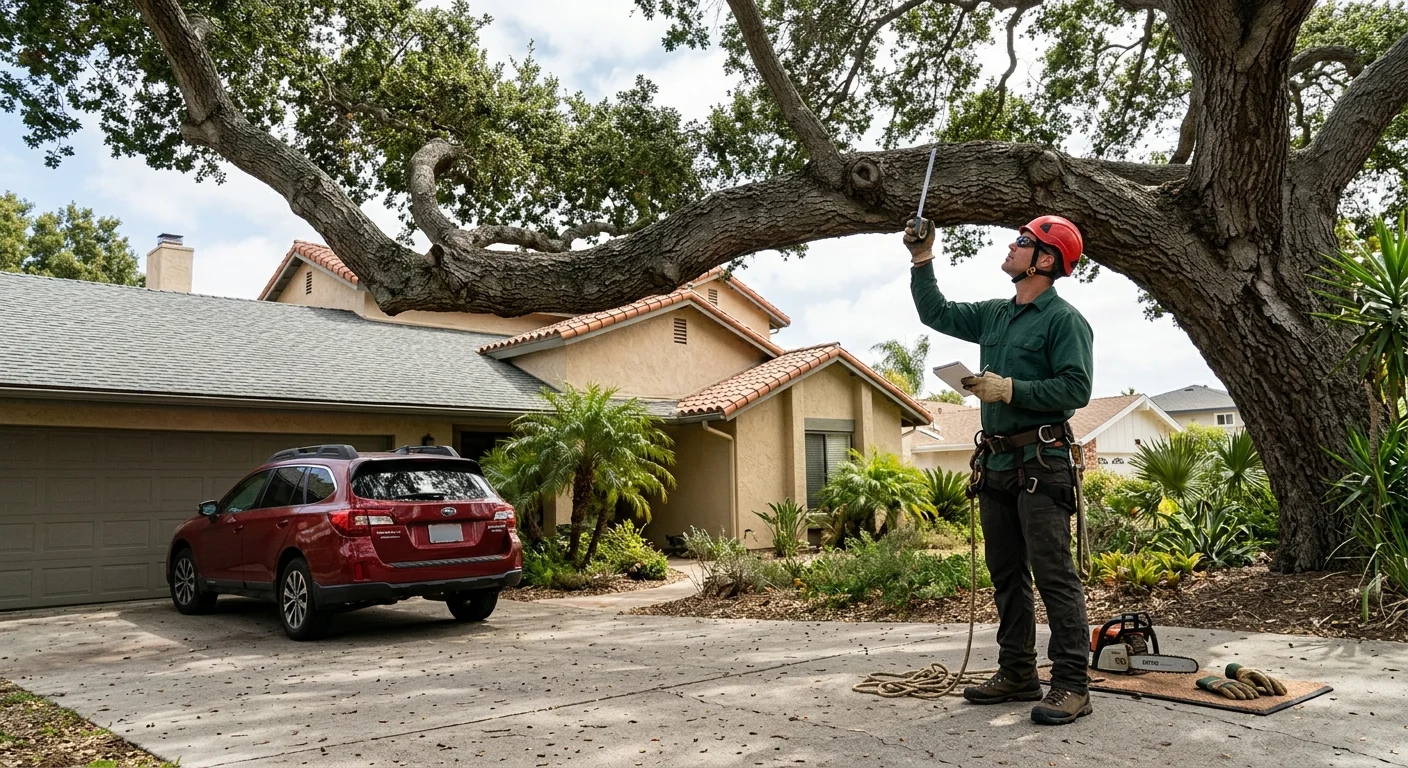
Start with the limb, the target, and the reason for the cut
Walk the yard from the ground. Do not get under the limb. Note which stem actually hangs over the roof, solar rack, carport, or neighbor’s patio. A jacaranda over a North Park bungalow is a different problem than a long eucalyptus leader over an Encinitas side yard. A coast live oak limb over an El Cajon patio carries different weight and a different remaining canopy.
Write the reason in one line. Typical planned reasons here are roof clearance, driveway headroom, a limb growing into a neighbor’s airspace, or a stem that rubs tile every Santa Ana. That is tree limb removal as a named cut, not a whole-tree takedown. Keep the tree if the rest of the structure is sound. Structural pruning is the usual service when the goal is a specific limb and a living tree.
Species and site change the plan. Inland lots in Escondido and El Cajon bake through summer, so deadwood in the same canopy can hide next to a live limb you meant to keep. Coastal lots in La Jolla and Pacific Beach pack trees into tight setbacks, so the same limb sits over glass, tile, and a narrow walk. East County canyon lots in Alpine and Lakeside add slope. A dropped section can roll. South Bay parkway strips in Chula Vista can put the trunk on one side of a sidewalk and the limb over private roof. Confirm who owns the tree before you hire.
If the limb is on a City of San Diego street tree, stop. Urban Forestry maintains more than 250,000 street trees. Trimming or removal of a street tree needs a City no-fee permit request and City inspection. A private crew’s schedule is not permission. Report City-maintained trees through Get It Done. Other cities set their own public-tree rules. Check the parcel city, not the mailing label. Start with our San Diego city tree service page, then call Planning or Public Works for that address.
If the limb is near overhead lines, stay back. Call 911 and SDG&E at 1-800-411-7343 for a downed line. For a live limb against a service drop or primary, the utility decides whether lines get covered, moved, or de-energized. Ordinary tree work does not include energized-line clearance.
Map roofs, fences, drives, and drop zones before anyone cuts
Tree branch removal next to a house is mostly a logistics problem. The independent contractor should walk the same path the wood will travel. Ask them to point at the drop zone, the chipper setup, and the haul route before they price the job.
Start with targets. Clay tile and solar arrays dent and crack. A stucco eave in Rancho Bernardo marks easily. A wood fence on a shared line in Santee can take a glancing piece and become a neighbor dispute. Parked cars in a Mira Mesa driveway are targets until they move. Pools in Chula Vista and Coronado turn chips into a second cleanup. Name each one in the quote.
Then map access. Many central San Diego lots have a 36-inch side yard, a locked gate, and no street parking for a chipper. Hillside homes in La Jolla and Del Mar may need a crane path if a limb cannot be lowered in sections. Ground support for a crane depends on slope, soil, drainage, and underground tanks or utilities. That is the contractor’s assessment, not a homeowner diagram. If digging or staking is part of protection, DigAlert covers San Diego County for member utilities. Private irrigation and sewer laterals need a separate locate. Marks do not give depth.
Drop zones need an actual empty patch, not a hope. On a flat Clairemont lot that might be the lawn. On a canyon lot in Tierrasanta or Spring Valley it might be a tarp on a terrace with a spotter below. On a Coronado cottage it might be the street, which can need an encroachment conversation with the city. Do not assume the street is free to occupy.
Tree trimming can include raising a canopy off a drive. Limb removal over a roof is usually more targeted. Ask which named stems come off, how they come down, and what stays. ISA guidance for mature trees is that each cut needs a purpose, and that large-tree work belongs with a professional. There is no verified homeowner clearance distance in our sources that makes a ladder over a San Diego roof a safe plan. Stay on the ground. Let the licensed crew set the method.
If birds may be nesting, say so. CDFW treats February through August as typical nesting season for many California species, with variation by species and place, and nesting in some areas in other months. A consulting biologist’s survey is the agency’s recommended path when work cannot wait. Do not poke a nest to check it.
Separate pruning, hauling, and excluded work in writing
A branch removal service quote that says “take the limb” is not a scope. You want three piles of work named: the cuts, the protection, and the debris. You hire and pay the independent company directly. Branch Pro San Diego does not cut, haul, or warrant the job.
Cuts: list the limb by location on the tree. “South leader over the garage” is usable. “Shape the tree” is not. Ask how much live canopy remains. ISA’s mature-tree pruning brochure treats 25 percent as a general upper guideline, and less on mature trees, depending on size, species, age, and objective. It is not a yearly quota and not a DIY allowance. Topping (cutting to stubs) is a different, harmful practice. If someone offers to “take the top off so it never hits the roof again,” that is not the same as removing one named limb.
Protection: house wrap, plywood on tile, cone-off of the drive, and who moves furniture or cars. None of that is automatic. If a crane is proposed, ask where the outriggers sit and what underground features they already know about.
Hauling: chips, cordwood, and off-site disposal are often extra. Some owners keep oak or eucalyptus rounds. Some HOAs ban piles in the driveway overnight. GSOB is contributing to oak mortality in many parts of San Diego County. Do not treat suspect oak wood as ordinary firewood to move around the county. Ask the contractor how they will handle oak material if the tree is a coast live oak, California black oak, or canyon live oak.
Exclusions: stump grinding, root pruning, a written arborist report, permit filing, and neighbor-side cleanup. Those belong in writing as included or not. California contractor licensing is required for tree work contracts of $1,000 or more, counting labor, materials, and other items, with narrow conditions on the minor-work exemption. Advertising as a contractor, employing others, needing a building permit, or splitting jobs to stay under the line can take the exemption away. Check the firm on the CSLB license lookup. Look for an active C-49 Tree and Palm classification, or an active legacy C-61/D-49 issued before 2024. An ISA Certified Arborist credential is a person-level certification, not a state license. You can verify an individual through ISA’s TreesAreGood resources. A missing directory listing does not by itself disprove a credential.
When a cracked or hanging limb needs a different assessment
Planned tree limb removal is for a live, attached limb you chose to take. A split crotch, a hanging slab, or a limb that already failed is a different assessment. Keep people and pets out of the fall line. Do not try to rope it from a ladder.
Signs that change the job include a visible crack at the union, a limb resting on the roof, bark peeling at a tear, or the canopy moving when the rest of the tree does not. Summer branch drop can occur on hot, still days on oaks and on eucalyptus. Some limbs that look sound still fail. That is a reason for a professional look, not a homeowner diagnosis from one symptom. Inland heat in Ramona and East County, plus dry Santa Ana periods, add load. Coastal marine layer does not make a cracked union safe.
If the limb is already hanging or the tree is coming apart, read our guide to cracked tree limbs in San Diego and treat it as unstable. Downed lines still go to 911 and SDG&E first. Private quotes come after the site is not an electrical scene.
A whole-tree removal is the right conversation when the remaining stem cannot stand without that limb, when decay is in the trunk, or when the tree was planted so close to the house that every future leader hits the roof. That is a keep-or-remove decision, not a bigger trim. Do not assume a cable will fix a failed root plate. Crown support and root failure are different problems.
Hiring someone who “just cuts branches” without a written plan is how roofs get hit. If you are comparing companies, use the same named limb, the same haul-off, and the same protection list. Our notes on how to hire a tree branch cutter cover that comparison without turning it into an emergency call.
What to verify with the independent contractor before approval
Stand on the driveway and walk the plan out loud with the person who will run the job. Confirm the business name on the CSLB record matches the contract. Ask for the license number and look it up yourself. Confirm general liability on the actual policy terms. A certificate is not the policy. California Insurance Code section 384 says coverage follows the policy, not the paper summary. Active California contractors must carry a $25,000 license bond (or a lawful deposit in lieu) as of January 1, 2023. That bond is not general liability and not workers’ compensation.
Ask how the job will be staffed. Workers’ compensation rules depend on employees and classification. C-49 is not on the current no-employee exemption exclusion list the way legacy D-49 is. Coverage is required when there are employees. Read the CSLB workers’ compensation record rather than taking a verbal “we’re insured.”
Confirm whose tree it is. Civil Code section 833 puts ownership with the trunk. A fence is not a survey. Overhanging growth does not by itself make the limb yours to destroy. Talk with the neighbor before a cut that affects their roof or their tree. Permits, heritage trees, and public right-of-way rules still apply even when growth crosses a line. Encinitas heritage trees, Poway native trees, and Escondido lot-size rules are city-specific. Do not copy one city’s process onto another parcel.
Confirm timing against weather and wildlife, not against a promised arrival window. We do not assign crews or quote response times. The independent company sets its own schedule. Ask them to say how they will stop work if wind, nest activity, or a utility issue shows up on the day.
Get the price in writing for that scope. No California agency publishes an official rate for tree limb removal. Aggregator averages are not a local quote. Access, height, targets, and hauling are what change the number. Two companies pricing different scopes are not a comparison.
Frequently asked questions
How do you cut a big limb off a tree?
You don’t, not over a house. A licensed tree contractor plans the cut, the remaining structure, and the drop. Large limbs often come down in sections so the bark does not strip and the piece does not free-fall onto tile. That method is their job, not a weekend project. Stay off ladders, roofs, and the limb itself.
How much does it cost to cut a limb off a tree?
No verified government source publishes a San Diego price for tree limb removal. National ranges on listing sites are not a quote for your roof. Ask independent companies for a written number on the same named limb, protection, and haul-off. Compare those papers. Do not hire on a verbal “we’ll take care of it.”
What is the 1-2-3 rule for pruning trees?
Search results use that phrase for more than one homeowner shortcut. Our approved sources do not treat a 1-2-3 slogan as a safe method for a big limb over a San Diego house. ISA’s mature-tree guidance is simpler: every cut needs a purpose, and large-tree work with powered tools belongs with a professional. Ask the contractor to name the cuts they will make.
How do you get a tree removed for free?
Private-yard limb work is not a free city service. In the City of San Diego, street-tree trimming or removal runs through Urban Forestry after inspection. A no-fee permit request is not a private crew showing up to cut your backyard eucalyptus. Chip programs deliver chips. They do not remove a live limb over a roof. If cost is the issue, tighten the written scope (named limb, haul-off yes or no) and get more than one bid on that same scope.
When to call us
Call when a live limb hangs over a San Diego roof, drive, fence, or neighbor line and you need a licensed tree company to price a named cut, not a guess from the sidewalk. Branch Pro San Diego matches you with licensed, independent local pros. You hire and pay them directly. Call us at (858) 400-4423 and we’ll connect you with a licensed local tree company.