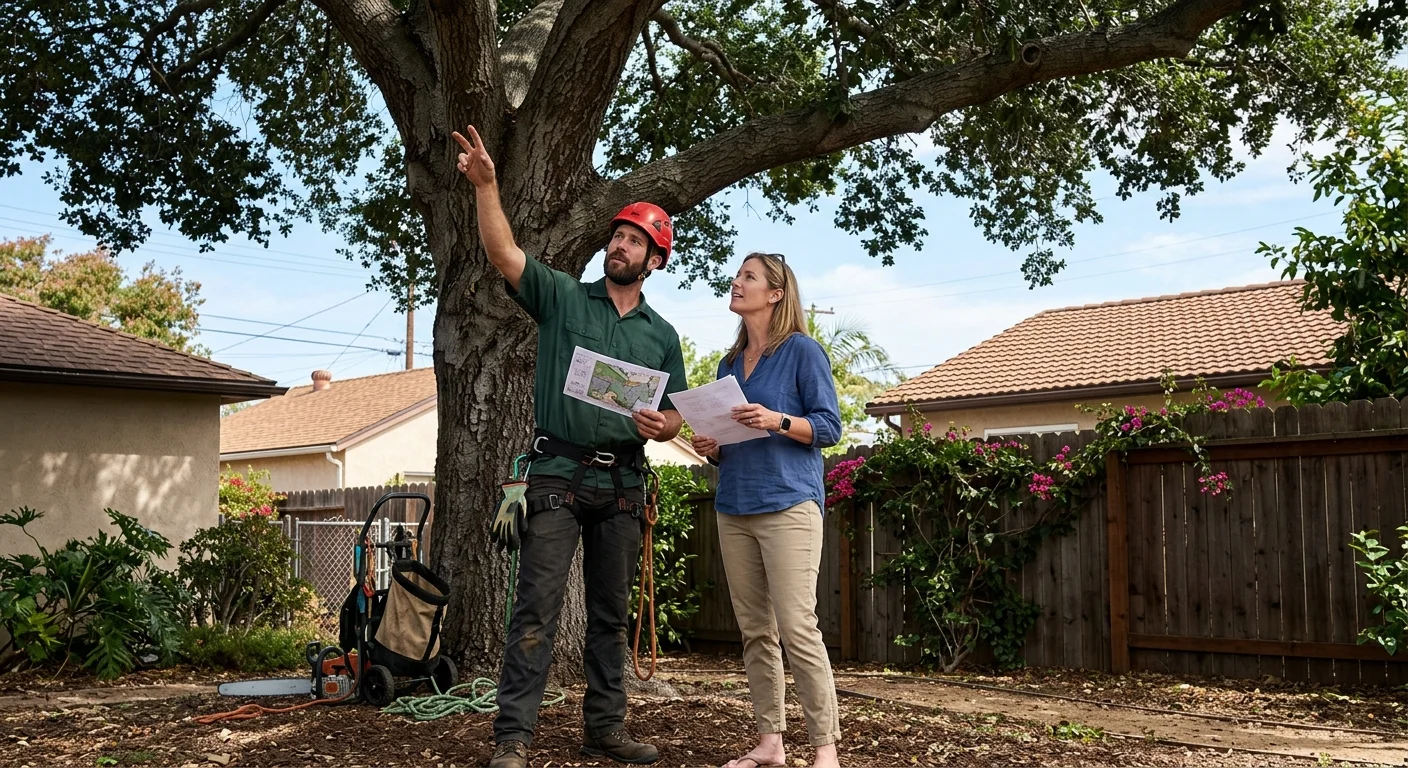
Describe the problem and the result you want, then let the professional name the cuts. Write the access you have and the cleanup you expect. Compare written scopes and current license records.
Branch Pro San Diego is a referral service. We connect customers with licensed, insured independent local tree professionals. You hire and pay the professional directly. We don’t prune trees, pull permits, or set prices.
If people are hurt or in immediate danger, call 911. If a line is down, stay away. From a safe place, call 911 and SDG&E at 1-800-411-7343. Don’t walk closer for photos. SDG&E decides whether lines can be de-energized, covered, or moved. If a standing tree already touches overhead lines, call SDG&E first. An ordinary tree contractor is not authorized to work energized lines.
What result are you hiring?
Describe the problem without prescribing every cut. Show each candidate the same branches. Clearance above a roof, room beside a driveway, or deadwood on named limbs are useful results. Ask the professional for objective-specific reduction, clearance, or deadwood work, not a general thin.
Avoid asking only for tree trimming. That phrase can produce very different scopes. One proposal may cover selected branch work. Another may include broader shaping. Our guide to tree trimming versus pruning can help you name the distinction before you request proposals.
Match the service page to the planned work. Structural pruning fits selected limbs and future branch form. Tree trimming and shaping may fit a broader appearance or clearance goal. If you’re considering removing the whole tree, say that before anyone writes a scope.
If the job is fire clearance, confirm the fire authority for that address. PRC 4291 applies in State Responsibility Areas. Locally designated Very High Fire Hazard Severity Zones follow Government Code 51182. Alpine, Ramona, and Jamul are not automatically one statute. Ask that fire authority what applies on the parcel.
Take photos only from safe ground, away from unstable wood and lines. Mark the target branches on copies of those photos. A branch-cutting quote is easier to compare when every candidate sees the same request.
How should the cuts be assessed?
Ask each candidate to walk the tree from a safe place and name the proposed cuts. The explanation should identify which branches are included and which remain. It should also cover what happens if decay, cavities, or nesting show up after a closer view.
Request written answers. Which unions will be inspected? Where are the proposed cuts? Does the scope cover one section or the whole canopy? Would new findings pause the work for a separate assessment?
Don’t assume every person offering branch cutting is an arborist. The ISA Certified Arborist credential belongs to an individual. It is not a California contractor license and does not replace one. An absent ISA directory listing does not by itself disprove certification. The person can share an ISA digital certificate.
Species and visible symptoms also shape the conversation. For a coast live oak, note crown thinning, bark staining, woodpecker work, or D-shaped holes if you can see them from the ground. UC IPM treats D-shaped holes as a useful borer clue. Thinning or staining is not a diagnosis. Ask whether branch work should wait for a health assessment. See our goldspotted oak borer guide.
If birds could be nesting, CDFW recommends a consulting biologist’s survey. February through August is typical for many species. Nesting can occur at other times, including year-round in some places. A biologist may set a buffer, or work may wait until nesting is complete. Don’t disturb a nest to inspect it.
What does the access plan need to cover?
Walk the property with each candidate from safe ground. Identify roofs, fences, pools, sheds, beds, parked vehicles, and neighboring space. Ask which areas must stay clear and how cut material will leave the yard.
Access differs across San Diego County. An Ocean Beach yard may have a narrow side gate and an alley. A City Heights lot may place several structures under one canopy. Inland lots may include slopes or a longer route to the street. For work within the city, use our San Diego tree service page to request a local match.
Ask whether the proposed access depends on a neighbor’s property. If it does, settle permission before the work date. The written scope should say who handles that coordination, and whether fences, gates, or movable objects must be cleared first.
Point out every visible overhead line during the site review. Line conflicts go to SDG&E first. Don’t ask an ordinary tree crew to decide whether they can work a live conductor. Keep utility limits separate from the rest of the pruning scope.
How do you verify the license and insurance?
Collect the contractor’s legal business name and license number before comparing proposals. Check those details against the written scope, insurance documents, and the state record. A company name that changes between documents needs clarification.
Use the official CSLB license lookup. The lookup can show classification, status, expiration date, bond or security status, and workers’ compensation status. For planting, maintaining, pruning, removing, stump grinding, and guying trees or palms, look for an active C-49 Tree and Palm Contractor license. Existing C-61/D-49 licenses issued before January 1, 2024 may still be used. An active legacy D-49 is not automatically invalid. Ask for the classification that matches the actual scope, and confirm it on CSLB.
California Business and Professions Code section 7048 currently exempts only an aggregate project price of less than $1,000. That total includes labor, materials, and all other items. The work must be casual, minor, or inconsequential. It must not require a building permit. The exemption does not apply if the person advertises as a contractor, employs another person, or does the work as part of a larger operation. Splitting contracts to stay under the number also disqualifies it. That dollar boundary increased on January 1, 2025. Don’t treat a small job as automatically unlicensed.
Workers’ compensation is a current-record check, not a slogan. Look at the workers’ compensation line on that CSLB record. Ask who will actually be on site. Current Business and Professions Code section 7125, operative until January 1, 2028, allows qualifying no-employee exemptions. It specifically excludes classifications C-8, C-20, C-22, C-39, and D-49. It does not list C-49. CSLB’s workers’ compensation page matches that no-exemption list. Don’t assume every C-49 contractor is barred from an exemption. Don’t assume a C-49 contractor never needs coverage either. If coverage is required and missing, license suspension can follow.
Ask for required workers’ compensation coverage, or a documented lawful exemption that matches who will actually be on site. Check the contractor’s license number, policy dates, and insurer. Coverage is controlled by the policy, not enlarged by the certificate.
Every active California contractor must also maintain a $25,000 contractor license bond, a requirement effective January 1, 2023. A cashier’s check may be deposited in lieu of the bond. Verify the current bond or security on the CSLB bond record. That bond is not general liability coverage and it is not workers’ compensation.
Our guide on hiring a licensed and insured tree service explains these checks in more detail.
What belongs in cleanup and exclusions?
Cleanup needs its own written description. Don’t treat haul away debris as a complete scope. Ask what happens to branches, logs, leaves, chips, and sawdust. Confirm whether any wood stays on the property and where it will be placed.
The proposal should identify the cleanup boundary. Does it cover the tree’s immediate work area, the access route, or both? Ask who moves outdoor furniture, planters, vehicles, and other objects before work begins. If a gate or fence limits access, document that condition before accepting the scope.
List excluded work beside included work. Common points include stump work, root work, additional canopy areas, neighboring branches, utility coordination, and repairs to unrelated property features. These aren’t automatically part of planned branch cutting. Each candidate should state what the proposal does and doesn’t cover.
Create a simple comparison using the same headings for every proposal: cutting goal, selected branches, access, credentials, utility limits, cleanup, and exclusions. Don’t compare the final amount until those columns describe comparable work. A lower proposal may simply contain fewer tasks.
Keep the accepted scope, credential records, and any property-access permission together. If the plan changes after a closer canopy look, request the revised work in writing.
Frequently asked questions
Is every tree branch cutter required to show a C-49 license?
Ask for the classification that matches the scope. An active C-49 or an active legacy D-49 can both be valid. Confirm status on CSLB. The minor-work exemption is an aggregate price under $1,000, with extra conditions.
Does ISA certification replace a contractor license?
No. ISA certification belongs to a named person. It is not a California contractor license. A missing directory listing does not settle the question. Ask for that person’s certificate if the credential matters.
Can the crew decide whether work near a power line is allowed?
No. Call SDG&E first for a line conflict. Ordinary tree contractors are not authorized to work energized lines.
What if an active nest is found after the quote?
Ask in writing how the professional will respond. CDFW points to a consulting biologist’s survey, a buffer, or a delay until nesting is complete. Don’t move the nest.
Does Branch Pro perform the cutting?
No. You hire and pay the independent professional directly.
Get connected with a local pro
If the tree is on a conductor, use the utility steps above first. For planned branch work, call (858) 400-4423. We’ll connect you with a licensed, insured independent local professional. Bring the cutting goal, access limits, and any line or safety issue. You hire and pay that professional directly.