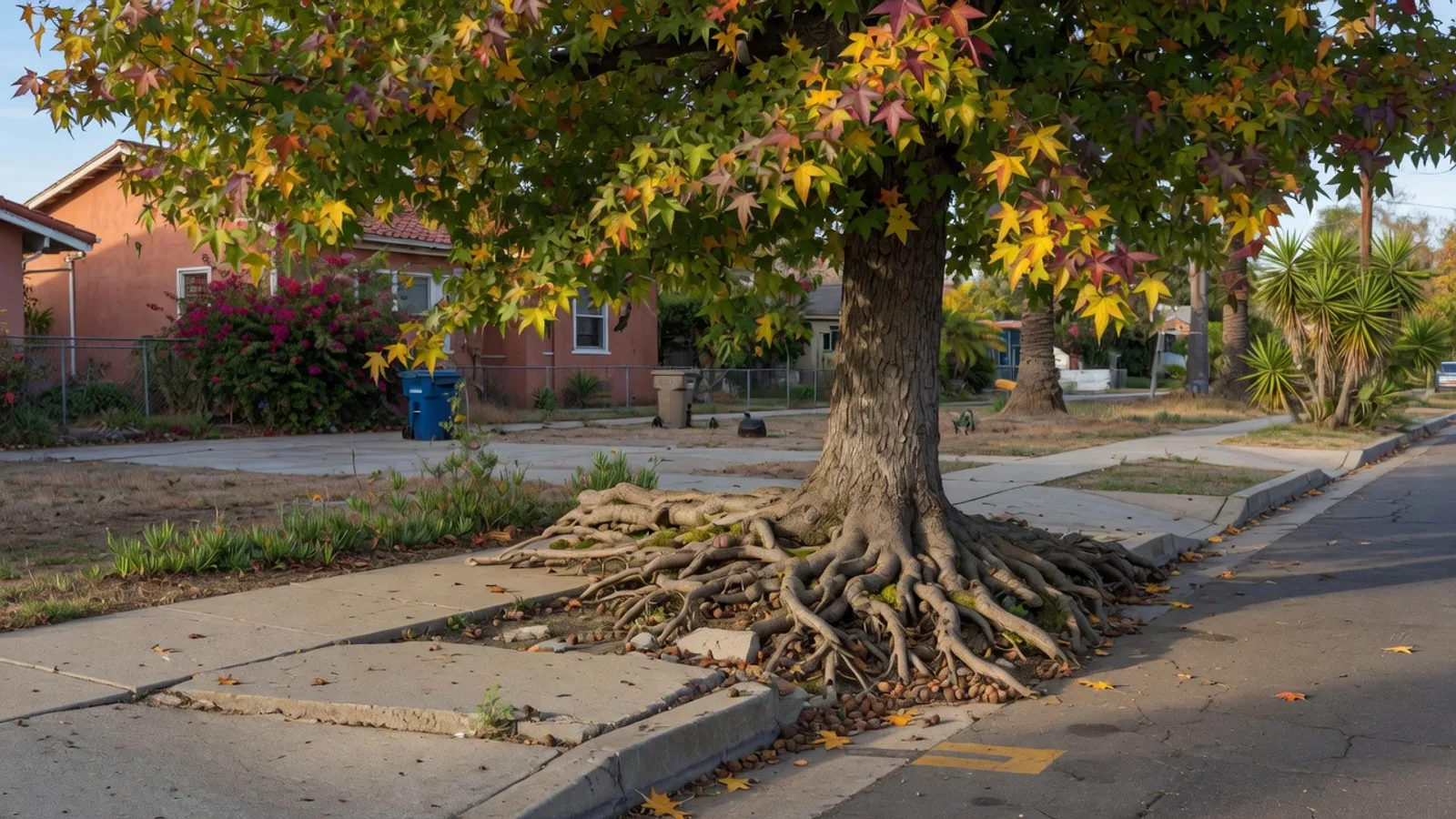
American sweetgum, Liquidambar styraciflua, is a large deciduous tree. Cal Poly SelecTree describes a species native to the eastern United States and Mexico, with a straight bole, palmately lobed leaves, fall color, and a maximum profile of 80 feet high and 40 feet wide. Those figures describe the species profile, not what a particular San Diego tree will reach.
CSU Stanislaus’s campus tree page, citing SelecTree, lists high root-damage potential, medium branch strength, and dry fruit as a litter issue. UF/IFAS names sweetgum among trees particularly sensitive to soil compaction.
This page is roots versus pavement, and pest host status. Fall color at USD is identification, not a root plan. See fall color trees in San Diego. For the general sidewalk-and-sewer job, see tree roots damaging sidewalks.
Branch Pro San Diego is a referral service. We connect you with licensed, insured independent local tree professionals. You hire and pay the professional directly. We don’t pour concrete, cut roots, or treat borers.
What are you actually seeing at the walk?
Surface roots lifting a North Park sidewalk are a trip-and-liability conflict. They do not, by themselves, prove a house slab is failing. That question belongs with a qualified engineer if the building is in play.
Spiky fruit drop is a litter fact from the same species, not a root diagnosis.
UCR lists liquidambar as a polyphagous shot hole borer host. Staining, tiny exit holes, or dieback on a sweetgum is a reason to ask for identification. See polyphagous shot hole borer. Host status is not an automatic infestation.
A City sidewalk tree is often a street tree. The City’s street-tree maintenance program uses a no-fee permit after City inspection, including root pruning in that program. Don’t hire a private crew to cut roots on a City tree because the walk is yours to trip on.
Should you cut the roots, the walk, or the tree?
Don’t trench blindly along the curb. Root cutting on an established tree can cause delayed decline or instability, according to UC IPM’s construction guidance. UF notes that compaction under the canopy is a separate injury, and that sweetgum is sensitive to it. Parking cars on the root zone is a compaction setup, not a pruning job.
Options the independent professional can discuss, after looking at the actual flare and the walk:
- Selective root work paired with a sidewalk repair the property or the City actually owns
- A root barrier only where the site and the remaining roots make that conversation real. Barriers are not a permanent-protection guarantee. UF/IFAS notes roots can return toward the surface in poorly drained soil.
- Removal if the tree is the wrong species for the planter width, or if pest and structure together close the case
Don’t top the canopy to “balance” roots you cut. Topping is a defect.
What belongs in a written scope?
Ask the independent professional for a written scope that separates:
- Who owns the tree and who owns the pavement
- Root work versus sidewalk repair versus removal
- Pest identification if PSHB clues are present, and how wood should be handled
- Stump grinding as a separate price if you are replanting a different species
For paid tree work, look up the license on the CSLB license lookup. An active C-49 Tree and Palm license or an active legacy D-49 can both be valid. California’s current minor-work threshold is an aggregate price under $1,000, with extra conditions.
Frequently asked questions
Is sweetgum a good parking-strip tree in San Diego?
SelecTree’s size profile and the high root-damage listing are reasons to compare the planter width before planting another one. An existing tree is a case-by-case conflict, not a species-wide removal order.
Do the spiky balls mean the roots are failing?
No. Fruit is litter. Roots are a separate inspection at the flare and the walk.
If I see tiny holes, should I take the tree down this week?
No. UCR lists the species as a host. Ask for identification of actual clues. Removal is a later decision.
Can Branch Pro tell the City to replace my sidewalk?
No. You hire the independent professional for the tree. Sidewalk liability and City processes stay with the owner and the City.
Get connected with a local pro
If the tree is on a conductor, call 911 and SDG&E at 1-800-411-7343 first. For a lifted walk or a suspected borer on sweetgum, call (858) 400-4423. We’ll connect you with a licensed, insured independent local professional. Describe whether the trunk is in the sidewalk strip and what the walk is doing. You hire and pay that professional directly.