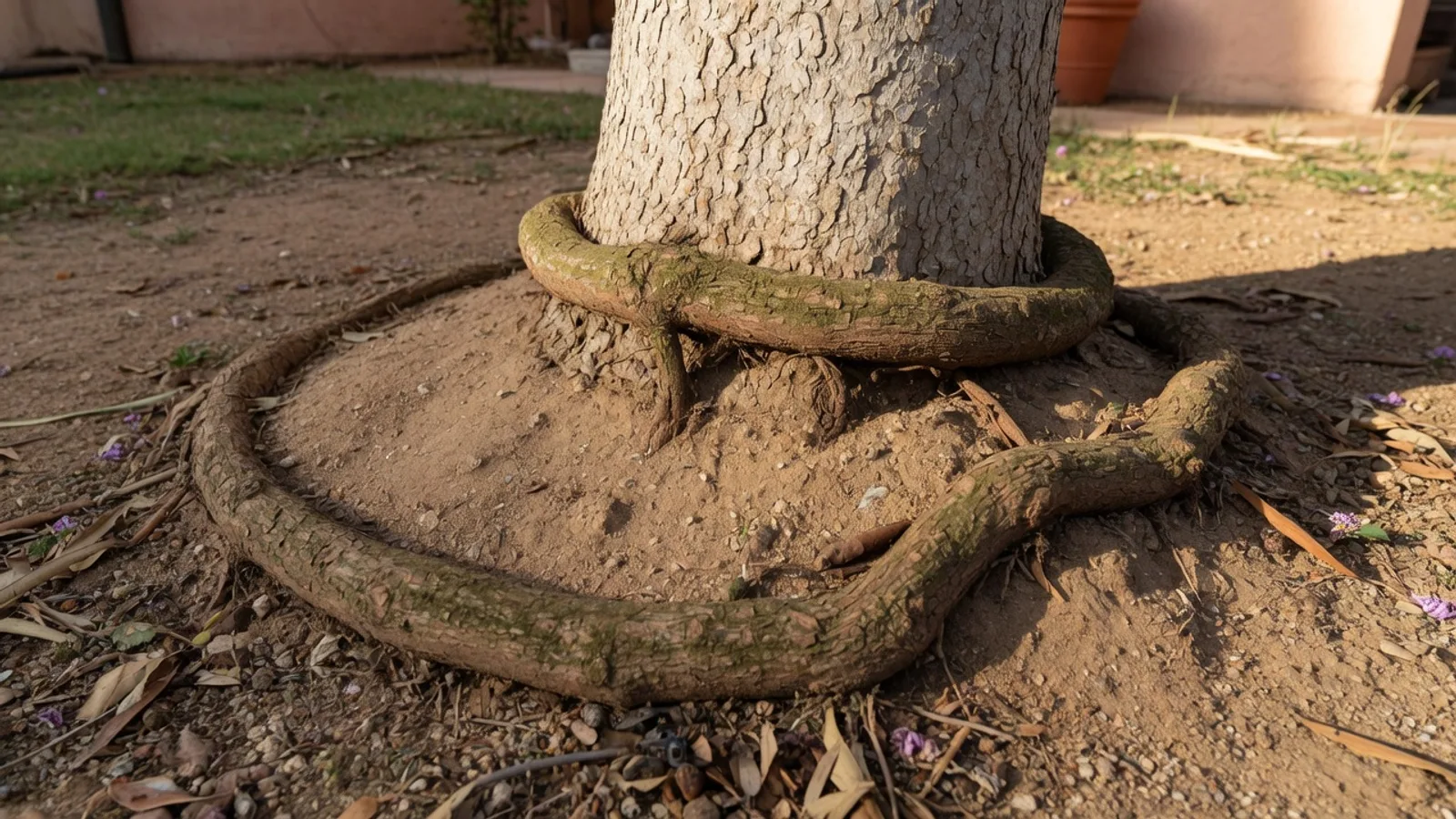
Girdling roots wrap or press the trunk so the tree cannot add wood normally at the flare. They often start as circling roots in a container, or as roots that turn back toward the stem after the tree was planted too deep.
UF/IFAS Gardening Solutions says the root flare should be visible above the ground. If the tree is planted too deeply, or the flare is covered, roots lack oxygen and may circle toward the surface, then tighten around the trunk as the tree grows. Trees grown in containers often have roots that run along the inner wall. At planting, UF says to shave off the outer inch of the root ball. After planting, if the girdling root diameter is less than 25 percent of the trunk diameter measured 4.5 feet above ground, UF says it is safe to cut and remove that root; if you cannot remove it without damaging the trunk, you can sever it and leave it in place. If the root is larger than 25 percent of the trunk, UF says removing it may not be possible and to consult a licensed arborist.
This page is that flare-and-circling task. A mention of girdling roots on a diagnosis walk-through is not this page. See tree diagnosis before pruning. Surface roots lifting a walk are sidewalk roots.
Branch Pro San Diego is a referral service. We connect you with licensed, insured independent local tree professionals. You hire and pay the professional directly. We don’t excavate flares or cut roots.
Don’t trench a ring around the trunk with a shovel to “find the girdling root.” That can cut the roots the tree still lives on.
What can you see without digging?
From the ground:
- Soil, mulch, or irrigation basin piled against the trunk so no flare shows
- A trunk that goes into the ground like a pole, with no widening at the base
- A root that sits on top of the soil and disappears against the stem
- A lean, thin crown, or early fall color on one side
A new street-tree planting in University City and a 20-year-old magnolia in a Coronado courtyard can both have buried flares. Age changes whether UF’s “dig it up and replant” option is even on the table. UF says that for larger trees planted only a few inches too deep, you may be able to remove the soil on top and expose the topmost roots.
Edward Gilman’s UF pages associate circling roots next to the trunk with trees that become unstable, and describe trees blowing over away from the circling root. That is a reason to get a professional look. It is not a homeowner proof that this tree will fall this winter.
What should happen before anyone cuts a root?
Ask the independent professional to find the actual flare first. Soil removal with hand tools or compressed air is a different scope from cutting a large stem-girdling root.
UF’s 25 percent comparison is a published threshold from that Florida page, not a California statute and not a promise that a cut will save the tree. A large girdling root that has already grown into the trunk is a save-versus-remove conversation.
Don’t add more soil or a volcano of mulch against the bark after the work. Keep mulch off the trunk.
If construction is coming, UC IPM warns that root cutting, compaction, and grade change can cause delayed decline. A future patio is a reason to resolve the flare now, not a reason to bury it deeper.
What belongs in a written scope?
Ask the independent professional for a written scope that separates:
- Exposing the flare
- Which roots they would cut, using a stated size comparison
- Roots they would leave because cutting them is worse
- Whether the tree is a removal candidate if the defect is too large
- City street-tree permit steps if the trunk is in the right-of-way
For paid tree work, look up the license on the CSLB license lookup. An active C-49 Tree and Palm license or an active legacy D-49 can both be valid. California’s current minor-work threshold is an aggregate price under $1,000, with extra conditions.
Frequently asked questions
If I can’t see a flare, is the tree already dying?
Not automatically. UF says deeply planted trees may grow slowly for years before failing. Have the flare found before you decide.
Can I shave the root ball on a tree that has been in the ground ten years?
UF’s outer-inch shave is a planting-time step. On an established tree, that is not the job. Exposing the flare and judging named roots is.
Should I fertilize to help it recover from a girdling root?
Don’t start with fertilizer. The defect is mechanical. Ask after the flare is visible.
Can Branch Pro tell me to cut a root from a photo of the trunk?
No. The independent professional finds the flare, explains options, and contracts with you.
Get connected with a local pro
If the tree is on a conductor, call 911 and SDG&E at 1-800-411-7343 first. For a buried flare or a root wrapping the stem, call (858) 400-4423. We’ll connect you with a licensed, insured independent local professional. Describe the species, the soil against the trunk, and any lean. You hire and pay that professional directly.