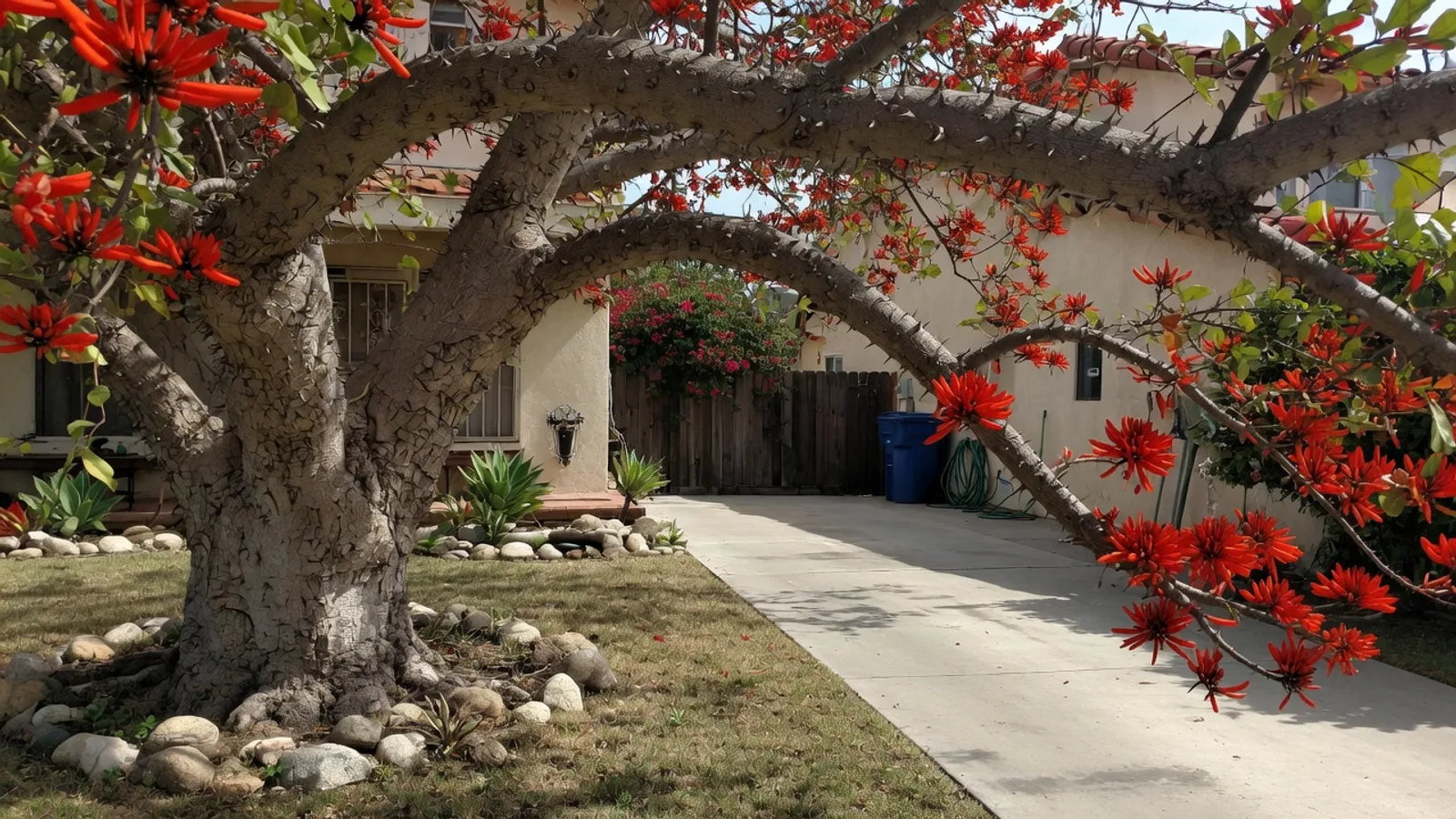
Coral tree is a genus. Identify the species before you treat one profile as the whole driveway problem. One named landscape example in San Diego writing is Erythrina afra. Its Cal Poly SelecTree profile describes orange or red winter or spring flowers, thorn-bearing branches, medium water, moderate root-damage potential, and a medium-weak branch rating. It is not listed as suitable beneath utilities. Those traits do not automatically apply to every Erythrina.
This page is limb-drop and risk on an existing coral tree. For color identification only, see flowering trees in San Diego.
Branch Pro San Diego is a referral service. We connect you with licensed, insured independent local tree professionals. You hire and pay the professional directly. We don’t climb, cable, or treat borers.
Stay out from under long, weakly attached limbs. Don’t prune thorns in shorts from a ladder.
Why do these limbs matter?
Medium-weak branch wood plus a heavy flowered limb over a Clairemont driveway is a target problem even when the tree still blooms. A Point Loma specimen with the same flowers over a side yard is a different target. Bloom is not a safety inspection.
UCR’s polyphagous shot hole borer page lists coral tree (Erythrina) among hosts of polyphagous shot hole borer and Fusarium dieback. Staining, tiny exit holes, or dieback on a coral tree is a reason to ask for identification, not a homeowner beetle ID. See polyphagous shot hole borer in San Diego.
Thorns matter for anyone who has to climb or chip. They are a handling fact, not a reason to top the tree.
What should you check from the ground?
- Species clues: flowers, leaflets, trunk, and thorns
- Long horizontal limbs over parking, play, or a roof
- Included bark, old topping stubs, or lion-tailed arms
- Dieback, staining, or fine holes that belong in a pest conversation
- Whether the tree is on your parcel, a neighbor’s, or in the City right-of-way
A City street tree still goes through the City’s street-tree maintenance process. Don’t treat a private limb-drop scare as a permit.
Don’t top a coral tree to “make it safer.” Topping is a defect. See tree topping. Reduction or removal of a named failing limb is a different scope from topping.
What belongs in a written scope?
Ask the independent professional for a written scope that separates:
- Deadwood and named live limbs over a target
- Whether reduction, cabling, or removal is being proposed, and why
- Thorn and chip handling
- Pest identification if Fusarium dieback is in play, and how infested wood should be handled
- Whole-tree removal and stump work as a separate price
For paid tree work, look up the license on the CSLB license lookup. An active C-49 Tree and Palm license or an active legacy D-49 can both be valid. California’s current minor-work threshold is an aggregate price under $1,000, with extra conditions.
If birds could be nesting, CDFW recommends a consulting biologist’s survey. February through August is typical for many species. Nesting can occur at other times.
Frequently asked questions
Are all coral trees weak-wooded?
No. SelecTree’s medium-weak rating on this page is for Erythrina afra, the named example. Confirm the species.
Does flowering mean the tree is healthy?
No. Flowers can remain on a tree that still has a structural defect or a borer problem.
Is every coral tree a PSHB case?
No. UCR lists the genus as a host. Host status is not an automatic infestation. Ask for identification of actual clues.
Can Branch Pro cable the tree from a photo?
No. The independent professional inspects structure, explains options, and contracts with you.
Get connected with a local pro
If a coral limb is on a conductor, call 911 and SDG&E at 1-800-411-7343 first. For a limb over a driveway or a suspected borer, call (858) 400-4423. We’ll connect you with a licensed, insured independent local professional. Describe the species clues, the target under the limb, and any dieback. You hire and pay that professional directly.