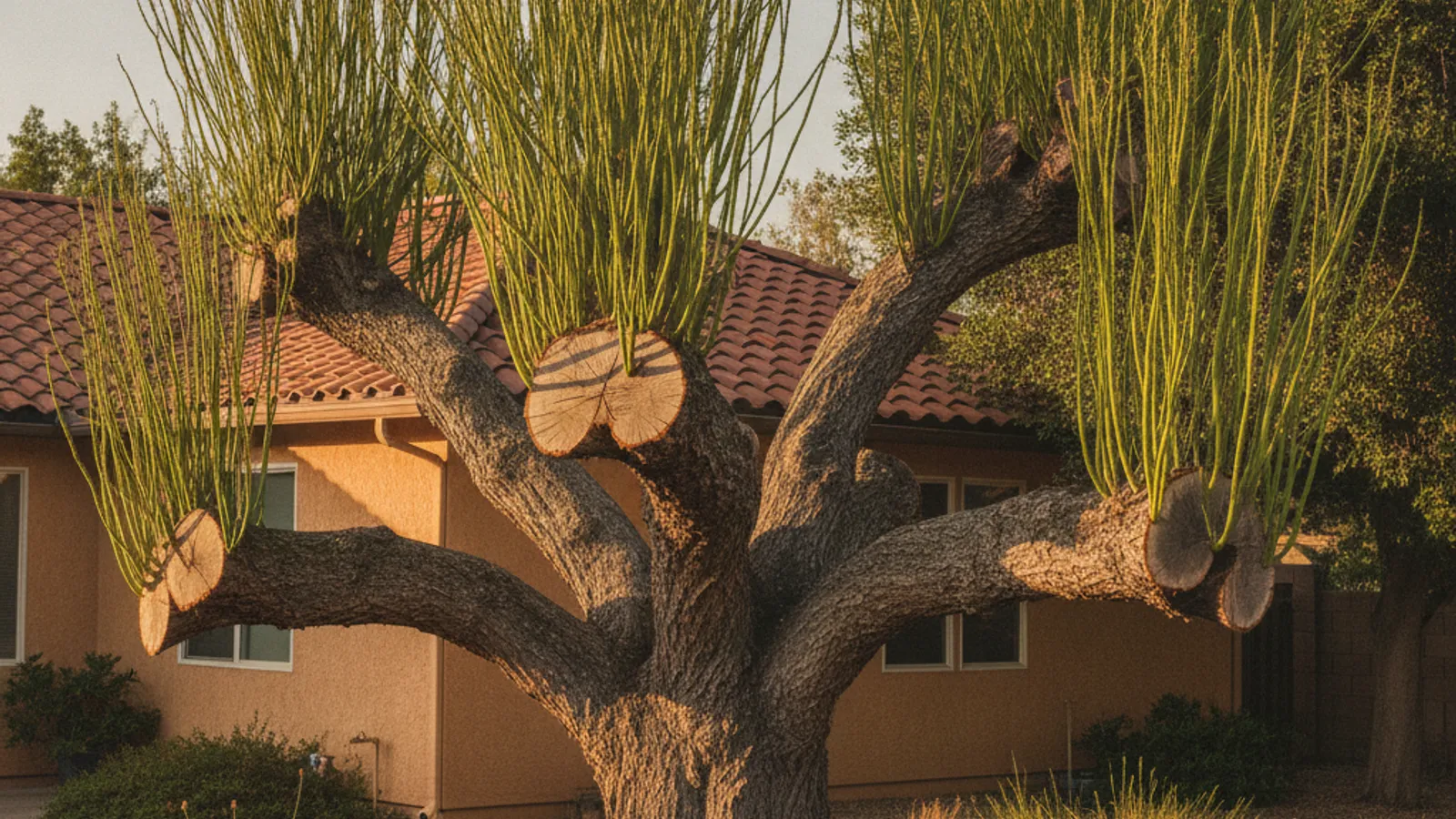
Topping is cutting large limbs, or the leader, back to stubs to shorten a tree fast. People ask for it when a tree feels too tall, blocks a view, or worries them before wind. ISA’s topping guide describes a different outcome. Indiscriminate cuts to stubs, or to laterals that can’t take over, can stress the tree, expose tissue to sun and decay, and send up weakly attached sprouts. Reduction to a suitable lateral is another method. Replacement is sometimes the better option.
Branch Pro San Diego connects you with licensed, insured independent local tree companies. You hire and pay that company directly.
What is tree topping?
Topping means heading large branches or the trunk at an arbitrary point, with no adequate lateral left to become the new end. Crews may call the same pattern hat-racking, rounding over, or heading. The look is a flat stub, then a flush of upright shoots.
A reduction cut is not that. The ISA mature-tree pruning brochure treats reduction as a purpose-based choice on that tree. The professional selects a lateral that can assume the terminal role and keep the tree’s form.
Lion-tailing is a different defect. It strips interior and lower foliage and leaves tufts at the tips. Selective outer-canopy work is not the same thing.
Why does topping stress a tree?
Leaves make the energy the tree uses to close and wall off wounds. Heavy stubbing removes a large share of that foliage at once, then leaves several large wounds. ISA describes trees as compartmentalizing injury, not healing the way skin does. A large, poorly placed stub is harder to wall off. Decay organisms and insects can enter that exposed wood.
The tree often answers with a dense cluster of sprouts. Those shoots are trying to rebuild a canopy. Their attachments are typically weaker than a branch that grew with a collar over years.
Sunscald on newly exposed bark is another ISA concern after hard heading. A tree that looked dense last month can suddenly have bare wood sitting in full light.
Why can a topped tree become more of a problem later?
People often want topping because the tree already feels risky. The later canopy can be a thicket of those sprouts on decaying stubs. Wind then loads many weakly attached shoots instead of a structured crown. That is why topping is a poor stand-in for a wind plan. Our Santa Ana prep guide covers forecast-based steps that don’t start with heading the whole top.
Routine interior thinning is also not a windproofing treatment. ISA says each cut needs a purpose, and that routine thinning does not necessarily improve health. Excessive foliage removal depletes reserves. Ask what the named cuts change, not for a general lightening of the sail.
If anyone is hurt, or there is an immediate threat to life, call 911. If someone proposes work near overhead lines, stop. That is not ordinary topping, and it is not a job for a home ladder. Stay away from the conductors. Call SDG&E before any private crew plans cuts that could reach a standing line. For a downed line, call 911 and SDG&E from a safe place. A contractor license is not line-clearance qualification. See trees near power lines.
What should you do instead of topping?
Name the real goal first. Shorter crown, a view window, clearance off a roof, or a tree that never fit the lot are different jobs.
Crown reduction shortens height or spread by cutting back to laterals that can take over, while keeping a tree-like form. ISA says reduction has to fit that species, size, age, and objective. A mature tree often needs a lighter dose than a young one.
Clearance pruning takes specific limbs off a roof, chimney, drive, or walk. The quote should name those limbs and the clearance you want, not a flattened top.
View work should start by asking whether selective clearance or reduction can meet the sightline without damaging the remaining crown. The quote should describe the living canopy that stays.
Keep, manage, or remove depends on the actual tree and site. ISA notes that replacement can be better than forcing a tree to a size it cannot keep. That is one option among others, not an automatic verdict because a tree was planted close. The independent company you hire for tree pruning or tree trimming should put those choices in writing. The wording on a quote matters, which is why trimming versus pruning is worth reading before you sign.
Topping versus a specified prune
| Goal | Topping pattern | What to ask for instead |
|---|---|---|
| Make the tree shorter | Flat stubs on the leader or large limbs | Reduction to named laterals, if that tree can take it |
| Tree feels heavy in wind | Strip the crown, then watch dense sprouts return | Named structural or deadwood cuts, plus a site-specific wind plan |
| Open a view | Chop the whole top or one face | Ask whether selective clearance or reduction can meet the sightline without damaging remaining crown |
| Tree outgrew the lot | Repeat heading every few seasons | Keep-and-manage versus remove-and-replace, quoted separately |
| Growth near power lines | Anyone with a saw tops it | Utility direction first, then qualified line-clearance work if SDG&E requires it |
If the tree already shows dieback, fungal conks, or a changing lean, that belongs in a condition record, not a topping debate. Signs a tree is dying and structural pruning help you ask better questions. From already-safe ground, record what you can see. A lean or other visual clue by itself does not settle the call. A qualified inspection does.
What if the tree was already topped?
A past topping job is a starting condition, not a verdict. Ask the inspector to record stub size and decay, sprout attachments, remaining live crown, and what sits under the tree. Restoration pruning tries to rebuild structure over time by selecting better laterals among those sprouts. Decay, targets, or lost form can still make the remaining risk unacceptable.
Staged dismantling of a tree that is coming down is removal planning. It is not a careful version of topping a tree you mean to keep.
Removal and an arborist consultation are separate scopes you can request from the matched company. An ISA credential belongs to a named person. Directory participation is voluntary. You can check a listing in the ISA credential directory, or ask that person for a digital certificate. A missing listing does not, by itself, disprove certification.
Frequently asked questions
Is tree topping ever the right call in San Diego?
Not as a way to keep a healthy tree shorter. ISA treats topping as harmful heading, and treats reduction or replacement as the real choices. Taking a failing tree down in planned sections is removal, not topping.
How do you price repair on a tree that’s already been topped?
Ask the independent company for a written restoration scope, a written removal scope, and what follow-up visits each plan includes. Compare those options before you choose.
Will a topped tree grow back the way it was?
It usually grows a cluster of upright sprouts from the stubs, not the original scaffold. Follow-up pruning can improve that form on some trees. It does not rewind the tree to an untopped structure.
What’s the difference between topping and crown reduction?
Topping heads a limb or trunk at a stub, with no adequate lateral left in charge. Reduction cuts back to a lateral that can take over and keep a more natural outline. Suitability depends on that tree.
Can topping get you in trouble with the city or an HOA?
Association rules sit in the governing documents. City and County tree rules depend on the parcel, whether the tree is public or private, and any protected designation. Confirm the address with Planning or the City arborist before irreversible cuts. Start with tree removal permits in San Diego.
How do I find a company that won’t top the tree?
Get the method in writing: reduction, clearance, deadwood, or removal. Ask them not to head large limbs to stubs. Verify an active C-49 or legacy C-61/D-49 for the firm doing the work. If someone claims ISA certification, verify that named individual.
Get a second look before anyone heads the tree
If a tree feels too big, too heavy, or in the way of a view, get the options on paper before a cut you can’t undo. Call (858) 400-4423. We’ll connect you with a licensed local tree company. You contract with that company for the assessment and any work.