A San Diego palm tree on a Carlsbad lot is almost never a generic trim. The species, the salt or heat on that street, and how a crew reaches it change the job. Start with the palm you have and the cuts you want, then have an independent licensed pro confirm both before anyone climbs.
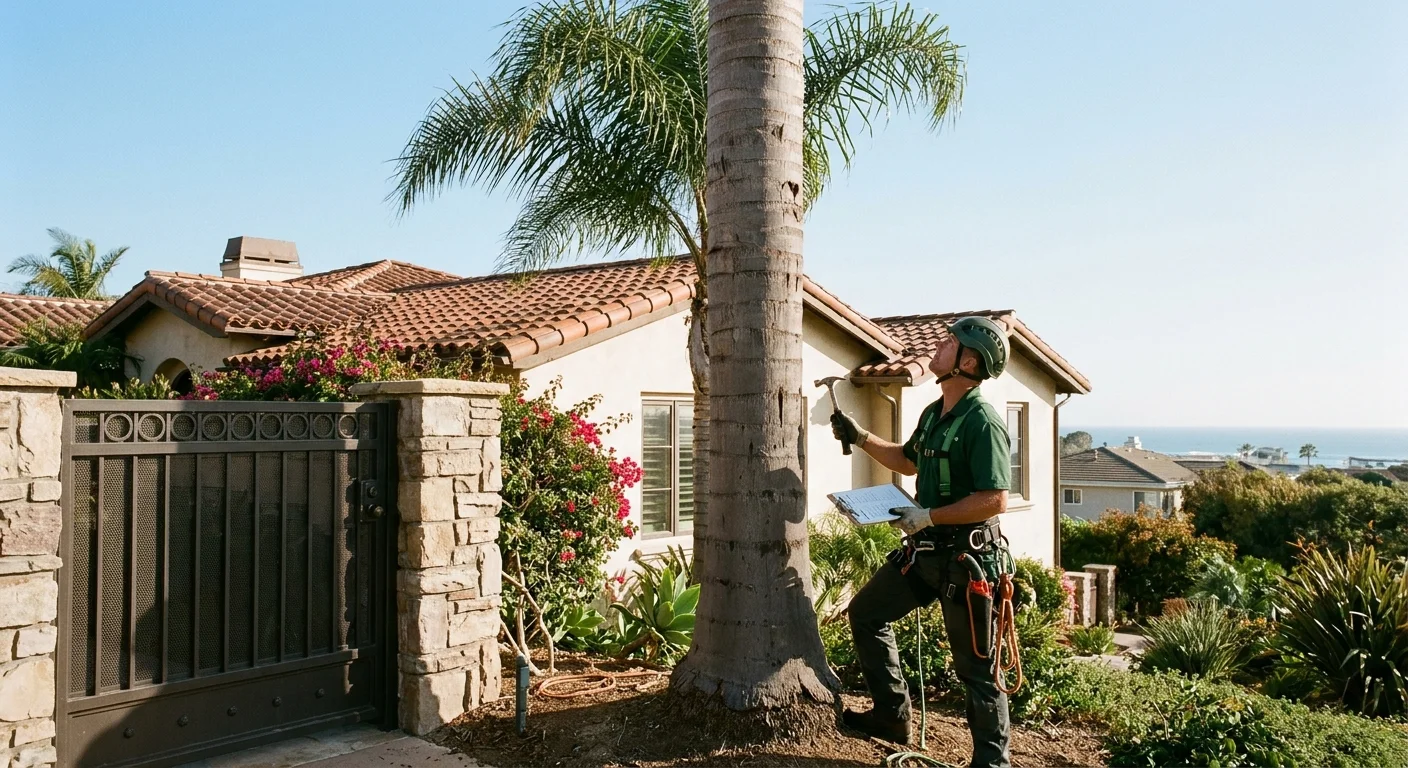
Start with the palm, the property, and the trimming goal
Carlsbad yards hold several planted palms, and they do not shed or hold dead leaves the same way. A queen palm (Syagrus romanzoffiana) has a single gray trunk with spaced scars, arching feather leaves, and leaflets that stick out in more than one plane. It is not self-cleaning. Dead leaves stay until someone removes them. A king palm (Archontophoenix cunninghamiana) has a slender ringed trunk and a smooth crownshaft, the green to dull-purple sleeve of leaf bases. Crownshaft palms usually drop old leaves on their own. That falling material still needs a plan if it can hit a roof, a walk, or a pool. Mexican fan palm (Washingtonia robusta) has a tapered trunk and a dense fan crown. It can keep a skirt of dead leaves. California fan palm (Washingtonia filifera) is the native western United States palm. It has a thicker, more columnar trunk and a more open gray-green crown. Hybrids between the two Washingtonia species are common, so one fan shape is not a species ID. Canary Island date palm (Phoenix canariensis) is a heavy single trunk with a diamond pattern of old bases, long feather leaves, and spiny basal leaflets. Pygmy date palm (Phoenix roebelenii) showed up as one of the five most common trees, by count, in the U.S. Forest Service 2017 inventory of the City of San Diego. That count is city inventory, not a Carlsbad planting census.
Name the palm before you describe the trim. A queen over a Village patio is a fruit-and-frond job. A tall Mexican fan on an Aviara slope is a skirt, access, and drop-zone job. A king in a sheltered courtyard is often more about where old leaves land than about climbing for a full skinning. If the botanical name is unclear, say so in the quote request and ask the independent company to identify it from the ground with photos of the trunk, crown, and any fruit.
The property sets the second half of the goal. A palm over tile in the Village, a palm inside an Aviara pool cage, and a palm on a street strip are three different scopes. Write down what you want: dead and hanging fronds off the walk, seed pods off the cars, clearance off the roof, or a cleaner trunk look. Palm tree trimming and removal is a different service family from general tree trimming. Palms have one growing point at the top. A bad cut there can kill the stem. The matched crew should protect that bud, skip climbing spikes on a living palm, and leave healthy foliage unless a named clearance needs a limited live cut.
How coastal Carlsbad salt differs from inland heat east of I-5
West of Interstate 5, lots near Carlsbad Village, Tamarack, and the Agua Hedionda shore take marine air and salt spray. Brown leaf tips on the ocean-facing side can be salt on the foliage. They can also be drought, irrigation salts, or something else. UC IPM treats those lookalikes as a reason to check the actual water and soil, not as a remote diagnosis. Do not strip living, salt-marked leaves just to make the crown look even. Living tissue still feeds the palm.
East of I-5, tracts in Bressi Ranch, Calavera Hills, and inland La Costa run hotter and drier. Heat and wind load change how a tall palm sits over a roof, but they do not create a published Carlsbad pruning calendar. University of Florida palm-pruning guidance is clear on this point: there is no single best season. Dead leaves, flower and fruit stalks, cold damage, and the palm’s condition drive the decision. For county timing context, see when San Diego palms get trimmed. That page is a planning aid, not a permission slip to wait on a hanging frond over a walk.
Species still matters across that I-5 split. A Southern California planning leaflet from UCCE puts king palms in a 30 to 50 foot height band with about a 20 foot crown, and queen palms around 50 feet tall with a narrower crown. Those are regional planning figures, not measured Carlsbad limits. The same chart treats king palms as needing wind protection and queens as more wind-tolerant. That is a siting note for Aviara ridgelines and open inland lots. It is not a promise that a queen will ride out Santa Ana winds without dropping fruit or fronds.
Overpruning does not buy a longer gap between visits. ISA palm guidance says aggressive high cuts can slow growth and attract pests. Retain healthy foliage. Limited live cuts for clearance are a different choice than skinning the crown down to a few upright leaves. If a neighboring inland job in Vista is the comparison you have in mind, read palm tree trimming in Vista as a separate access-and-heat pattern. Vista is not Carlsbad’s coast, and Carlsbad’s coast is not Bressi Ranch.
For other tree work in the same city, start with tree service in Carlsbad. Palm cuts still need their own species check and written scope.
Map gates, roofs, pools, and street access
A Carlsbad trim quote is half climbing and half logistics. Walk the lot the way a chipper and a drop zone would use it. Older Village and Barrio lots often have a narrow side yard, a locked gate, and street parking that fills by late morning. Aviara and La Costa HOA lots often add a keyed vehicle gate, guest-parking rules, and a pool fence that blocks the only path to the trunk. Tile roofs, solar, play equipment, and glass around a pool all belong in the notes. So does the place where cut fronds will land.
Ask who opens the gate, where the truck can sit, and whether the crew can stage on the driveway without blocking a fire hydrant or a neighbor’s apron. A palm over the house may need a climber, an aerial lift, or a different method. The independent company decides that after they see the trunk, the targets, and the ground. Do not treat a crane as automatic on every tall palm. Ground support, slope, and underground utilities matter if a lift or crane is even on the table.
Separate a private-yard palm from a city street tree. Carlsbad Municipal Code section 11.12.090 requires a permit to prune, cut, trim, or remove street trees. Parks and Recreation issues that permit for the City Manager. City arborist review is part of a removal request. A private palm that merely overhangs the sidewalk is not automatically a city street tree. Confirm the trunk location with the city before anyone cuts a right-of-way palm. Do not order private removal of a city tree because a contractor is available.
If fronds or fruit sit in power lines, stay back. Call 911 for a downed line, and call SDG&E at 1-800-411-7343. The utility decides whether a line can be de-energized, covered, or moved. Ordinary tree work does not include energized high-voltage clearance. Keep tools and people away until SDG&E says the site is clear.
HOA lots need one more pass. Many Carlsbad associations care about street-facing palms and debris in shared drives. That is a documents question, not a citywide rule. Pull the CC&Rs and any architectural rules for the address. A trunk on the common area is a different owner than a trunk in a private rear yard. California Civil Code sections 833 and 834 place ownership by the trunk, not by where a frond hangs. A fence is not a survey.
Separate frond work, seed pods, hauling, and excluded cuts
ISA’s palm guidance is the right shape for a written scope. Normal work is dead and dying fronds, plus fruit and flower clusters when they are a site risk. Keep healthy foliage. Limited live cuts can be justified for clearance. An absolute “never touch a green frond” line overstates that brochure. A hurricane-cut or pineapple-cut of live tissue is the other extreme. Frequent severe pruning, sculpting persistent leaf bases into a pineapple, and skinning the trunk open wounds. Palms do not close those wounds the way a branched tree does.
Keep seed pods and fruit stalks on their own line in the quote. Queen palms make orange fruit and a mess on cars and walks. Removing a fruit cluster is not the same job as pulling a full skirt off a Mexican fan. Hauling is a third line. Fronds are bulky. A Village lot with no alley and no driveway stacking room needs an agreed dump plan. Leaving a pile for the owner is a different price conversation than loading out. Branch Pro does not set that price. The independent company does, in writing.
Say what is excluded. Persistent leaf bases on some palms stay attached. Forcing them off can wound the trunk. Climbing spikes on a living palm leave permanent holes. Tool sanitation matters on Canary Island date palms because Fusarium wilt can move on contaminated tools and debris. UC IPM describes that wilt as lethal on that host, with no established cure. One-sided leaf death has other causes too, including petiole blight and pink rot. Do not diagnose from a photo. Do not ask a homeowner to climb, tap, or probe a suspect trunk. Unusual crown lean, sudden decline, or a green crown with a soft base is a reason to stop cosmetic trimming and get a qualified look.
Dead fan-palm skirts can hold litter and, on Mexican fan palm, are noted by the California Invasive Plant Council as a possible fire hazard in escaped stands. That inventory is not a government order to remove every yard palm. For parcel defensible-space rules, use CAL FIRE’s current guidance and the local fire authority. Statewide Zone 0 rules for the first five feet were not a fully effective universal law at the last ledger check. Confirm the address. Do not clear living palms in that zone on a rumor.
Birds can nest in skirts and crowns. CDFW treats February through August as typical for many species, with nesting possible in other months. Do not disturb an active nest. If work must happen when birds could be nesting, a consulting biologist’s survey is the agency’s recommended path.
What to confirm with the independent palm pro before approval
Branch Pro San Diego is a referral service. We match you with licensed, independent local tree companies. We do not climb, cut, haul, or pull permits. The contract and payment run between you and the pro.
Ask for the contractor license number and check it on the CSLB license lookup. Tree and palm work of $1,000 or more, in the aggregate, generally needs a California contractor license. The current tree classification is C-49. An active legacy C-61/D-49 issued before 2024 can still be valid. Do not treat a missing C-49 as automatic proof the company is illegal, and do not skip the lookup. Confirm status, classification, and the bond record. A $25,000 contractor license bond has been required since January 1, 2023. That bond is not general liability insurance. A certificate of insurance is not the policy. California Insurance Code section 384 says coverage follows the policy terms, not the certificate paper.
ISA Certified Arborist is an individual credential, not a state license and not a company badge. You can ask the person who will assess the palm to share a certificate, and you can look in the ISA credential directory. An absent public listing does not by itself disprove a credential.
Put the job in writing before anyone starts: species as identified, which palms, which cuts, which live foliage if any, fruit and seed work, debris haul, site protection, and what is excluded. The provider confirms how long they will be on site after they review that palm work. There is no published Branch Pro arrival window. If the palm is a city street tree, the matched crew’s permit path through Carlsbad Parks and Recreation belongs in that writing. If an HOA has to sign off, get that in hand first.
Photograph the palm from the ground, from a place that is already safe. Do not walk under hanging fronds to get a better angle. Do not set a ladder against the trunk.
Frequently asked questions
What kind of palm trees grow in San Diego County yards?
Planted queens, kings, Mexican fans, California fans, Canary Island dates, and pygmy dates show up across the county. Carlsbad yards follow that mix, with queens and fans common on residential lots and kings more often in sheltered coastal pockets. Identify the actual trunk, leaf type, and fruit. Do not assume a palm will shed because a neighbor’s palm sheds.
Is California getting rid of palm trees?
No verified statewide program to remove palms is in the approved sources for this site. Cal-IPC lists Mexican fan palm as Moderate-Alert for ecological impact where it escapes into riparian and other wild areas. That inventory is science-based. It is not a city demolition order for a backyard palm. Removal still follows the parcel’s owner, HOA, and city rules.
What is the only palm tree that is native to California?
California fan palm, Washingtonia filifera, is the native palm of the western United States. Native stands belong to desert oasis country more than to Carlsbad streets. Most Carlsbad palms are planted ornamentals, including Mexican fan, a related species from northwestern Mexico. Correct ID matters because the two can hybridize.
Which city in California has the most palm trees?
A ranked city count could not be confirmed from the primary sources used for this page. Do not treat a skyline photo as a census. For a Carlsbad job, the useful number is how many palms are on your lot, how tall they are, and whether each trunk is private, HOA, or city.
When to call us
Call when a Carlsbad palm is dropping fronds or fruit on a roof, pool, or walk, when a skirt or crown needs a climber, or when a street-tree or HOA rule has to be sorted before cuts. Independent licensed tree companies do the work. Call us at (858) 400-4423 and we’ll connect you with a licensed local tree company.