A Leucadia eucalyptus hanging over a tile roof is a different job from a Cardiff palm dropping fronds into a side yard. On Encinitas lots west of Interstate 5, salt, marine layer, and skinny access shape the trim as much as the tree. Get those three things on paper before you approve a cut.
Branch Pro San Diego is a referral service. We match you with licensed, independent tree companies. We do not trim, haul, or climb. The pro you hire does the work and you pay that company directly.
Define the trimming goal for the specific tree
Walk the lot with one tree in mind, not a vague “clean it up.” Name the tree as well as you can: coast live oak in a canyon draw, eucalyptus over a garage, queen palm in a Cardiff side yard, Torrey pine on a bluff lot. A named tree plus a named goal is what a written quote can actually price.
Pick one primary objective. Clearance over a roof, a chimney, or a walkway. Deadwood that could fall on a parked car on Coast Highway. Light into a north-facing room. Fruit or flower litter off a patio. Shape after storm breakage. Those are different cuts. Mixing them into “make it smaller” is how topping happens. ISA’s mature-tree pruning guidance treats about 25 percent live-crown removal as a general upper guideline, and less than that for mature trees. It is not a yearly target and not a health upgrade by itself. Each cut needs a purpose.
Write what you want left behind. Keep the western shade on a stucco wall. Keep the screen toward a neighbor on Vulcan Avenue. Keep living palm fronds that still feed the crown. Independent tree trimming crews work to the specification you approve. If the specification is “take it down hard,” you will get a hard cut, and the tree will respond with weak sprouts.
Separate trimming from diagnosis. Brown tips on the ocean-facing side can be salt. Sparse interior wood can be old topping. A lean after a wet week can be roots. If the tree looks unhealthy, pause the cosmetic list and get a condition check first. That is the job of a consultation when an Encinitas tree needs an arborist, not a standing trim ticket.
Palms are not shade trees. Normal palm work is dead or dying fronds and fruit or flower clusters that create site risk. Healthy foliage stays unless a real clearance need exists. Climbing spikes wound a palm trunk, and those wounds do not close. If the quote only says “hurricane cut” or “skin the trunk,” send it back.
How salt air and marine layer differ from inland North County
Encinitas is not Escondido with a beach. West of I-5, especially in Leucadia and Cardiff-by-the-Sea, trees take salt in two ways. Sea spray hits foliage. Saline irrigation or soil salts hit roots. UC IPM describes browning on leaf tips and margins, sometimes heavier on the ocean-facing side or on lower leaves that sprinklers wet. That pattern is a clue. It is not a remote diagnosis. Drought, drainage, and pests can look similar. Coastal location alone does not prove salt injury.
The marine layer changes the workday, not the biology textbook. Morning fog on 101 keeps decks wet and makes roofs slick. Crews still need firm footing, dry saws, and a drop zone that is not a neighbor’s skylight. Afternoon west wind off Swami’s and Moonlight Beach can move a long limb during a cut. Ask the company how they plan the drop, the tie-in, and the haul path in that weather. Do not ask them to promise a clock time. We do not publish arrival windows, and neither should a quote that has not seen the lot.
Olivenhain and the lots east of El Camino Real sit in a different pocket. They get less salt spray and more inland heat. A trim plan copied from a Rancho Santa Fe grove or an Escondido avocado row will overcut a Cardiff street tree and under-account for salt-scorched foliage on a Leucadia lot. For the broader county contrast, see coastal versus inland trimming in San Diego. This page stays on Encinitas access and salt.
Do not strip live canopy because the leaves look tired. Salt-damaged living tissue is still working. Heavy thinning does not “let the tree breathe,” and it does not save water. ISA is clear that excess foliage removal reduces energy reserves. Ask for selective deadwood, targeted clearance, and a reason for every live cut.
If a tree sits near a structure in a mapped fire area, that is a separate conversation with the fire authority for that address. Statewide Zone 0 rules were still in review as of early September 2026. Do not treat a beach-cottage trim as automatic vegetation removal in the first five feet.
Map roofs, fences, alleys, and street parking
Encinitas lots west of 101 are often short, fenced, and already full. A quote that never walks the alley is not a quote. Walk it yourself first and take photos from the ground.
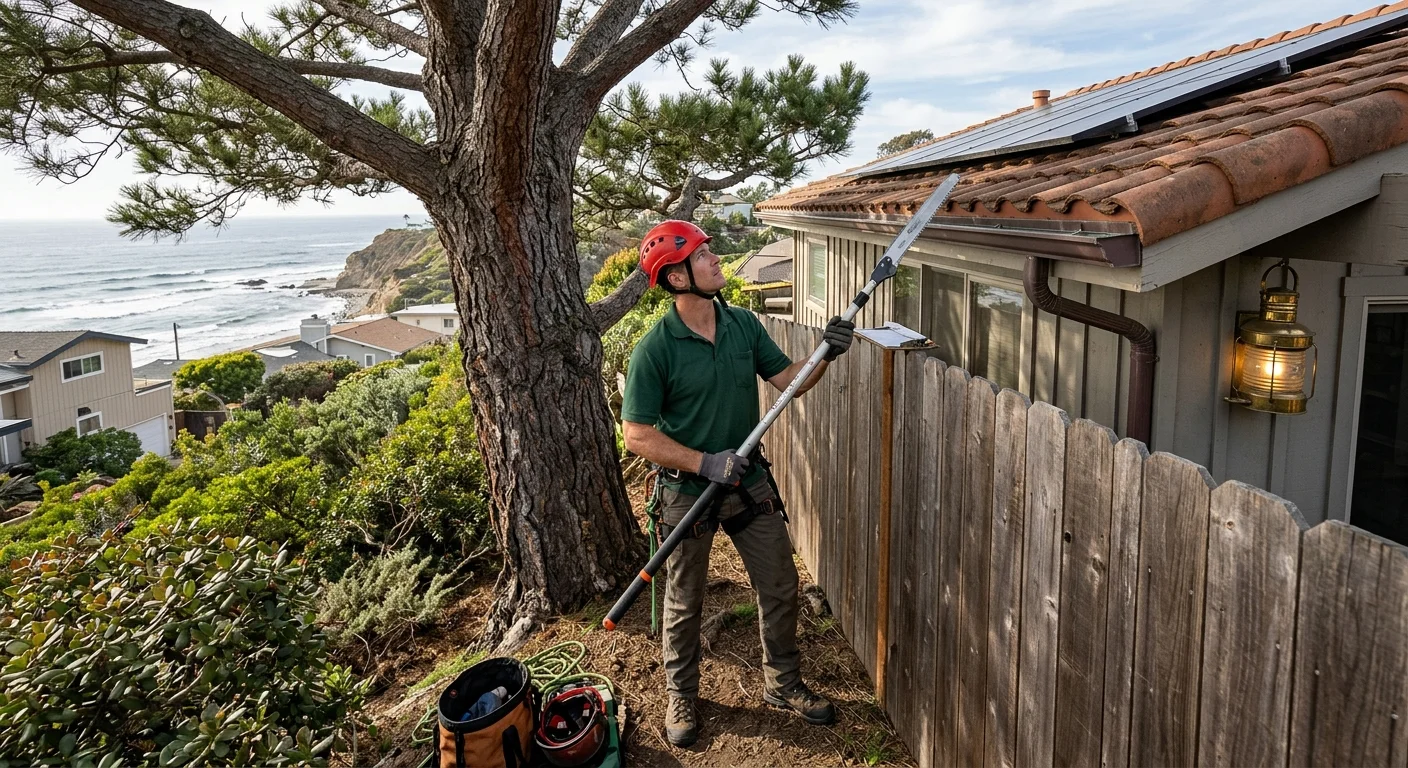
Mark the drop zone. Tile and solar arrays on Old Encinitas and New Encinitas roofs do not tolerate a free-falling limb. Glass, spas, and narrow side yards in Cardiff terraces need a planned lower and a planned carry-out. A fence on a shared line is not a cutting license. California ownership follows the trunk, not the branch. Stay on your side until the neighbor, the boundary, and the scope are clear.
Mark access. Many Leucadia cottages use a rear alley rather than a wide driveway. Measure gate width, slope, and overhead wires. Note where a chipper can sit without blocking a fire hydrant or a bike lane on Coast Highway. Street parking along 101 and around Moonlight fills up. Write where the truck will stand, who will move cars, and what happens if a tour bus or a beach crowd takes that curb.
Mark targets: play equipment, a parked car, a neighbor’s greenhouse, a service drop from the house to the pole. If any part of the tree is near energized lines, stop. That is SDG&E’s call, not a homeowner ladder job. For a downed line, stay away, call 911, and call SDG&E at 1-800-411-7343. Ordinary Encinitas tree service work waits until the utility says the site is clear.
If the only way out is over a neighbor’s roof or through a HOA walkway, say so in the quote request. Tight-lot structural pruning is often the safer scope than a full reduction. Crane work is a different service, with ground support, underground utilities, and lift path all assessed on site. Do not assume a crane because the tree is tall.
Separate pruning, hauling, cleanup, and excluded work
A coastal trim fails in the last hour if the paper never named debris. Ask the independent company to split the job in writing.
Pruning is the cuts. List the trees, the objective, and the approximate size class the estimator saw. Hauling is off-site disposal of wood and green waste. Cleanup is rakes, blowers, and what remains on beds, gravel, and the alley. Chips left as mulch are not the same as a clean haul. If you want chips, say where they may sit. Do not pile them against siding or in the first few feet of a structure. Confirm current defensible-space rules with the fire authority for that parcel.
Name the exclusions. Stump grinding, root pruning, irrigation repair, fence reset, and hardscape patching are not automatic. Palm fruit clusters are not the same as a shade-tree thin. A heritage-tree report is not a trim. Permit filing, if required, belongs in the contract as work the licensed crew handles, not as something Branch Pro files.
California contractor licensing applies to tree work contracts of $1,000 or more, counting labor, materials, and everything else in the job. The current classification for this trade is C-49 Tree and Palm Contractor. Some companies still work under a valid legacy C-61/D-49 issued before 2024. Check the actual license on the CSLB lookup. ISA Certified Arborist is a personal credential, not a state license and not proof that every person on site holds it.
Ask how the crew will staff the job and whether workers’ compensation is on the CSLB record. A C-49 holder is not automatically exempt and not automatically required in every no-employee case. Read the record. Coverage is required when the contractor has employees.
Get the price as a written scope, not a hallway number. We do not publish rates, discounts, or free-estimate promises. The company you hire sets the price after they see access, salt-damaged wood, and the haul path.
Check city or utility responsibility before approval
Confirm who owns the tree before anyone climbs. A parkway planting between sidewalk and curb can be a city tree even if you water it. A tree on private land can still be a designated heritage tree. Encinitas Municipal Code Chapter 15.02 requires City Arborist authorization to remove city trees and designated heritage trees. Heritage status can apply on private land. Heritage removals also need a Planning Commission hearing. More than minor maintenance pruning of a heritage tree needs approval. Construction in a tree protection zone can require an owner-prepared plan the City Arborist approves. Read the current text in Chapter 15.02 and confirm the address, the tree, and the scope with the city. A mailing address is not a jurisdiction check. Do not treat a 14-day notice rule as a promise of how fast a permit lands.
If a complete heritage nomination is pending, removal waits until the city considers it. Proposed development-tree changes from 2025 are not law unless the city has adopted them. Ask staff what is in force for your parcel.
Utility vegetation near high-voltage lines is SDG&E’s program, not a private trim you green-light from the sidewalk. Clearance distances vary by voltage and location. Do not measure them yourself and start cutting. Ask the estimator whether the work is private-yard pruning, a city tree, or a utility conflict. Those three paths do not share one form.
Birds nest in Encinitas canopies. California Department of Fish and Wildlife describes February through August as typical for many species, with nesting possible in other months. If work must happen when birds could be nesting, CDFW recommends a consulting biologist’s survey. An active nest gets a buffer or a delay. That is wildlife law, not a city trimming calendar. There is no single best month to trim every California tree.
Frequently asked questions
How much does tree work cost in Encinitas?
No .gov source publishes an official Encinitas trimming or removal price. Ignore round numbers you see on ads. Ask the licensed company for a written scope that names the trees, the cuts, haul-off, and what is excluded. For removal planning next door in this same coastal strip, use Encinitas and Carlsbad removal cost questions as a planning page, not as a rate sheet.
What is the best month to trim trees in Encinitas?
There is no single best month. Match the work to the tree, the objective, and weather you can actually stand in. Deciduous fruit trees are often assessed when they are leafless. Palms are maintained for dead fronds and site risk, not a May-to-July ritual. Hazard limbs do not wait on a calendar. Nesting risk is highest for many species from February through August, and a biologist’s survey is the right step if work cannot wait.
Can seniors get a tree removed for free?
We could not confirm a city or county program that removes private Encinitas trees at no cost because the owner is a senior. If a flyer promises a free senior removal, ask which agency funds it and get that in writing. Branch Pro does not waive fees or run discounts. We connect you with licensed companies. Those companies set their own prices.
Are there pines in Encinitas?
Yes. Torrey pine is native to coastal San Diego County, including the reserve just south of the city and some private coastal lots. Other pines appear in yards too. Species identity matters for pruning and for any protected-tree review. A five-needle bundle is a clue for Torrey pine, not a field ID by itself.
When to call us
Call when a coastal Encinitas tree needs a licensed company: live wood over a roof, a palm over a walk, a heritage question, or a lot too tight for a ladder. Call us at (858) 400-4423 and we’ll connect you with a licensed local tree company.