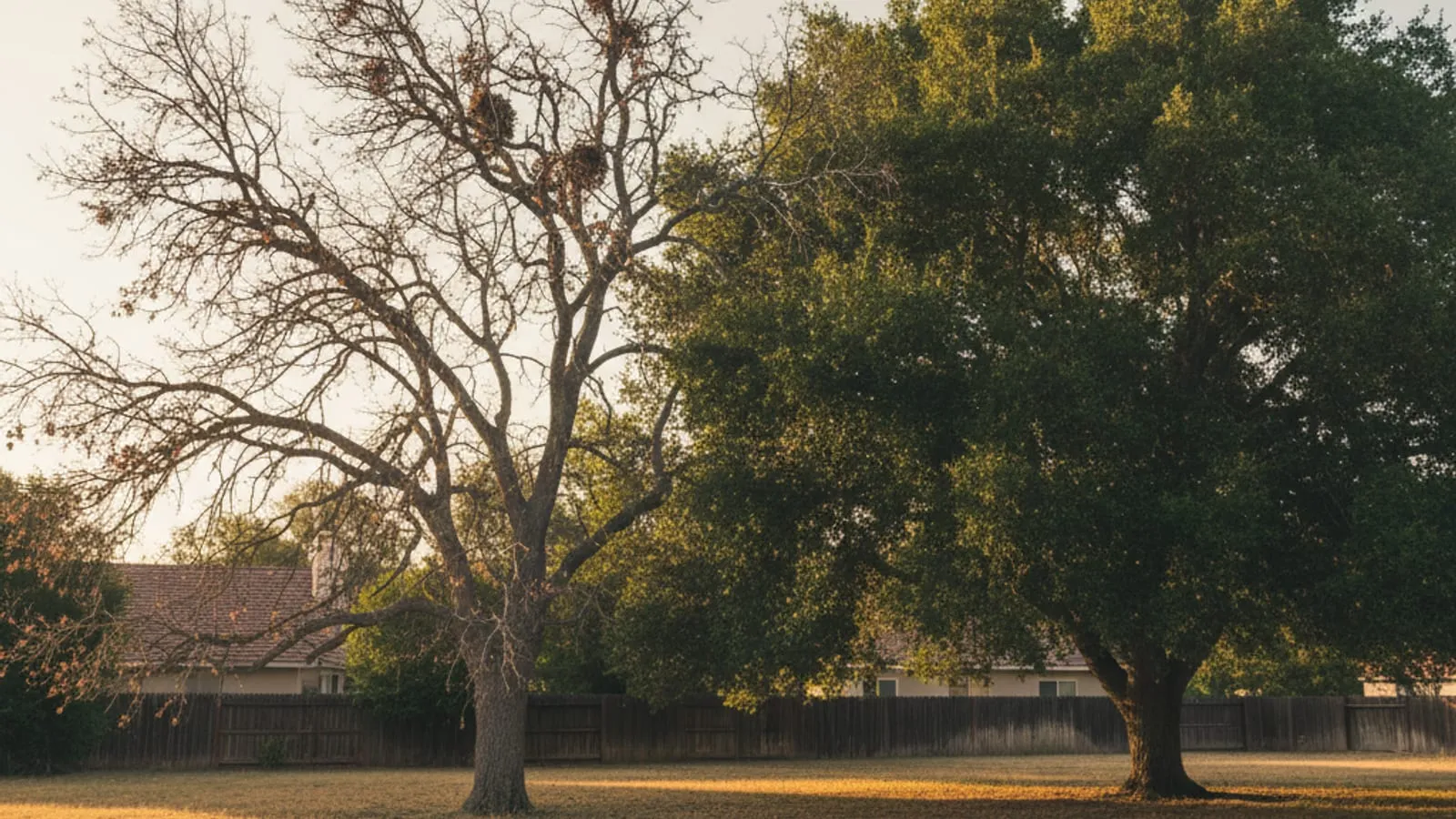
A bare branch, hole, lean, or patch of loose bark doesn’t prove a tree is dying. Record what changed, keep people away from unstable material, and have the whole tree and site assessed before choosing treatment or removal.
National “8 signs your tree is dying” lists treat bark shedding, leaf drop, and mushrooms as universal death sentences. In San Diego, sycamore bark can shed as a species trait, palms may show South American palm weevil damage, and goldspotted oak borer is an oak-specific insect. Start with the host species, then the observed change.
These ten observations can help you describe the problem. They aren’t do-it-yourself diagnoses.
1. Canopy thinning or branch dieback
Photograph the whole canopy from a safe location. Note whether the change affects one branch, one side, or most of the crown. Compare current photos with older images when available.
Crown thinning can appear with several problems, including goldspotted oak borer damage, but it doesn’t identify the cause by itself. UC’s goldspotted oak borer guidance recommends evaluating the host tree and severity instead of relying on one symptom.
2. D-shaped holes on an oak trunk
Older UC IPM diagnostic guidance identifies D-shaped exit holes as a characteristic goldspotted oak borer sign. Bark staining and crown thinning are less specific. Review the distinctions in UC IPM’s goldspotted oak borer Pest Notes.
Ask a qualified professional to identify the tree, inspect the trunk, and assess the damage before discussing treatment or removal. Don’t turn a photograph or hole count into a final diagnosis.
UC’s current distribution page records ongoing oak mortality in many areas throughout San Diego County, with isolated confirmed areas in Riverside, Orange, Los Angeles, San Bernardino, and Ventura counties. Moving infested firewood is identified as a likely route for satellite infestations.
3. Other holes, galleries, or boring dust
Different insects affect different hosts. A hole alone doesn’t establish that a tree is hollow or beyond recovery.
UC IPM bark-beetle guidance says healthy trees can withstand limited attacks and that only some aggressive bark-beetle species act as sole causes of mortality. A few affected branches and extensive trunk infestation are different conditions.
Ask for the insect, host species, affected area, and severity to be identified. Avoid applying a pesticide or ordering removal from a photograph alone.
4. Palm decline or crown damage
South American palm weevil is established in San Diego County and can damage Canary Island date palms. Severe damage may lead to crown failure, but symptoms still require identification. See UC IPM’s giant palm weevil guidance.
Report a suspected finding to the San Diego County agricultural commissioner and seek current local guidance. Don’t climb, probe, cut, or move suspect material without an identified handling plan.
5. Recent root cutting or soil compaction
Tell the assessor about trenching, paving, grading, vehicle traffic, excavation, or fill near the tree. UC IPM construction guidance explains that root cutting, crushing, and soil compaction can cause delayed decline and reduce stability. Large-root injury can increase windthrow risk, especially in wet soil.
Don’t trench for a root barrier or cut large roots before the tree and surrounding utilities are assessed. A barrier may redirect roots, but it doesn’t guarantee permanent protection or harmless installation.
6. A new lean or movement at ground level
Stay clear if a tree has shifted or soil is moving around its base. Photograph the tree from a safe location without standing beneath the crown or entering a damaged area.
Tell the assessor when the change appeared and whether it followed rain, excavation, impact, or another event. A long-standing lean and recent movement require different questions, but either needs site context.
7. Cracks, splits, or hanging branches
Record where the damage sits and what lies beneath it. Keep people, pets, and vehicles outside the affected area.
Don’t pull, climb, or test a damaged limb. An assessment should consider the defect, remaining structure, branch or tree position, and anything that could be struck.
8. Growths, cavities, or softened wood
A shelf-shaped growth, cavity, or soft area deserves inspection, but a photograph can’t establish how much sound wood remains or identify every cause.
Don’t strike, drill, scrape, or enlarge the area as a substitute for an assessment. Ask what inspection method supports the recommendation and what uncertainty remains.
9. Bark loss or fresh wounds
Document the location and size of the affected area. Avoid peeling away more bark.
Species, wound history, pests, sun exposure, and surrounding construction all matter. A wound doesn’t prove the whole tree is dead, but its location and extent can affect the next step.
10. Several changes appearing together
A combination of canopy loss, trunk damage, root disturbance, or recent movement deserves a site-specific assessment. It still doesn’t make removal automatic.
Ask the professional to separate tree health, structural condition, and site risk in the findings. Treatment, monitoring, pruning, and removal are different recommendations and should be supported by the observed condition.
What should you do next?
Keep people, pets, and vehicles away from unstable trees or hanging material. If a line is down, stay away and report it to both 911 and SDG&E at 1-800-411-7343, as directed by SDG&E’s power-outage safety guidance.
For other concerns, take photographs from a safe place and request an assessment. Ask the professional to identify:
- The tree and observed condition
- Evidence supporting the diagnosis
- The affected area and remaining structure
- People or property that could be struck
- Treatment, monitoring, pruning, or removal options
- Limits or uncertainty in the assessment
Don’t assume insurance pays every tree-related expense. The California Department of Insurance says fallen-tree damage to an insured home is generally covered subject to policy terms and exceptions. Vehicle damage requires applicable optional comprehensive or other-than-collision auto coverage. Review its storm insurance guidance, then confirm deductibles, documentation, and removal allowances with your insurer.
Frequently asked questions
Can one symptom prove a tree is dying?
Usually not. Canopy loss, bark staining, holes, sparse growth, and wounds can have more than one cause. Identification, severity, tree condition, and site history all matter.
Is a scratch test enough?
Don’t make a whole-tree removal decision from one scraped twig. One branch doesn’t reveal the condition of the roots, trunk, remaining crown, or surrounding site.
Do beetle holes mean removal is required?
No. The insect, host, location, and extent of damage must be identified. UC IPM distinguishes limited attacks from extensive trunk infestation and doesn’t support one removal rule for every bark beetle or tree.
Can an infested tree be treated?
That depends on the pest, tree species, damage level, and current treatment guidance. UC’s goldspotted oak borer management guidance distinguishes preventive or early treatment decisions from heavily damaged trees that may require removal and controlled wood handling.
Should a visibly dead tree be removed?
Request a site-specific risk assessment. The decision depends on the remaining structure, tree location, and what could be struck. Keep away from unstable material and contact the utility first when lines are involved.
How much does an assessment cost?
The provider sets the fee and scope. Ask whether the visit includes identification, a health or risk assessment, photographs, a written report, and follow-up recommendations. Record what’s included before hiring the provider.
How do I verify an ISA credential?
ISA certification belongs to an individual and is separate from a California contractor license. Ask the named person for a current digital certificate and check the ISA credential directory. A missing directory listing alone doesn’t disprove certification because participants may omit details.
Call (858) 400-4423 to be connected with a licensed, insured independent provider for an arborist consultation. Ask who will perform the assessment, what credentials that person holds, and whether a written report is included. The provider sets its availability, scope, and price, and you hire and pay that provider directly.