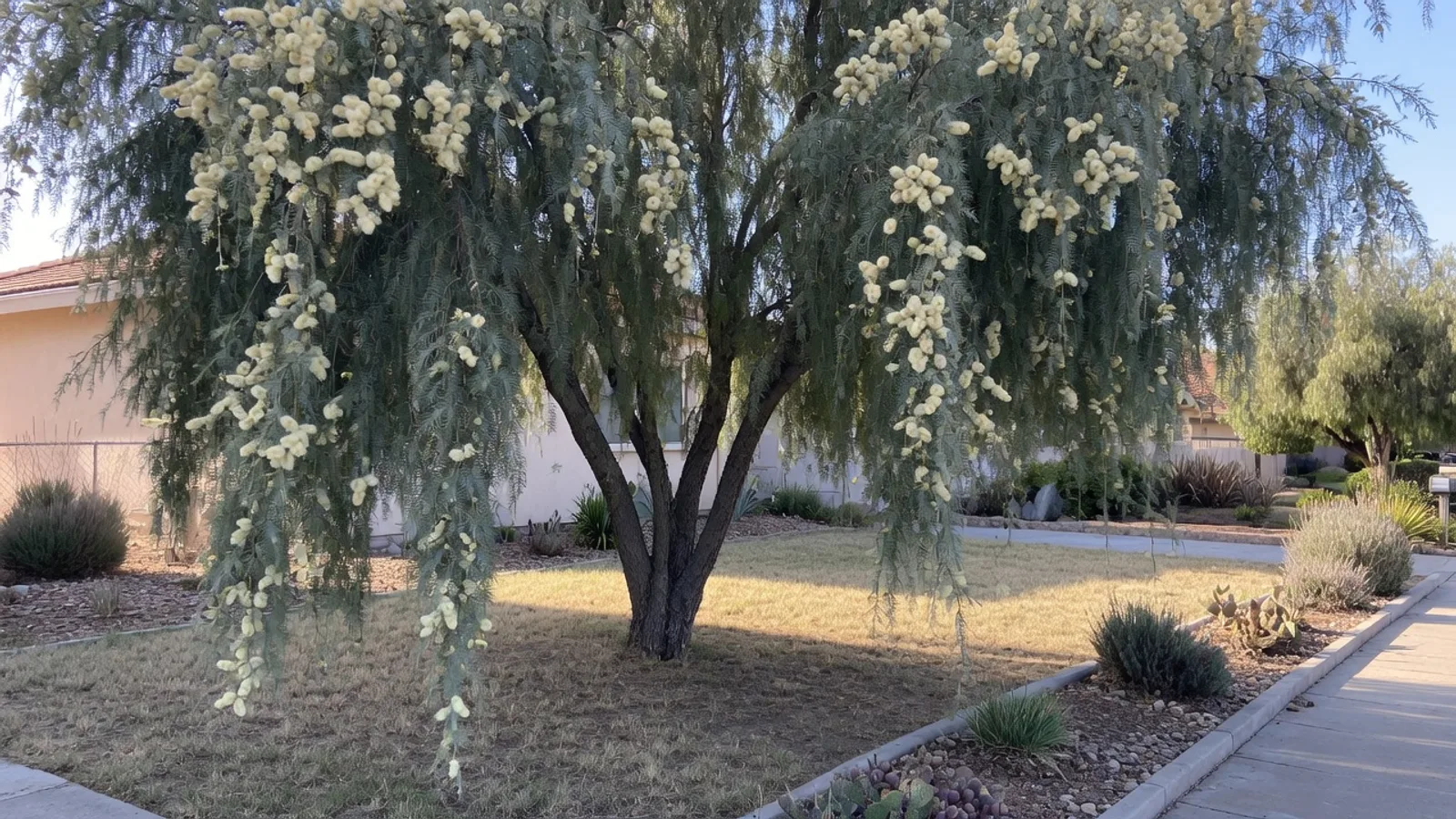
Willow acacia in San Diego landscapes is Acacia salicina, also called weeping wattle. It is not a true willow (Salix), and it is not Australian willow (Geijera). Confirm the botanical name before anyone prunes, removes, or replants.
The University of Arizona Campus Arboretum describes an Australian evergreen with pendulous grey-green phyllodes, fragrant cream-white spring flowers in round heads, and long pods that turn brown and split. It is a full-sun, low-water tree that can take drought. UA notes that under sub-standard conditions the stressed tree produces suckers and spreads by clonal shoots, and that in those circumstances the species is considered somewhat invasive.
Cal Poly SelecTree is the other profile this site already uses for the species. That comparison lists a Low water category, an evergreen with drooping branchlets, cream-white flowers and pods, and a weak branch rating. See the nine-tree table in drought-tolerant trees for San Diego.
Branch Pro San Diego is a referral service. We connect you with licensed, insured independent local tree professionals. You hire and pay the professional directly. We don’t plant, prune, or guarantee a species will stay small.
How do you tell it from look-alikes?
- Phyllodes, not true leaflets: long, narrow, weeping
- Cream-white puff flowers, not yellow sweet-acacia balls
- Brown pods with a red aril on the seed, per UA
- Evergreen weeping outline, not the deciduous desert willow (Chilopsis)
Sweet acacia is a different plant with thorns and yellow-orange flower puffs. Australian willow is Geijera, Medium water in the Cal Poly comparison, and a different pruning conversation.
A Mission Valley parking-island planting and a Ramona side-yard specimen can both be A. salicina and still need different work. Name the tree, then name the target.
What problems show up on existing trees?
Weak branch wood is the pruning conversation. Long, weeping arms over a walk or a carport drop pieces in wind. Don’t top it to “thicken it up.” Topping is a defect. See tree topping.
Pods and spent flowers are a litter fact on paving. UA describes 4-inch pods that split at maturity.
Suckers at the base after drought, construction, or a hard cut are the other named behavior. UA says stressed trees send clonal shoots. Cutting the trunk without a root plan can leave a thicket. Ask the independent professional how they will handle the stump and the suckers. See stump grinding.
Low water does not mean a newly planted tree needs no irrigation. UA recommends deep irrigation for a stable root structure and monthly watering for best appearance, while noting it can withstand long drought.
What belongs in a written scope?
Ask the independent professional for a written scope that separates:
- Deadwood and named weak arms over a target
- Whether reduction is being proposed, and why
- Suckers versus the original trunk
- Removal and stump work if the tree is the wrong species for the space
- Replant choice, if any, as a separate decision. Compare the drought-tolerant table rather than swapping in another unvetted acacia.
For paid tree work, look up the license on the CSLB license lookup. An active C-49 Tree and Palm license or an active legacy D-49 can both be valid. California’s current minor-work threshold is an aggregate price under $1,000, with extra conditions.
If the tree is a City street tree, use the City’s street-tree maintenance process.
Frequently asked questions
Is willow acacia a California native?
No. UA and SelecTree treat it as an Australian species used in dry landscapes.
Is it the same as desert willow?
No. Desert willow is Chilopsis linearis, deciduous, with trumpet flowers. It has a Very Low water category in its Cal Poly profile.
Should I plant one under power lines?
Don’t assume it is utility-friendly. Several profiles in the drought-tolerant comparison mark species unsuitable beneath utilities. Use SDG&E tree safety guidance for the actual lines.
Can Branch Pro identify it from a phone photo of the weeping shape?
Weeping shape is shared by several trees. The independent professional confirms the species on site and contracts with you.
Get connected with a local pro
If the tree is on a conductor, call 911 and SDG&E at 1-800-411-7343 first. For pruning, suckers, or a removal, call (858) 400-4423. We’ll connect you with a licensed, insured independent local professional. Describe the flowers, the pods, and what sits under the canopy. You hire and pay that professional directly.