Desert willow has a Very Low water category in its Cal Poly profile, but it isn’t the right choice for every San Diego yard. California pepper, willow acacia, and Chilean mesquite have Low categories. Australian willow is Medium, while California sycamore is High. Western redbud offers a smaller native option. For tipu, confirm irrigation needs for the actual site and allow room for its broad canopy.
The useful comparison is bigger than drought tolerance. Check mature room, drainage, litter, thorns, utilities, and the planting area’s future use before choosing.
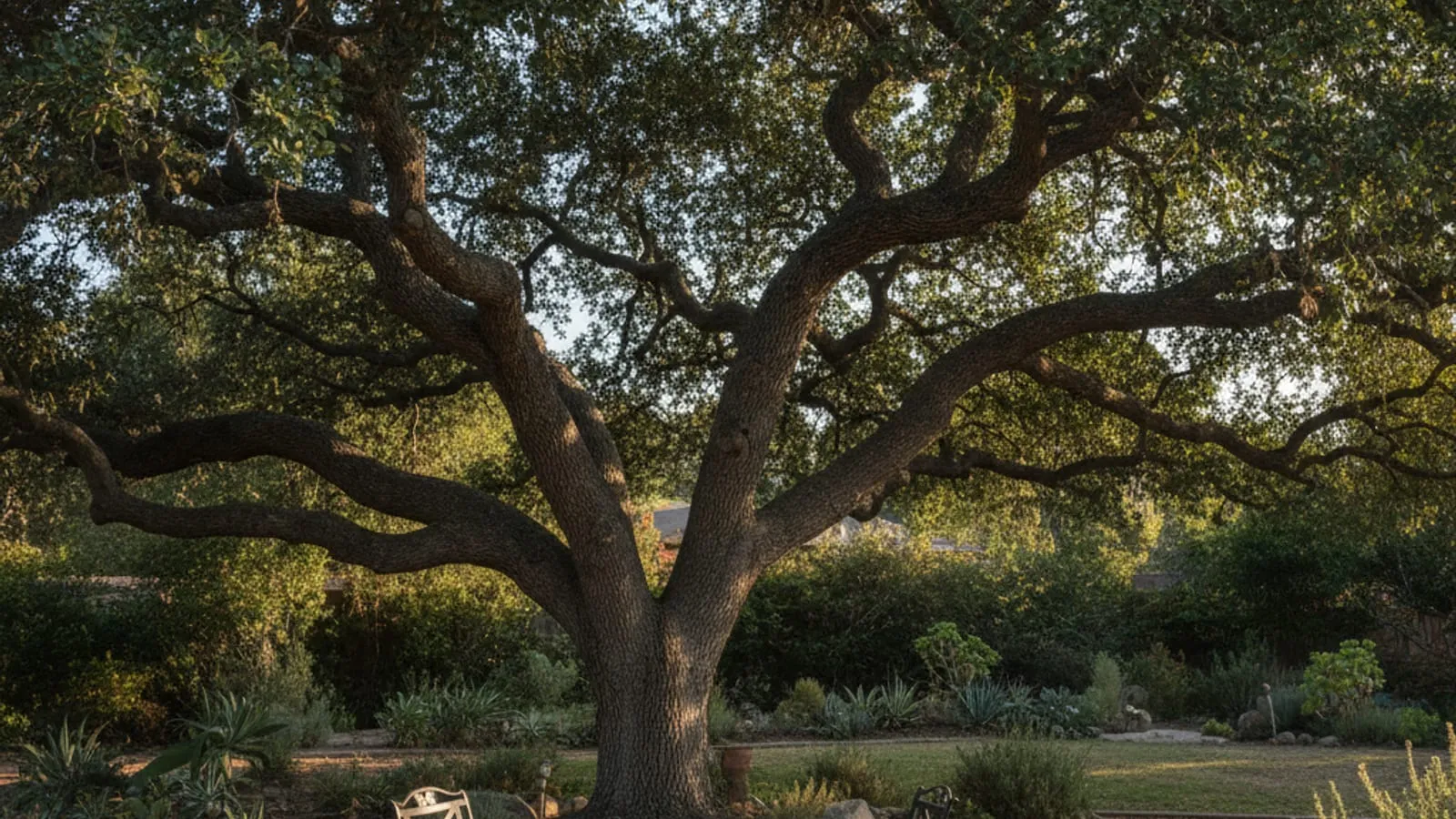
Illustration of a large tree in a garden setting.
Species comparison: nine trees for San Diego yards
The table compares water or moisture needs with each tree’s main site constraint. Use the linked profile to check mature height and width, then compare that space with the yard.
| Species | Source profile | Water or moisture distinction | Main site consideration |
|---|---|---|---|
| Tipu tree | Cal Poly | Confirm irrigation for the actual site | Partly deciduous, with a broad canopy and yellow-orange flowers. Allow substantial room. |
| California pepper | Cal Poly | Low | Evergreen, weeping, and potentially large. Expect fruit and leaf litter. Cal Poly flags high root-damage potential and possible invasiveness in California. |
| California sycamore | Cal Poly | High | A large California native associated with riparian settings. It needs suitable moisture and root space. |
| Desert willow | Cal Poly | Very low | Deciduous, sun-loving, and sensitive to poor drainage. Its trumpet flowers are followed by long capsules. |
| Willow acacia | University of Arizona and Cal Poly | Low | Evergreen with drooping branchlets, cream-white flowers, and pods. The Cal Poly profile gives it a weak branch rating. |
| Sweet acacia | University of Arizona | Drought tolerant with suitable drainage | Fragrant yellow-orange flower puffs, thorns, and pods matter near paths, play areas, and pools. |
| Chilean mesquite | Cal Poly | Low | Fine foliage, yellow flowers, and pods. Some selections are thornless, but the species isn’t uniformly thornless. |
| Western redbud | UC Davis Arboretum | Irrigation varies with management | A small native tree or shrub with rose-purple spring flowers and summer seed pods. It accepts sun or partial shade. |
| Australian willow | Cal Poly | Medium | Evergreen with a narrow, weeping form and small white flowers. Its profile says it isn’t suitable beneath utilities. |
Which tree fits your main constraint?
For the lowest documented water category, start with desert willow. It still needs sun, drainage, and enough room away from overhead lines. The species profile doesn’t classify it as suitable beneath utilities.
For a smaller native choice, compare western redbud with the available planting space and irrigation plan. UC Davis describes it as a small tree or shrub, not a fixed-height utility tree.
For broad shade, tipu and California sycamore need more room than a tight side yard. California sycamore also carries a high water category. Native status alone doesn’t make it suitable for a dry lot.
For a narrow form, Australian willow deserves consideration, but its water category is medium. Willow acacia has a similarly narrow appearance with a low water category, yet its branch rating and pod drop belong in the decision.
California pepper, sweet acacia, and Chilean mesquite all bring litter or thorn questions. Those details can rule out a tree beside a pool, walkway, play space, or regular parking area.
What should you check before planting?
Look up before choosing. Several profiles in this comparison mark the species unsuitable beneath utilities. SDG&E advises customers to consider overhead lines when selecting and placing trees. Use SDG&E’s tree safety guidance for the actual utility setting.
Identify the jurisdiction. Street-tree and protected-tree rules aren’t uniform across San Diego County. For example, the City of San Diego requires inspection and a no-fee permit request for street-tree trimming, removal, planting, or root pruning. Poway has separate rules for certain native, heritage, and commercial-property trees. Confirm the parcel jurisdiction, tree location, and project with the responsible city or county department.
Plan around roots without promising a barrier will solve them. Root cutting, soil compaction, and construction near an established tree can cause delayed decline or instability, according to UC IPM. If future paving or excavation is likely, resolve that conflict before planting.
Check fire requirements for the address. California’s Board of Forestry describes Zone 1 as five to 30 feet from a structure and Zone 2 as 30 to 100 feet, limited by a nearer property line. Requirements depend on the property’s fire authority and classification. Confirm the address before selecting or placing vegetation through the Board of Forestry defensible-space guidance.
Use a species-specific watering plan. Low and very-low water categories don’t mean a newly planted tree needs no water. Soil, drainage, root condition, weather, and species affect the plan. Our guide to watering trees in San Diego explains what to inspect without treating one schedule as universal.
How should mature trees be pruned?
Each cut should have a purpose. The ISA mature-tree pruning guide warns that excessive foliage removal reduces energy reserves. Its general percentage is an upper guideline, with less appropriate for mature trees depending on species, age, condition, and objective.
Topping isn’t the same as a planned reduction. ISA explains that indiscriminate cuts can expose tissue to sun injury and decay while producing weakly attached sprouts. If a tree needs clearance or structural work, describe the objective when requesting tree pruning.
Frequently asked questions
What is the best very-low-water tree in this comparison?
Desert willow has a Very Low water category in its Cal Poly profile. It is deciduous, needs sun for flowering, and can struggle with poor drainage. Its long capsules also create litter.
Is California pepper the lowest-water choice?
No. Cal Poly categorizes California pepper as Low water, not Very Low. Its weeping evergreen form can provide substantial canopy, but fruit and leaf litter, root potential, and the site’s available room matter.
Can I plant a tipu tree near a driveway?
Don’t use a universal setback. First compare the tree’s mature canopy, existing hardscape, soil, drainage, and the location of established roots. Excavation or root cutting near a mature tree can affect stability. The tipu tree guide covers the species-specific decision.
Which of these trees can go beneath power lines?
Don’t choose from height alone. Cal Poly marks Australian willow, desert willow, Chilean mesquite, and California sycamore as unsuitable beneath utilities. Ask SDG&E about the specific line and choose a planting position that avoids future conflict.
Is California sycamore drought tolerant because it’s native?
Native and low-water aren’t the same. Cal Poly places California sycamore in a High water category and associates it with riparian settings. It can be a meaningful native choice where moisture and root space fit. Read the California sycamore guide before treating it as a dry-yard substitute.
When should I plant one?
Planting timing depends on species, site, weather, and the care available after planting. Our San Diego planting-timing guide and soil and planting guide cover those decisions without promising one calendar window for every tree.
Get help matching the tree to the site
Branch Pro San Diego connects customers with licensed, insured independent tree service professionals. The professional evaluates the site and sets the scope, availability, and price. Call (858) 400-4423 to discuss planting-space, root, utility, or existing-tree concerns.
An arborist consultation can help when the choice depends on an existing tree or a difficult site. Use tree health diagnosis for a struggling tree, and tree removal when removal is being considered. Individual ISA credentials can be checked through the ISA credential directory.
For more comparisons, see native trees of San Diego and trees for backyard privacy.