Shot hole borers don’t kill trees by chewing wood, they farm a fungus inside the trunk that cuts off the tree’s water supply, and once that fungus spreads through the vascular system there’s no cure. The first sign is usually a cluster of pinhole-sized entry marks, often with a dark stain, sugary exudate, or fine sawdust below them. In San Diego County this pest has hit avocado groves in Fallbrook and Valley Center hardest, along with coast live oaks, sycamores, and box elders across the county’s canyons and older neighborhoods.
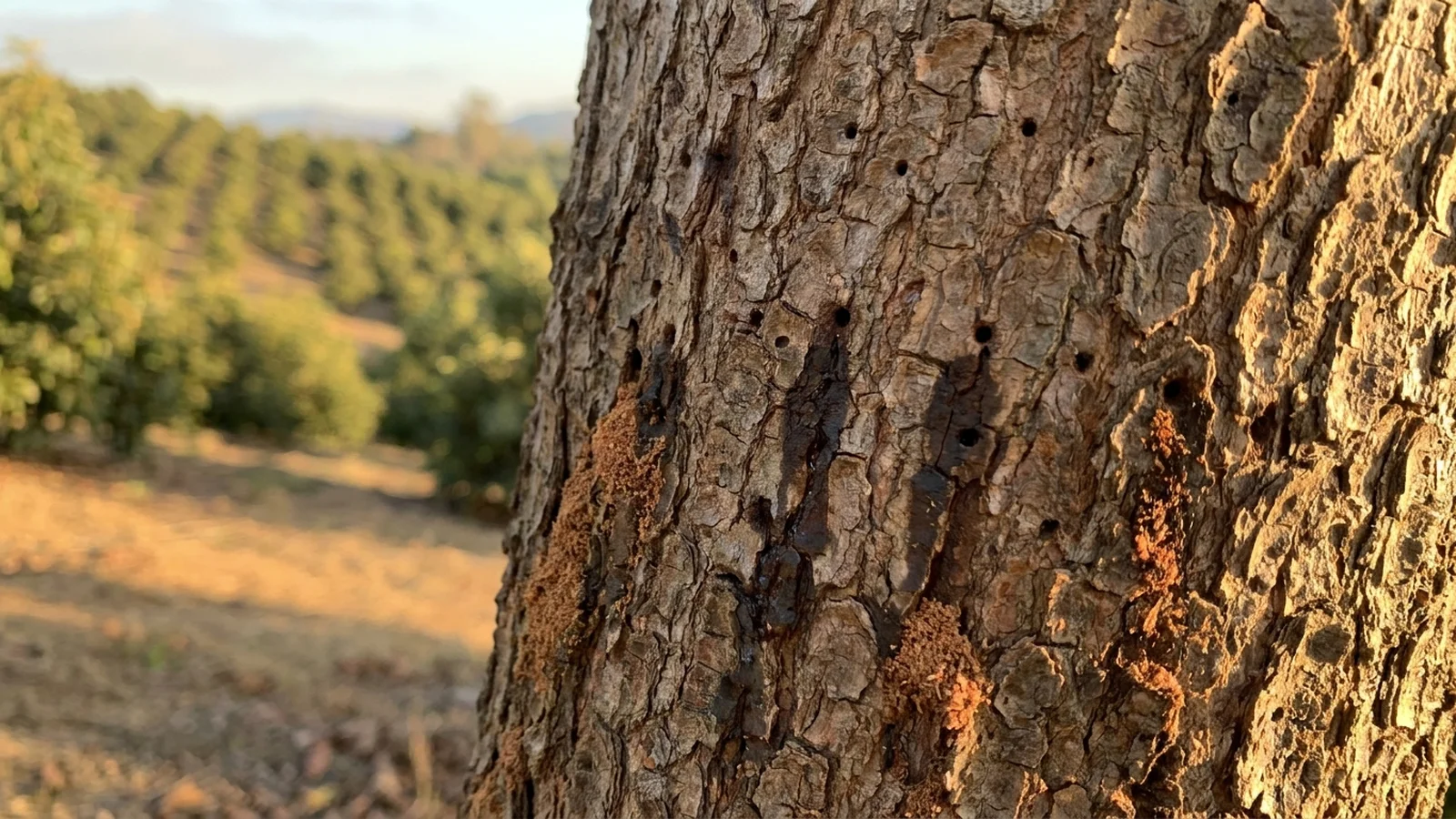
What is the shot hole borer?
Shot hole borer is the common name for two nearly identical invasive ambrosia beetles, the polyphagous shot hole borer (PSHB) and the Kuroshio shot hole borer (KSHB), first found in the Tijuana River Valley in the early 2000s and established across San Diego and Los Angeles counties since the early 2010s. The beetle itself is tiny, about the size of a sesame seed, and it doesn’t eat wood. It bores a tunnel into the trunk or a major limb and plants a fungus called Fusarium dieback inside the gallery, then farms that fungus as food for itself and its larvae.
The fungus is what actually kills the tree. It spreads through the sapwood and blocks the tissue that moves water and nutrients, the same basic mechanism that kills a palm with Fusarium wilt or an elm with Dutch elm disease. A tree can host thousands of these tunnels at once, and by the time the canopy shows obvious stress the vascular damage is usually already extensive.
San Diego County has an outsized stake in this pest because it’s the avocado capital of the country. Fallbrook and Valley Center carry most of the county’s working groves, and PSHB is a documented, ongoing threat to avocado production there, not a hypothetical one. For the broader picture of what’s stressing avocado trees in this region, our guide to why an avocado tree is dying in San Diego covers the other common causes side by side.
How do I know if it’s shot hole borer?
The entry holes are the giveaway, and they’re small enough that people miss them from a few feet away. Look closely at the trunk and major limbs, especially at branch unions and old pruning wounds.
| What you see | What it points to |
|---|---|
| Pinhole-sized entry holes (about the width of a pen tip), often in tight clusters | Shot hole borer, active infestation |
| Dark staining, gumming, or a wet-looking stain around the holes | Fusarium dieback spreading in the sapwood |
| Fine, sugar-like white crystals or sawdust-like frass at the hole | Beetle boring activity, common on avocado and box elder |
| Individual branches wilting or dying while the rest of the canopy looks fine | Localized vascular blockage from an isolated gallery cluster |
| Whole-canopy thinning and dieback from the top down over one to two seasons | Advanced, widespread infestation |
| One-sided browning with no entry holes present | More likely root stress, drought, or a different disease, not this pest |
If you’re seeing scattered branch dieback without clear holes, our common tree pests in San Diego guide walks through the other borers and sap-feeders that cause a similar look from a distance.
Which trees does it attack in San Diego?
Shot hole borer is unusually unpicky. Researchers have confirmed it reproduces in more than 60 tree species across Southern California, and it will test-bore into dozens more without necessarily breeding there. The hosts that matter most locally are:
- Avocado, the highest-stakes host in this county. An infested grove tree loses limbs and yield fast, and Fallbrook and Valley Center growers have been dealing with this pest directly since the mid-2010s.
- Coast live oak, already under pressure from the gold-spotted oak borer in the same canyons and hillsides. A tree can carry both pests at once.
- California sycamore and box elder, both common along seasonal drainages and older residential streets, and both frequent reproductive hosts.
- Willow, coral tree, and several maple species, planted widely as shade trees in older San Diego neighborhoods.
If you own avocado trees on a rural-residential parcel, this pest is worth checking for on a schedule, not just when something looks obviously wrong. Our tree health diagnosis service is built for exactly this, confirming what’s actually present before anyone recommends spending money on treatment or removal.
Can an infested tree be saved?
Sometimes, and it depends almost entirely on how early it’s caught and how many galleries are already established. A tree with a handful of isolated entry holes and no significant canopy dieback can sometimes be managed: pruning out and properly disposing of the infested limbs, then monitoring closely for new activity. Once the fungus has spread through a large share of the trunk’s vascular system, no fungicide or trunk injection reverses that damage, and the honest recommendation shifts to removal.
This is why a real diagnosis beats guessing. A certified arborist consultation can tell you within one visit whether a tree is in the manageable early stage or past the point where treatment helps. Waiting to find out usually means losing the option to manage it and being left with only the removal option.
When does an infested tree have to come out?
Remove it when any of these are true:
- Canopy dieback covers a significant share of the tree, not just one or two branches. At that point the vascular damage is too widespread to reverse.
- Entry holes are spread across the main trunk, not clustered on one limb you can prune out. Trunk-level infestation is the hardest to manage and the most likely to be terminal.
- The tree is a high-value grove avocado that’s stopped producing, since a heavily infested tree still acts as a breeding source for beetles that spread to healthy neighbors.
- A dead or dying tree sits near a structure, driveway, or another healthy tree, where dropped limbs or continued beetle spread create real risk.
Removing an infested tree properly matters as much as removing it at all. Shot hole borer spreads through infested wood, so material has to be chipped small or otherwise processed on site rather than hauled off whole, the same rule that applies to gold-spotted oak borer material. At Branch Pro San Diego, our crews handle infested-tree removal across the county’s grove and canyon properties, including the larger avocado and oak removals common in Fallbrook and Valley Center, and we process the wood correctly so the pest doesn’t spread to the next property. Our tree removal team can give a same-day estimate for grove and residential work alike.
How to protect healthy trees
There’s no spray that makes a tree immune, but a few habits lower the risk meaningfully.
- Check trunks and major limbs a few times a year, especially on avocado, oak, sycamore, and box elder. Catching a small cluster of holes early is the difference between pruning and removal.
- Never move firewood or green waste from an infested tree. The beetle and its fungus travel in the wood itself, which is how this pest has spread through the county as fast as it has.
- Keep trees watered and unstressed. Drought-stressed trees are more attractive to boring beetles and recover from damage more slowly.
- Have grove and high-value ornamental trees checked on a schedule, not just when something looks wrong. Fallbrook and Valley Center growers who catch isolated infestations early have the best odds of keeping the rest of a grove clean.
Branch dieback and canopy thinning are also two of the clearest signs a tree is dying that a homeowner can spot without climbing a ladder, and with this pest, catching it while it’s still isolated is what keeps the tree in play as an option.
Frequently asked questions
What does shot hole borer actually do to a tree?
The beetle bores a tunnel into the trunk or a limb and introduces a fungus called Fusarium dieback, which it farms as food. The fungus, not the beetle itself, does the real damage by spreading through the sapwood and blocking the tree’s water and nutrient flow, eventually killing the branch or the whole tree.
What’s the first sign of a shot hole borer infestation?
Small, pinhole-sized entry holes on the trunk or major limbs, often clustered together and marked by dark staining, gumming, or fine sawdust-like frass. Individual branches may wilt or die back while the rest of the canopy still looks normal.
Can a tree recover from shot hole borer?
Sometimes, if it’s caught while only a few isolated galleries exist and before significant canopy dieback sets in. Pruning out infested limbs and monitoring closely can work at that stage. Once the fungus has spread through a large share of the trunk, no treatment reverses it and removal becomes the safe option.
Why does San Diego County care about this pest more than most places?
San Diego County, especially Fallbrook and Valley Center, produces the majority of California’s avocado crop, and shot hole borer is a direct, documented threat to that industry. The same pest also attacks coast live oaks and sycamores that are common across the county’s canyons and older neighborhoods.
What should I do if I find entry holes on my tree?
Call (858) 400-4423 for a diagnosis before doing any pruning yourself. Cutting into an infested tree without knowing the extent of the damage can spread the pest to healthy wood, and a professional can tell you within one visit whether the tree is still manageable or needs to come out.