Spider webs in trees almost always come from one of three sources: spider mites, webworms, or ordinary orb weaver spiders. Only the first two hurt the tree. Fine, dusty webbing on leaves and needles points to spider mites. Thick silk nests wrapped around whole branch tips point to webworms or tent caterpillars. A classic round web strung between branches is just a spider, and it’s actually good for your tree.
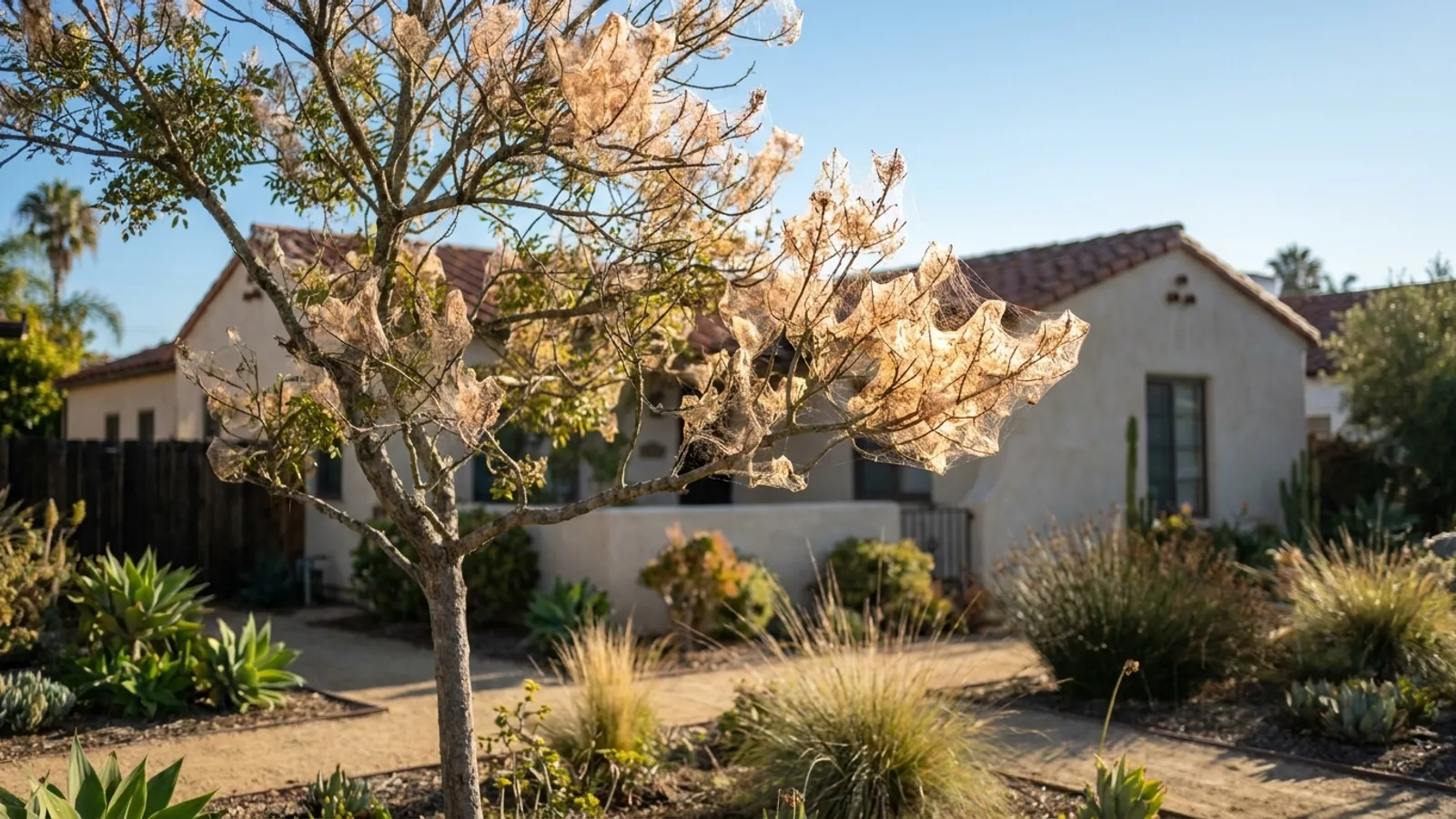
What causes spider webs in trees in San Diego?
Three culprits make webs in San Diego trees, and each one looks different up close. San Diego’s long, dry season matters here. Heat, dust, and drought stress push spider mite populations up fast, especially on inland and canyon lots. Webworms show up in late summer and fall, and orb weaver spiders peak at the same time of year.
| What the web looks like | Where it sits | Culprit | Risk to the tree |
|---|---|---|---|
| Fine, dusty sheeting over leaves or needles | Undersides of leaves, between twigs | Spider mites | Real. Stippled, bronzed leaves and early leaf drop |
| Dense silk nest enclosing a whole branch tip | Branch ends and forks | Webworms or tent caterpillars | Moderate. Chewed leaves, ugly nests, rarely fatal |
| Round, wheel-shaped web between branches | Open gaps in the canopy | Orb weaver spider | None. It’s eating the pests for you |
If the webbing comes with sticky leaves or black film, you may be looking at a different problem. That combination points to aphids or scale, which we cover in our guide to black sooty mold on tree leaves.
Spider mites: the webbing that actually hurts trees
Spider mites are tiny arachnids that thrive in exactly the conditions San Diego serves up all summer: heat, dust, and dry, water-stressed trees. They pierce leaf cells and drain them, leaving tiny light dots called stippling. Heavy infestations wrap leaves and needles in fine, dusty webbing and turn the canopy yellow or bronze.
Pines, cypress, and fruit trees are common targets here. The quick test takes ten seconds. Hold a sheet of white paper under a branch and tap it hard. If tiny specks start crawling, you have mites.
Two things make mites worse in San Diego yards. Dusty conditions near canyons, dirt roads, and construction favor mites over the insects that eat them. And a drought-stressed tree has weaker defenses, so a tree that’s already struggling gets hit hardest. If your tree is showing bigger warning signs than webbing, run through the signs your tree is dying before treating for mites alone.
Webworms and tent caterpillars: the thick silk nests
Fall webworms build dense silk nests over the ends of branches in late summer and fall, and they feed on the leaves inside the nest. In San Diego they favor fruit trees, mulberry, ash, and liquidambar. Tent caterpillars do something similar in spring, building their tents in branch forks instead of at the tips.
The nests look alarming, but on a mature, healthy tree they’re mostly cosmetic. The caterpillars eat leaves, the tree pushes new ones, and the tree moves on. Small trees, young trees, and trees already stressed by drought or disease are the exception. Losing a big share of their leaves in one season sets them back.
The right response is usually simple. Prune out the webbed branch tips while the nest is small and dispose of them. For nests you can’t reach, a pro can treat the tree or prune it out safely. Never try to burn a web out of a tree. It’s a real fire hazard in a county built around defensible space rules, and the flame does more damage to the branch than the caterpillars ever would.
Orb weavers: the harmless webs of fall
If the web is round, symmetrical, and strung across an open gap between branches, it’s an orb weaver spider. San Diego sees a wave of them from late summer through fall, which is why big webs seem to appear everywhere at once. They don’t feed on the tree at all. They catch flies, moths, and other insects, including some of the pests that do hurt your trees.
Leave these webs alone, or knock them down with a broom if they’re across a walkway. There’s nothing to treat and nothing to spray.
How do you get rid of webs in trees?
Match the fix to the culprit, and start with the gentlest option that works.
- Blast mites off with water. A hard spray from the hose, aimed at the undersides of leaves every few days, knocks spider mite numbers down and washes off the dust they love.
- Keep the tree watered and the dust down. Deep watering during dry months is the single best mite prevention on inland lots.
- Prune out webworm nests. Clip webbed branch tips while nests are small, bag them, and put them in the green bin.
- Use horticultural oil or insecticidal soap. Both control mites and young caterpillars, cost under $30 at a garden center, and spare the beneficial insects that broad sprays kill.
- Bring in a pro for big or repeat infestations. Professional tree spraying in San Diego runs $150 to $600 per treatment for most yard trees, and the right product choice matters more than the spraying itself.
Skip the broad-spectrum insecticides from the big box store. They kill the predatory mites and insects that keep spider mites in check, which is why trees often look worse the summer after a DIY spray.
When should you call a professional?
Call a pro when the tree is too tall to treat from the ground, when webbing comes back year after year, or when the canopy is visibly thinning. At that point the webs are a symptom, and the real question is what’s stressing the tree underneath. A proper tree health diagnosis identifies the pest, the stress driving it, and whether treatment or tree pruning is the right move. If you just want an expert set of eyes before spending anything, an arborist consultation is the cheaper first step.
At Branch Pro San Diego, we connect homeowners with tree crews across all of San Diego County, from coastal yards in Rancho Santa Fe to dusty inland lots in Escondido where mite pressure runs highest. For the full rundown of what else might be chewing on your trees, see our guide to common tree pests in San Diego.
Frequently asked questions
Are spider webs in a tree bad for the tree?
Usually not. Round webs from orb weaver spiders are harmless and even helpful, since the spiders eat insect pests. The webs to act on are fine, dusty webbing over leaves, which means spider mites, and thick silk nests around branch tips, which mean webworms or tent caterpillars.
What are the webs all over my tree in late summer?
In San Diego, late summer webs are usually either fall webworm nests or orb weaver spiders, and the shape tells you which. Webworm nests are dense silk bags enclosing branch tips with chewed leaves inside. Orb weaver webs are open, wheel-shaped, and strung between branches with a single spider at the center.
Do webworms kill trees?
Almost never. A healthy, mature tree can lose a surprising amount of leaf to webworms and recover fully the next season. The exceptions are young trees, small ornamentals, and trees already stressed by drought or disease, where heavy defoliation does real harm and treatment is worth it.
Should I remove spider webs from my tree?
Remove webworm nests by pruning out the webbed branch tips while they’re small. Knock down mite webbing with a strong spray of water, then treat with horticultural oil if it returns. Leave round orb weaver webs alone, and never use fire to clear any web out of a tree.
How much does it cost to treat webs in trees in San Diego?
DIY control is cheap: water sprays are free and horticultural oil costs under $30. Professional tree spraying in San Diego runs $150 to $600 per treatment for most yard trees, depending on tree size and product. Repeat infestations sometimes need two treatments timed a few weeks apart.
Not sure which web you’re looking at? Call (858) 400-4423 for a free estimate anywhere in San Diego County. The crews in the Branch Pro network will tell you straight whether the webs are mites, webworms, or just a busy spider, and what treatment is worth paying for, if any.