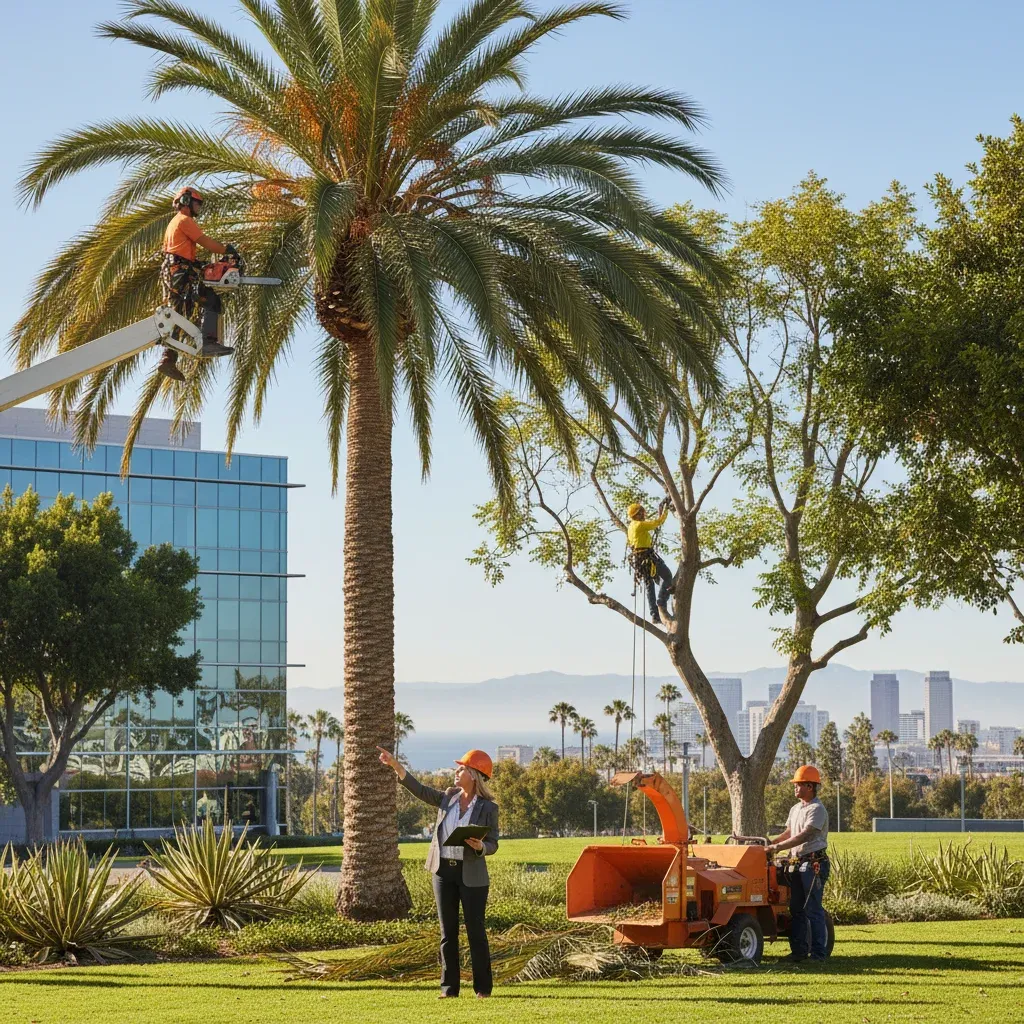
Commercial tree pruning and maintenance for property managers: what to budget and expect

If you manage a multi-unit property, shopping center, or office park in San Diego, trees are part of your liability and your curb appeal. But commercial tree maintenance is different from residential. You’re managing dozens or hundreds of trees across parking lots, pedestrian paths, rooftops, and setbacks. You need a predictable schedule, clear accountability, and crews that understand hazard liability the way property managers do.
This guide walks you through the real costs, timing, and decision points for commercial tree maintenance in San Diego.
Why commercial tree maintenance isn’t optional — it’s risk management
A neglected tree doesn’t stay neglected forever. It either gets pruned, or it gets removed after it damages a car, blocks a sight line, or drops a limb on a tenant.
From a property manager’s standpoint, tree maintenance is preventive. The cost of one emergency removal ($1,500 to $4,000) is often higher than three years of regular pruning ($300 to $600 per tree annually).
Insurance also matters. Most commercial liability policies specifically exclude tree damage caused by lack of maintenance. If a branch drops from a tree your property neglected, the liability is yours, not the insurance carrier’s.
When to prune: the San Diego commercial tree maintenance calendar
San Diego has a long growing season, so “winter dormancy” looks different here than back east. Most tree work happens in fall and early spring, but the real schedule depends on the tree type and your tenants’ tolerance for disruption.
August through October. Late summer is peak pruning season in San Diego. Trees have recovered from summer heat stress, and you’re ahead of Santa Ana wind season (late October through April). Deadwood removal before wind season is the single highest-priority maintenance task — falling branches hit cars and power lines every Santa Ana season.
November through February. Winter is ideal for heavy structural pruning. Most deciduous trees are fully dormant, and tenants are less disrupted by crews on property. This is also the best window for large removals and stump grinding.
March through May. Spring brings new growth, so light shaping and minor deadwood removal is fine. Avoid heavy pruning — you’ll trigger a flush of weak new growth right into the dry season.
June and July. Minimal maintenance. Most commercial properties hold off during peak heat to avoid stress-pruning trees. Emergencies (obviously) are handled anytime.
Who’s responsible for what: service agreements that actually work
The best commercial tree maintenance programs have clear lines of responsibility. “Tree service” can mean a lot of things, so specify in writing.
Routine annual pruning (what most properties need): Light canopy thinning, deadwood removal, clearance from roofs and power lines, and a final cleanup. Budget $300 to $750 per tree per year depending on tree size and growth rate.
- Small trees (under 25 feet): $300 to $400/year
- Medium trees (25 to 40 feet): $400 to $600/year
- Large/specimen trees (over 40 feet): $600 to $1,000/year
Emergency and reactive work (things that pop up): A tree drops a limb, a branch is overhead power lines, or roots are lifting hardscape. Emergency work costs more because crews respond on short notice. Budget $500 to $2,000 for a single emergency.
Stump removal (after a tree comes down): $125 to $350 per stump depending on size and ground conditions. Many properties defer this — a stump takes up space but costs less than active maintenance.
Hazard identification: what property managers look for
You don’t need to be a certified arborist to spot problems. These are the red flags that trigger maintenance calls.
Deadwood visible in the canopy. Any branch that’s gray, obviously brittle, or leafless is a hazard, especially before wind season. One removal call now beats an emergency removal after a storm.
Large branches overhanging parking areas or walkways. Even healthy branches fall sometimes. Clearance pruning keeps them off roofs, car windshields, and pedestrian zones.
Cracked or split trunk. A tree with a visible crack is unstable. Some can be braced with cables, but most eventually come out. Consult an arborist.
Leaning trunk. If a tree leans noticeably more than it did a year ago, roots may be failing. Document the angle (photos work) and get it evaluated.
Visible root damage to hardscape. Roots lifting a parking lot or sidewalk aren’t going to fix themselves. You can install a root barrier, replace the hardscape, or remove the tree — each has a cost-benefit calculus that an arborist can explain.
Insect or disease signs. Shot hole borer damage (small, dark holes in the trunk), bark peeling, premature leaf drop, or branch dieback in spring are all signs of pest or disease pressure. Catching it early sometimes saves the tree; waiting guarantees removal.
Budgeting for the full cycle: what a real commercial maintenance program costs
Here’s a realistic budget for a medium-sized property with, say, 30 trees.
Annual routine maintenance: 30 trees × $500 average per tree per year = $15,000.
This covers pruning, deadwood removal, clearance work, and cleanup three to four times per year (or one major seasonal pass, depending on the service agreement).
Emergency/contingency budget: Set aside 20 to 30 percent of routine costs = $3,000 to $4,500 per year.
Most years you won’t spend it. But one ice storm or wind event can demand $5,000 in emergency limb removal.
Planned removals: Every 7 to 10 years, one or two trees on a 30-tree property will need removal. Budget $2,000 to $5,000 per removal cycle (depending on tree size and access).
Stump grinding: $1,500 to $2,000 if you grind all stumps; less if you defer some.
Real-world total: $20,000 to $25,000 annually for a medium property. For larger properties, the per-tree cost drops slightly due to economies of scale; for very small properties, it’s higher.
Service frequency: how often does a tree actually need pruning?
This is where property managers save money or waste it.
Most healthy hardwoods benefit from annual or biennial pruning — a light shaping and deadwood pass keeps them tidy and safe without triggering aggressive regrowth.
Fast-growing species like pepper trees, elms, and acacias need attention every 12 to 18 months or they’ll shade out parking areas and touch power lines.
Palm trees (common in San Diego courtyards) vary wildly: Queen palms need pruning yearly; Mexican fan palms every other year; Canary Island dates can go 3+ years between pruning.
The trap: skipping maintenance for three years, then hiring someone for an expensive “bring it back” job that shocks the tree, followed by boom regrowth and another overgrowth cycle two years later. Annual or biennial maintenance keeps trees stable and costs less in the long run.
Red flags: when to call an arborist (not just a pruning service)
Most tree work is straightforward pruning. But some situations need an arborist’s diagnosis before you commit to removal, bracing, or other big-ticket work.
Cable bracing. If a tree has co-dominant trunks that could split or branches that could fail under weight, cables or bracing can sometimes stabilize it. Costs $500 to $2,000 per tree, and requires professional installation. Without an arborist’s evaluation, you’re guessing whether it’ll work.
Disease or pest management. If your trees have bark beetle damage, shot hole, sooty mold, or canker disease, you need treatment recommendations. Some issues can be managed with pruning and care; others mean removal. An arborist’s report ($300 to $600) tells you which.
Protected or Heritage Trees. In San Diego, certain tree species and sizes require city permits or arborist reports before work. The City of San Diego regulates Heritage Trees; some HOAs have their own protections. An arborist knows the rules.
The partnership: what to expect from a good commercial tree service
Here’s what a professional commercial tree service should deliver.
A written scope of work and pricing. Not a generic estimate, but a specific plan: how many trees, what pruning work per tree, and whether deadwood removal, cleanup, and other services are included.
Insurance certificates. Before crews set foot on the property, you should have a certificate showing general liability and workers’ comp. If a crew can’t provide one, don’t hire them.
Scheduling that minimizes disruption. Most commercial work can happen early morning, weekends, or off-peak seasons. Good contractors build that into the bid.
Photo documentation. Before and after photos aren’t glamorous, but they prove the work was done and give you a record if tenants complain or insurance questions arise.
Follow-up communication. After the job, a summary of what was done, anything that came up during the work (a hazard that needs follow-up, for example), and recommendations for the next maintenance cycle.
Questions for your tree contractor before you hire
Have you done work on multi-unit properties or HOAs before? Commercial sites have different expectations around scheduling, insurance, and liability. Contractors with that experience move faster and know the rules.
Can you provide references from other property managers? Residential customers have different needs. You want someone who understands the property manager’s perspective.
What’s included in your routine pruning price? Clarify: Does it cover cleanup? Chip disposal? If the crew finds a dead branch they didn’t expect, is that extra? These details add up.
What’s your policy if a tree gets damaged during pruning? If a contractor’s saw slips and scars the trunk, or if pruning triggers unexpected insect activity, who pays to fix it? Good contractors carry insurance for this; they should tell you upfront.
How long between pruning and final cleanup? Some crews leave and come back for debris removal days later. Others chip and haul on the same day. Which is it?
Frequently asked questions
How much does it cost to remove a tree at a commercial property?
Tree removal runs $1,500 to $4,000 depending on tree size, access, and proximity to structures. A large tree in a tight parking lot costs more than an open-lot removal. Stump grinding ($125 to $350) is usually a separate line item. Get a written quote before work starts.
Can I negotiate a discount for multiple trees?
Yes. If you have 10+ trees on a property, most contractors will give you a discount on the per-tree rate. The discount is usually 10 to 20 percent. Make sure it’s in writing.
Do I need an arborist’s report for insurance purposes?
Not automatically, but if an accident happens — a branch falls, a tree fails — insurance will investigate. Having annual arborist reports or documented maintenance creates a record of due diligence. That protects the property manager’s liability.
What happens if a tree dies after pruning?
Trees rarely die from proper pruning. But if a contractor over-prunes, or if a tree was already stressed before the work, it can decline post-pruning. Get a guarantee in writing: most reputable contractors will guarantee their work for 30 days and address problems that arise from their pruning.
Should I remove all trees to reduce maintenance?
Only if the property has no aesthetic or environmental value to preserve. Trees add property value, reduce heat island effect, and increase tenant satisfaction. One hazard tree is worth removing; removing all trees to save money usually costs more in the long run through reduced property value and increased runoff management.
If your San Diego property’s trees have been neglected, or if you’re setting up a maintenance program for the first time, a single consultation with an arborist or certified tree service can save thousands in reactive emergency costs. Most inspections are free, and a professional can walk the property, show you priorities, and give you a realistic budget for the year ahead.
Call (858) 400-4423 to schedule a free commercial tree maintenance evaluation. We’ll document what you’ve got, flag anything urgent, and give you a maintenance plan that works for property managers who manage to a budget.