A hanging brown frond over a Clairemont driveway is a trimming job. A thick Mexican fan skirt in Chula Vista is a cleaning job. Palm tree cleaning is trunk, boot, and debris work. A palm tree trim is the frond cut, and often the flower or fruit stalks. They are not the same scope.
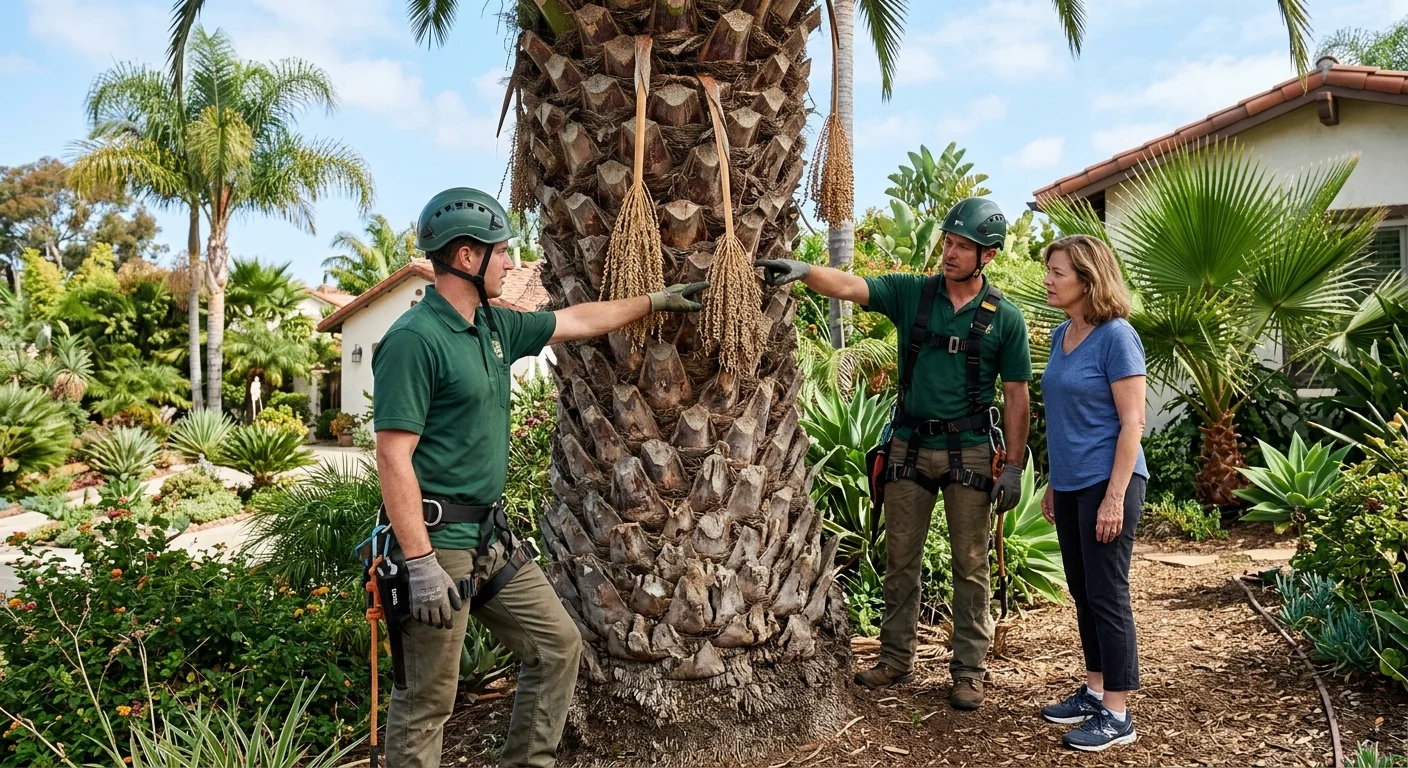
Cleaning, skinning, and frond trimming in plain words
In San Diego yards, people say “clean the palms” when they mean three different things. Frond trimming is the canopy work: dead or dying leaves, and sometimes flower or fruit clusters over a walk, pool, or roof. The International Society of Arboriculture describes that as normal palm pruning. Keep healthy foliage. Limited live-frond cuts for clearance can be part of a trim. A few upright leaves left at the top is over-pruning.
Cleaning is the extra material around the trunk and the drop zone: spent stalks, loose fiber, hanging fruit, and debris at the base. Queen palms are not self-cleaning. Dead leaves stay until someone cuts them. A king palm with a crownshaft sheds old leaves on its own. That drop still has to be managed on a patio in Mission Beach or Coronado.
Skinning, or shaving, strips old leaf bases off the trunk. Those bases are the boots. UC palm-disease guidance treats pineapple sculpting and trunk skinning as wounds that do not close. Climbing spikes permanently wound palm trunks too.
A written palm tree service quote should split that work. A trim can leave boots. Cleaning can leave a full green crown. Skinning is a separate choice, usually about looks, not a proven health treatment. Branch Pro San Diego matches you with licensed, insured independent tree companies. Those companies do the cuts. For contracts of $1,000 or more, look for a C-49 Tree and Palm Contractor license or an active legacy C-61/D-49 on the CSLB license lookup.
What boots, flower stalks, and dropped fronds each suggest
Boots are old leaf bases still attached to the trunk. Mexican fan palms often keep a dense skirt. That skirt is a fire and drop issue, not a reason to shave the trunk smooth. Cal-IPC notes that dead fronds on this species can create a fire hazard. If the palm sits near a house in East County or on a canyon lot, ask the local fire authority what they want cleared. A skinned trunk is not defensible space by itself. Start with CAL FIRE, then confirm the address.
Flower and fruit stalks are a separate line item. ISA treats clusters as a site-risk item. Removing them does not starve the palm. Queen palms drop messy orange fruit on walks in Mission Valley and Pacific Beach. Canary Island date palms set heavy clusters. You can take the stalks and still leave a full green crown.
Dropped fronds are a third signal. Ordinary shedding is common. A sudden pile, or a green frond that failed, needs a ground-level look. See palm fronds dropping in San Diego. One-sided brown on a Canary Island date palm is not a home diagnosis. It can be Fusarium wilt, petiole blight, or something else. South American palm weevil is established in San Diego County and kills that species. Report suspected weevils to the county agricultural commissioner. Do not move infested material as ordinary green waste.
If fronds keep hitting a roof in San Diego, name the material and who owns the palm. City of San Diego street-tree work needs a no-fee permit after City inspection. A private crew’s availability does not authorize a City palm.
How coastal salt and inland heat change the discussion
Coastal palms from Imperial Beach through Coronado, Ocean Beach, and La Jolla take salt spray and marine layer. UC IPM describes salt injury from sea spray or saline sprinkler water as tip and margin browning. It can sit heavier on the ocean-facing side. That browning is not a cleaning problem. Skinning the trunk will not green the crown. Cutting every off-color leaf can strip foliage the palm still uses.
Inland heat in El Cajon, Escondido, Ramona, and parts of Rancho Bernardo is a water problem first. Hot, dry air raises demand. Overwatering and drought can look similar from the street: off-color leaves, a thin crown, litter on the ground. UC IPM says those patterns overlap. Check soil moisture and drainage before anyone writes “clean it up” as the fix.
Queen palms along older inland streets often show yellow older fronds. UF/IFAS notes that partly living queen-palm leaves can still supply potassium. Cutting them for a tidy photo can hide the clue a diagnostic visit needs. Pygmy date palms, one of the most common trees in the City of San Diego’s 2017 urban-forest inventory, stay small. Cleaning talk on those is usually old fronds and fruit, not a 40-foot climb.
Santa Ana winds change the drop risk, not the pruning rule. A heavy Mexican fan skirt over a Santee walk is a real hazard in an east wind. A hurricane cut is still over-pruning. Aggressive high cuts can slow growth and attract pests. Leave fertilizer recipes and Epsom-salt doses out of a cleaning quote. No verified San Diego rate belongs there.
When appearance is not enough to choose the work
A skinned, pineapple-cut palm photographs well from the curb. That look is not a health plan. UC’s landscape palm-disease guide treats skinning and sculpting leaf bases as wounds that never close. Fusarium wilt of Canary Island date palms has no cure. Contaminated tools and debris spread it. A green crown does not rule out hidden trunk decay. Sudden crown drop can happen with a green canopy. Stay on the ground. Do not tap, probe, or climb a suspect palm.
Appearance also fails when the palm is the wrong legal tree. A parkway palm in the City of San Diego is a City process. Other cities and County land use their own rules. If you cannot confirm the rule for your address, ask that city’s Planning or Public Works, or County PDS if you are unincorporated. We could not confirm a countywide HOA rule that palms must be skinned. Get the guideline in writing from the association.
Do not cut the top off a palm to shorten it. Palms have one terminal bud. Destroy that growing point and the palm does not push a new leader. Climbing spikes permanently wound a living trunk.
If the palm is near overhead lines, stop. Call SDG&E at 1-800-411-7343 for line conflicts. For a downed line, stay away and call 911 and SDG&E. Ordinary tree trimming crews are not line-clearance electricians unless the utility and the company say so in writing.
Yellow leaves belong in a diagnosis conversation, not a cleaning upsell. For cut-by-cut limits, see how to prune a palm tree in San Diego. This page stays on what you are buying and what stays on the tree.
What belongs in a written palm-care scope
Ask for the species on the page: queen, Mexican fan, Canary Island date, pygmy date, king, or unknown, confirm on site. Ground photos help. The quote should list, in plain words, the dead or dying fronds to remove and the living fronds to keep. It should say yes or no on flower and fruit stalks. It should say what happens to boots and fiber: leave them, reduce the hanging skirt, or full skinning. It should cover debris haul-off, including fruit and old fronds.
The same page should bar climbing spikes on living palms. It should require tool cleaning between palms, especially any Canary Island date palm. It should name access, the drop zone, and what sits under the crown: pool, tile roof, cars, play set. It should state private yard versus street tree versus HOA common area, and who obtains any City or association approval.
Price depends on height, access, and that list, so it is not in this article. Job length is the provider’s call after they see the site. Branch Pro does not set fees or send a crew.
If the independent company proposes skinning, ask why. Looks is an honest answer. Disease prevention is not a claim we can support from approved sources. A hurricane cut is over-pruning. Fertilizer, Epsom salt, or a spray is a separate pest-control question. A C-49 is not a Department of Pesticide Regulation pest-control business license. Keep the written scope tight enough that a second company could bid the same work. That is how you compare a cleaning visit to a trim without buying both by accident.
Frequently asked questions
How do I make a palm tree green again?
You don’t green a palm by stripping yellow leaves or skinning the trunk. Living and partly living fronds still feed the plant. Off-color foliage can be salt, water, nutrient stress, or disease. A Canary Island date palm with one-sided death needs a qualified look, not a cosmetic clean. Keep people away from a palm that looks unstable.
How much Epsom salt should I put on a palm tree?
No verified San Diego dose is in our claims ledger, so we will not invent one. Hardware-store Epsom salt is not a confirmed fix for a yellow queen palm. Ask the company how they would test or treat, and whether a pest-control license even applies. Do not cut the yellow leaves just to hide the symptom.
Can I cut the top off my palm tree?
No. The growing point sits in the crown. Cut that out and the palm cannot replace it. Height control on a tall Mexican fan or Canary Island date is a removal-and-replace decision, not a topping cut.
What should I not do to a palm tree?
Don’t use spikes on a living trunk. Don’t hurricane-cut the crown. Don’t skin or pineapple-cut leaf bases as a health treatment. Don’t work near energized lines. Don’t treat a City street palm as your private tree. Don’t assume a green crown means the trunk is sound.
When to call us
Call when the palm hangs over a roof, walk, or wires, or when cleaning and trimming are sold as one vague visit. A licensed independent tree company should write the scope before anyone climbs. Call us at (858) 400-4423 and we’ll connect you with a licensed local tree company.