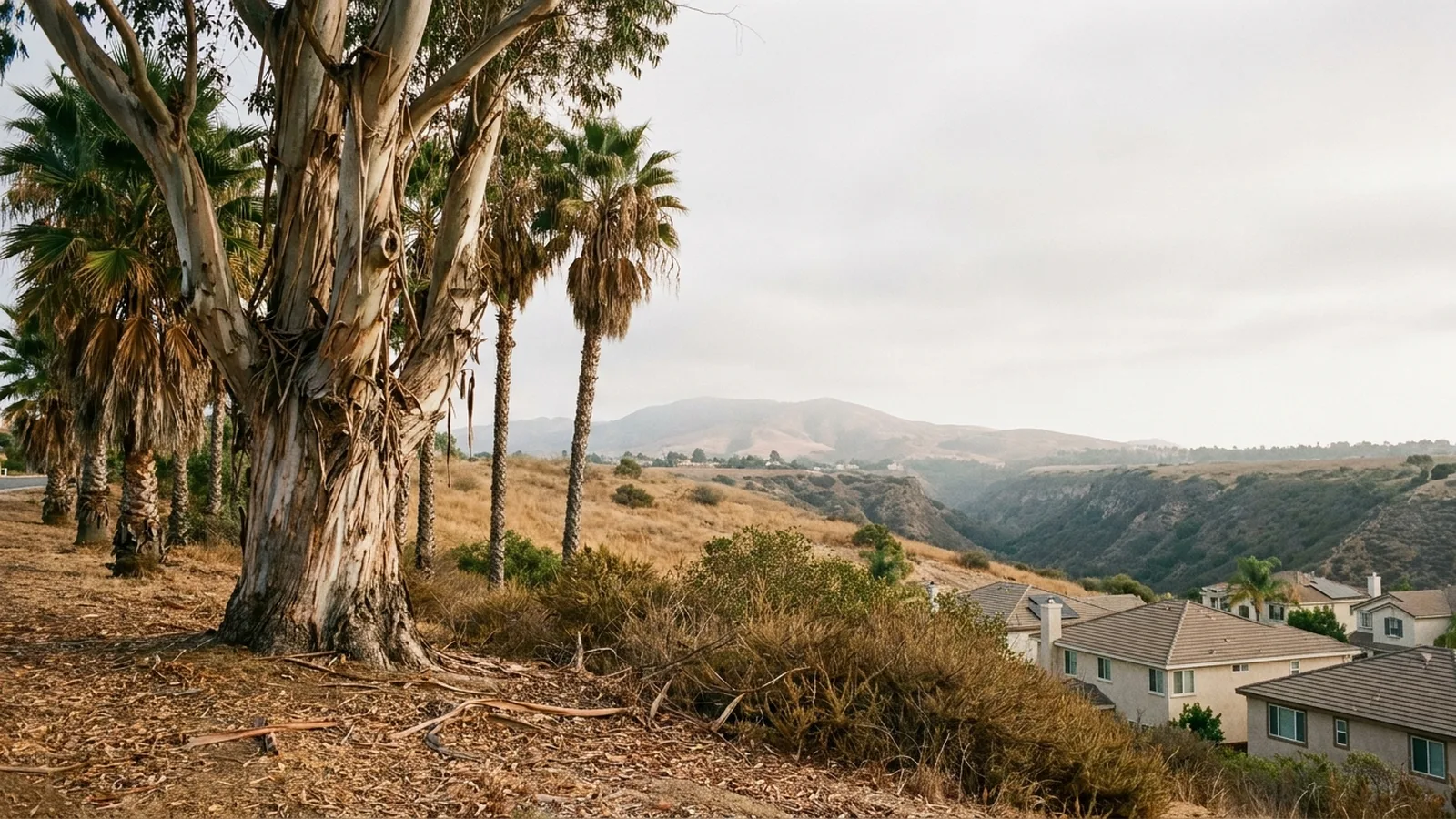
Blue gum, Mexican fan palm, tree-of-heaven, saltcedar, Brazilian pepper, and black locust can all raise invasive-tree concerns in San Diego. Their impact ratings differ, and none belongs on an automatic removal list. First confirm the species, its location, and the problem it creates.
The California Invasive Plant Council inventory rates current ecological impact as High, Moderate, or Limited. Watch is different. It identifies plants at high risk of becoming invasive in the future, not plants with a current ecological-impact rating. These classifications don’t rank wind danger or order property owners to remove a tree. They help separate ecological spread from ordinary mess, maintenance, or a site-specific safety concern.
Species comparison
| Species | Ecological impact and spread | Useful next step |
|---|---|---|
| Blue gum eucalyptus (Eucalyptus globulus) | Cal-IPC rates blue gum Limited. It has escaped cultivation along much of California’s coast and can affect habitat and fire conditions. | Confirm the species and assess the individual tree before considering pruning or removal. |
| Mexican fan palm (Washingtonia robusta) | Cal-IPC rates Mexican fan palm Moderate with an Alert designation. It can establish in waterways and other moist areas, while retained dead fronds can create a fire hazard. | Distinguish it from California fan palm and hybrids, then address dead material, spread, and site conditions. |
| Tree-of-heaven (Ailanthus altissima) | Cal-IPC rates tree-of-heaven Moderate. It spreads through seeds, creeping roots, and suckers, and can suppress nearby vegetation. | Include root response and follow-up growth in any control plan. |
| Saltcedar (Tamarix ramosissima) | Cal-IPC rates saltcedar High. It occurs along streams and lakes and can change soil chemistry, water availability, habitat, and fire frequency. Other Tamarix species have different ratings. | Confirm the exact species and the rules for work near waterways or habitat. |
| Brazilian pepper (Schinus terebinthifolius) | Cal-IPC rates Brazilian pepper Moderate with an Alert designation. It can spread in watered areas, waterways, canyons, and roadsides along parts of Southern California’s coast. | Plan for seedlings and later follow-up, not only removal of the main stem. |
| Black locust (Robinia pseudoacacia) | Cal-IPC rates black locust Limited. Root sprouts and seedlings can form stands that displace native growth. | Ask how stump work and new sprouts will be handled. |
Invasive versus just messy
A non-native tree isn’t automatically invasive. Heavy litter, unwanted shade, or frequent pruning needs don’t establish ecological spread. Cal-IPC’s inventory is science-based, but Cal-IPC has no regulatory authority. Its listing doesn’t replace an inspection, a local permit check, or an assessment of the tree’s actual condition.
Location matters too. A volunteer palm beside a drainage channel presents a different question from a maintained palm in a paved courtyard. A saltcedar near water calls for different planning than a blue gum in a private inland yard. Record where seedlings or suckers appear, what lies beneath the canopy, and whether the tree stands in a right-of-way, drainage, easement, or protected area.
Is California pepper the same as Brazilian pepper?
No. California pepper (Schinus molle) and Brazilian pepper (Schinus terebinthifolius) are different species. Despite its common name, California pepper comes from South America. It has narrow compound leaflets and can escape cultivation into dry washes.
That doesn’t make every California pepper a removal candidate. Use its botanical name when requesting an assessment. Fruit, leaves, bark, and growth around the parent tree can help distinguish the two peppers.
What to do if you have one
Start with identification. Take clear ground-level photos of leaves, bark, fruit, flowers, seedlings, and the whole tree. Include the trunk base and any shoots emerging away from it. An arborist consultation referral can connect you with an independent professional, but ask that person to record the botanical name and the features supporting it.
Next, confirm who controls the location. Invasive status doesn’t cancel local rules. Within the City of San Diego, street-tree trimming, removal, planting, and root pruning follow a City inspection and no-fee permit process described by the Urban Forestry maintenance program. Other county cities use different processes. Check the parcel jurisdiction, tree ownership, right-of-way, easements, and project conditions through our tree-removal permit guide.
Also check for active nests before vegetation work. California wildlife guidance says many species typically nest from February through August, while nesting can occur outside that period. When birds may be nesting, CDFW recommends a consulting biologist’s pre-work survey. A biologist may set a protective buffer, or work can wait until nesting is complete.
Why root follow-up belongs in the quote
Removing the visible trunk may not control a species that spreads underground. Penn State Extension explains that cutting tree-of-heaven alone can stimulate stump and root sprouts. Black locust also spreads through root sprouts and seedlings.
Ask the independent professional to define:
- Whether the goal is removal, containment, or monitoring
- How the stump and accessible roots will be treated
- Who handles chips, fill, and final grade
- How new seedlings or suckers will be identified
- What follow-up is included, if any
- Which product label and legal requirements apply if chemical control is proposed
Stump grinding isn’t proof that every root has been controlled. The right approach depends on the species, surrounding plants, access, utilities, and the property’s next use. Our stump-regrowth guide explains the questions to settle before work begins.
How fire and utility conditions change the decision
Fire-related concerns are species-specific. Cal-IPC identifies fire effects for blue gum, a dead-frond hazard for Mexican fan palm, and changed fire frequency around saltcedar habitat. Those findings don’t prove that every specimen poses the same risk.
Check the tree’s distance from structures, accumulated dead material, access, and applicable fire-authority requirements. Our defensible-space guide explains how to verify the rules for the actual address.
Keep away from trees or palms touching power lines. SDG&E decides whether lines must be de-energized, covered, or moved before work. Use our guide to trees near power lines for the correct reporting path.
What should replace a removed invasive tree?
Match the replacement to the available space, water, soil drainage, mature canopy, roots, and nearby structures. A native label alone doesn’t prove that a tree fits every yard or fire plan. Our guide to drought-tolerant trees for San Diego can help you compare candidates after the site constraints are clear.
Avoid planting directly into an unprepared stump area. Remaining roots, wood, altered soil, and settlement can affect what succeeds there. Agree on cleanup, fill, and final grade before choosing the planting location.
Frequently asked questions
What is the most invasive tree in San Diego?
Cal-IPC uses High, Moderate, and Limited ratings for current ecological impact across California. Watch identifies future invasion risk, not current impact. Saltcedar Tamarix ramosissima has a High rating. Mexican fan palm, tree-of-heaven, and Brazilian pepper have Moderate ratings. Blue gum and black locust have Limited ratings. Those ratings don’t determine the condition or danger of a tree at one address, so removal still requires a site-specific assessment.
Do I need a permit to remove an invasive tree in San Diego?
Possibly. The answer depends on the parcel jurisdiction, ownership, tree location, protected status, and project conditions. A Cal-IPC listing isn’t a permit exemption. Confirm the address and tree category with the city or County department that controls the parcel before scheduling removal.
Is California pepper invasive?
California pepper can escape cultivation and naturalize in dry washes, but it isn’t the same species as Brazilian pepper. Confirm Schinus molle versus Schinus terebinthifolius before applying a species-specific recommendation.
Will an invasive tree grow back after removal?
Some can. Tree-of-heaven and black locust can produce new growth from roots. The quote should state how the stump, accessible roots, seedlings, and later sprouts will be handled. No single follow-up period proves permanent control.
Are eucalyptus trees invasive in California?
Cal-IPC lists blue gum eucalyptus as Limited for ecological impact. That classification doesn’t apply to every eucalyptus species, and it doesn’t establish that a particular tree must be removed. Confirm the species and assess the individual site. Our eucalyptus dangers guide separates identification from condition and risk.
Branch Pro San Diego connects customers with licensed and insured independent local tree-service professionals. The professional sets the scope, availability, and price. Call (858) 400-4423 and ask for the species identification, control plan, and permit responsibilities to be written into the quote.
If you’re seeing holes, thinning foliage, or dieback, don’t assume the cause from appearance alone. Our pine bark beetle guide explains why the pest and damage extent need confirmation. The San Diego tree-identification guide covers the evidence to collect first.