A leaning eucalyptus over a tile roof in El Cajon is a different job than a pepper tree behind a locked side gate. Inland heat dries wood. Santa Ana winds load weak unions. Driveways, slopes, and street parking decide how an independent crew takes the tree down. Plan that path before anyone starts a saw.
Why the tree may need removal
Tree removal in El Cajon starts with a real target, not a vague “get rid of it.” Name what the tree is doing to the house, the walk, or the people who use the yard. A dead leader over the garage is one problem. A live oak with a thinning crown is another. A parkway tree on Magnolia Avenue is a third, because the City of El Cajon, not the homeowner, controls that strip.
Walk the lot from the street first. Look at the roof, the patio cover, the HVAC, the play set, and any overhead service. Then look at the trunk: lean, cracks, cavities, and soil that has heaved after a wind event. Photograph from a safe place. Do not circle an unstable tree, and do not put a ladder against it.
East County lots mix shade trees, palms, and older eucalyptus close to houses. A tree that still leafs out can still be a poor keep if the main union is splitting toward the ridge. A tree that looks bare after a hot summer may still be viable. Do not treat bark stain, a thin crown, or a few exit holes as a home diagnosis. Goldspotted oak borer is contributing to oak mortality in many parts of San Diego County. That is a reason to get a qualified look, not a reason to order a felling from a photo.
If the tree sits between the sidewalk and the curb, stop and treat it as a City tree until Public Works says otherwise. El Cajon’s urban forestry program prunes parkway trees. Owners water those trees and must not trim or remove them on their own. Condition, public safety, and documented sewer obstruction go through the City. A private backyard tree is usually the owner’s job, but an El Cajon mailing address can still sit on unincorporated County land. Confirm the parcel before you hire.
Keep versus remove is a site call. Tree trimming in El Cajon’s heat and wind can reduce sail on a sound tree. Once the independent professional says the structure, the roots, or the targets make keeping it unreasonable, switch the plan to tree removal and write the scope as a takedown, not a heavy prune.
How East County heat and Santa Ana winds change the plan
El Cajon sits inland of the marine layer. Summer heat and dry air stress trees that still look fine on a coastal lot. Drought-stressed wood is more likely to attract boring insects. A few beetle attacks do not mean every tree will die. Extensive trunk infestation, a failing root plate, or a large dead section over a bedroom does change the keep-or-remove math.
Santa Ana winds are a dry, downslope flow from the desert through Southern California mountain passages. The National Weather Service describes them as more common in the cooler months, roughly September through May, not as a single fall week. Check the current NWS San Diego forecast for your address. Do not guess a canyon wind speed, and do not send anyone into the canopy because a warning just posted.
Heat and wind change the removal plan in three practical ways. First, deadwood and overextended limbs fail toward roofs and driveways on the valley floor the same way they fail on a hillside. The difference is what sits under the fall line: a carport on East Main, a pool in a tract yard, or a steep drop behind a Fletcher Hills pad. Second, dry fuel around the house is a fire question. California’s 100-foot defensible-space rule applies in State Responsibility Areas and Very High Fire Hazard Severity Zones. Zone 0, the first five feet, is guidance that is not a statewide removal order yet. Confirm the actual map and written rules with the fire authority for that parcel at CAL FIRE’s Ready for Wildfire. Third, last-minute cutting on an already failing tree is not wind prep. If the decision is removal, the company you hire sets a calm work window. They do not climb a moving tree to “lighten” it the afternoon of a warning.
Our El Cajon tree service page covers who to call for local work. This page is the removal plan: heat, wind, and the physical path off the lot.
Map roofs, slopes, gates, and street access
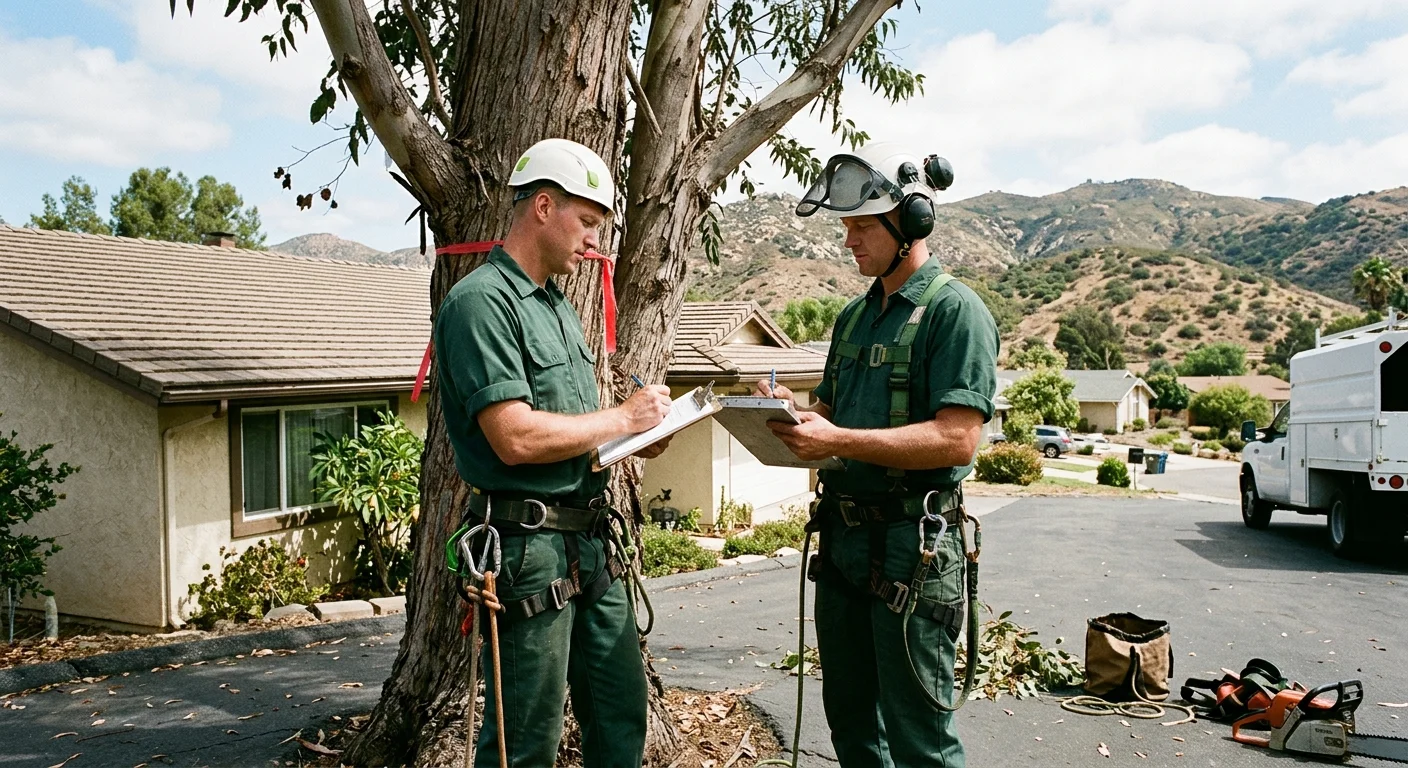
The quote is only as good as the access map. Walk it with the estimator the way the crew will work, from the street to the stump.
Start at the curb. Note parking, a narrow cul-de-sac, a school-day stack on a residential street, and whether brush or a parked trailer blocks the drop zone. Then measure the real gate, not the house number. A 36-inch side yard with a tight 90-degree turn is a different job than a double driveway that can hold a chipper. Hillside streets in Fletcher Hills and Granite Hills often add slope, rock, and a downhill drop. Valley lots closer to downtown El Cajon more often bottleneck at carports, block walls, and shared drives.
Mark every target in the fall radius: tile or composition roof, solar, patio glass, a neighbor’s shed, the service drop, and the play set. If any part of the tree is in or on a power line, stay back. Call 911 and SDG&E at 1-800-411-7343. The utility decides whether a line can be de-energized, covered, or moved. An ordinary tree contract does not authorize work on energized conductors. SDG&E does not typically prune service drops, but heavy strain or abrasion is an exception. Ask SDG&E before private work starts. Do not classify wires by height or color.
If the plan includes stump grinding or any powered digging, treat underground utilities as unknown until they are marked. DigAlert covers San Diego County. Public marks usually run to the meter, not every private irrigation line or sewer lateral, and marks do not give depth. Private locates are a separate arrangement.
Ask how pieces will leave the yard. Over the roof, through the gate, or from a street setup each creates a different protection and cleanup plan. Crane work, if the company proposes it, needs firm, drained ground and a clear lift path. California crane-setup rules put slope, compaction, and buried tanks or voids on the table. None of that is a promise that a crane will be used, or that mats make damage impossible.
Write the access notes into the bid: gate width, slope, overhead wires, neighbor yards, and who moves cars. That is the local half of tree service in El Cajon. The other half is the four line items below.
Separate cutting, hauling, stump work, and cleanup
A removal quote that says “take down the tree” is not a complete scope. Split the job on paper so you are not arguing about chips on the driveway at the end of the day.
Cutting is the takedown itself: piece-out versus a more open drop, rigging around the roof, and whether palms, hardwoods, or a multi-stem pepper get different handling. Hauling is what leaves the lot. Wood, brush, and chips are separate piles. Some owners want the wood cut to firewood length and stacked. Some want everything off site. Oak wood with suspected goldspotted oak borer should stay on the property until the company explains legal, local handling. Do not treat infested wood as ordinary free chips, and do not assume a burn pile is allowed. San Diego County burn rules sit with the local fire authority, not with a tree quote.
Stump work is its own decision. Grinding reduces the visible stump. It does not pull every lateral root, and it does not leave a planting hole ready for sod or a new tree. Remaining roots, altered soil, and old pests still matter if you want to replant in the same spot. Agree how diameter is measured, how deep the grind goes, who rakes chips, and who brings fill. If you want the hole brought to grade, say so. Stump grinding is easy to leave off a removal bid and expensive to add as a surprise.
Cleanup is the last line: sawdust in gutters, scuff marks on stucco, irrigation you asked them not to crush, and the sidewalk left passable. Ask who is responsible for final grade and for any side gate that has to come off for access. The independent company confirms how long they expect to be on site after they see access and rigging. Do not treat that as an arrival promise from us.
What to verify with the independent contractor before approval
Branch Pro San Diego matches you with licensed, independent local tree companies. We do not cut, haul, or grind. You contract and pay the company that does the work. Read the bid as if you will have to enforce it without us on the lot.
Check the license on the CSLB lookup. California requires a contractor license for tree work of $1,000 or more, counting labor, materials, and everything else in the job. The current tree classification is C-49 Tree and Palm. A contractor who still holds an active legacy C-61/D-49 issued before 2024 may still do that work. An ISA Certified Arborist credential is a professional certification on a person. It is not a state license and it does not replace C-49 or D-49. You can ask to see an ISA certificate. A missing public directory listing does not, by itself, prove someone is uncertified.
On the same CSLB record, look at status, expiration, the $25,000 contractor bond (required since January 1, 2023), and workers’ compensation. Coverage is required when the company has employees. A C-49 holder is not automatically exempt and is not automatically barred from a no-employee filing under current law. Read the actual record. A certificate of insurance is not the policy. Coverage follows the policy’s terms, exclusions, and conditions.
Then lock the job in writing: which tree, how it comes down, where wood goes, whether the stump is ground, who protects the roof and side yard, and who talks to the City if the tree is in the parkway. If birds could be nesting, California’s nesting season for many species is typically February through August, and some birds nest in other months. CDFW recommends a biologist survey when work cannot wait. Do not move a nest.
If you want a second opinion on keep versus remove, ask for an arborist consultation as its own scope. Directory listings live at Trees Are Good. That still does not make every referred worker ISA-certified.
Frequently asked questions
Will the electric company trim trees around power lines?
SDG&E manages vegetation around its high-voltage lines under utility rules. It does not typically prune a service drop to the house, with exceptions when the drop is under heavy strain or abrasion. If a line is down, or a tree is on a line, stay away and call 911 and SDG&E at 1-800-411-7343. Do not hire a tree company to work an energized line.
Is it legal to cut down an oak tree in California?
There is no single statewide oak-removal ban. Local city and county rules, and whether the tree is in a parkway or on private land, control the next step. In El Cajon, do not touch a parkway oak until Public Works says you may. If the parcel is unincorporated, start with County Planning. Confirm the address, the tree, and the scope before anyone cuts.
Is there a cheapest time of year for tree removal in El Cajon?
No verified public source publishes a seasonal discount for El Cajon removals. Access, size, targets, wood handling, and stump work drive the bid more than the calendar. Inland heat and Santa Ana periods change how and when a crew can work safely. Ask the company in front of you for a current written price, not a market average.
When to call us
Call when a specific El Cajon tree has to come down and the lot, the roof, or the wires make the path unclear. The independent company you hire should be licensed and insured for that scope. Call us at (858) 400-4423 and we’ll connect you with a licensed local tree company.