A large eucalyptus or coast live oak over a La Jolla roof is rarely a drop-and-haul job. The yard often has no landing zone, and the street may barely hold a chipper. Tree removal with a crane is how independent crews lift wood up and out when it cannot come down through the lot.
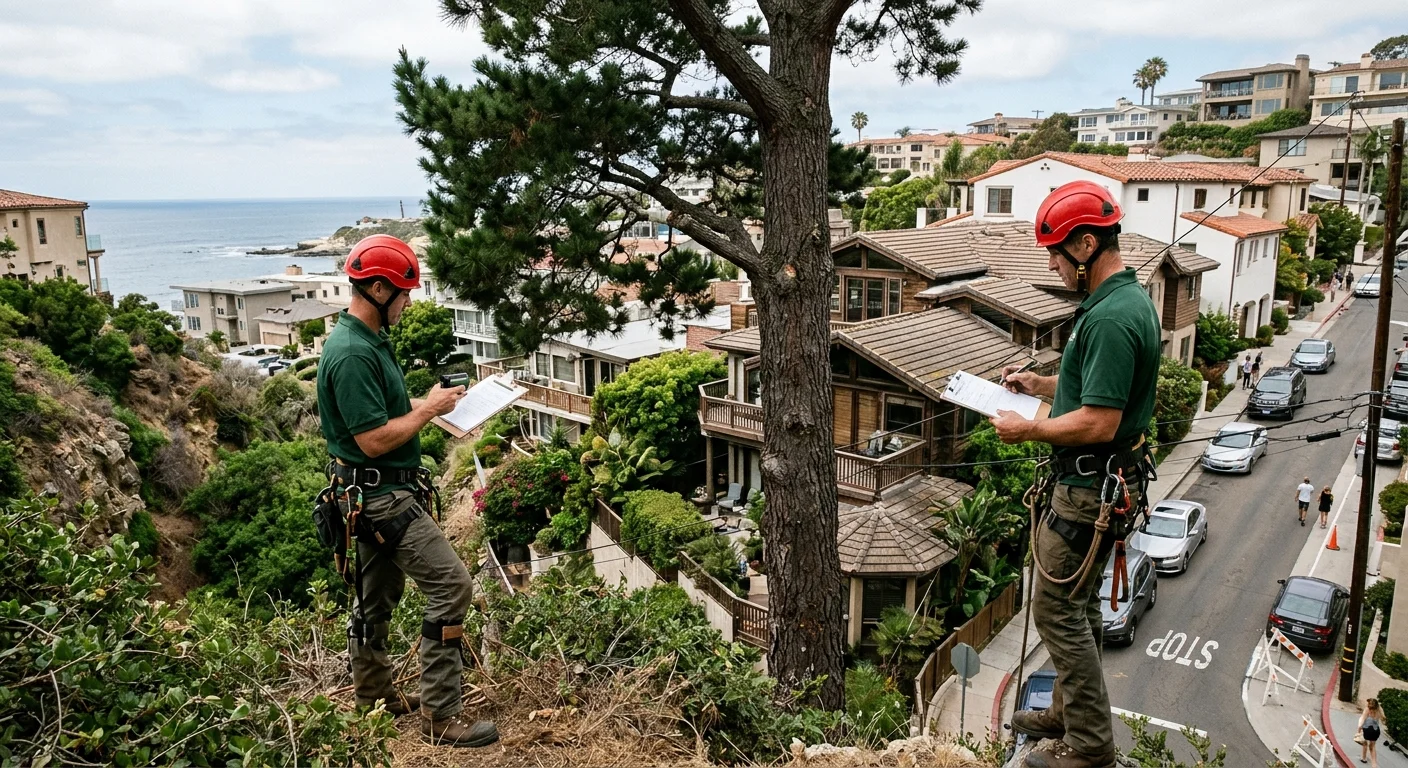
The tree, the lot, and why access is tight
La Jolla is a City of San Diego community, not a separate city with its own tree code. A La Jolla mailing address does not change that. Confirm whether the tree sits in a private yard, a parkway, or the public right-of-way before anyone cuts.
Tight lots here usually fail on three things at once: the tree, the targets under it, and the path out. A mature canopy can sit a few feet from tile, glass, and a neighbor’s wall. The backyard may fall toward a canyon. The only truck path may be a steep drive or a one-way coastal street.
Name what you can see from the ground. Species, lean, dead wood, and what sits under the drip line. Photograph from a safe place. Do not walk under a hung limb or a split union for a closer shot.
If the tree is a City street tree, a private crew’s calendar is not permission to remove it. The City of San Diego reviews street-tree trimming, removal, planting, and root pruning after inspection, then uses a no-fee permit process. Staff decide immediate safety. Other removal requests are reviewed under Council Policy 200-5. Report City-maintained trees through Get It Done. Power-line conflicts go to SDG&E. Private-yard trees still need the parcel, coastal, and habitat questions checked with the City when the work is part of a larger project.
California requires a C-49 Tree and Palm Contractor license, or a valid legacy C-61/D-49, for tree-service contracts of $1,000 or more. The $1,000 figure is an aggregate of labor, materials, and other items. Advertising as a contractor, hiring others, or splitting work to stay under the line can take the exemption away. Confirm the company on the CSLB license lookup before you hire.
For tree service in La Jolla, the first useful visit is a walk of the tree and the access. A crane is a later decision, not the opening move.
How La Jolla streets, canyons, and roofs shape the plan
Coastal streets, hillside grades, and canyon edges change the plan more than the species name does. A crane needs room to set, firm ground for its outriggers, and a clear path for each section of wood.
California crane-setup rules look at slope, compaction, firmness, drainage, and the manufacturer’s requirements. Known tanks, utilities, and voids under the pad have to be communicated. Supporting mats can spread load. They do not guarantee the lawn, the pavers, or a buried line will be unharmed.
A canyon-edge lot adds a second problem. There may be no safe place to land wood on the downhill side. The house, a pool, or a deck often sits between the trunk and the street. The crew has to plan the lift over those targets, not through them. Hillside streets above the Village and shoreline blocks have the same squeeze in a different shape: parked cars, tight turns, and roofs packed close.
Roofs in La Jolla sit close. Tile, solar, and glass do not take a swinging log. If SDG&E lines share the same airspace, stop. Keep people and tools away. For a downed or conflicting line, call 911 and SDG&E at 1-800-411-7343. The utility decides whether a line can be de-energized, covered, or moved. An ordinary tree crew does not control that.
Parking, cones, and any occupation of the public right-of-way are separate from the tree itself. Ask who will arrange street use if the crane has to sit in the roadway. Do not assume a neighbor’s driveway is available.
This is the local planning question a countywide crane page cannot answer. The tree is only half the job. The street, the grade, and the roof line decide whether a lift is even possible.
When rigging may handle the work without a crane
Not every large tree removal on a tight lot needs a crane. Climbing and rope rigging still handle many trees that are sound enough to climb, with room to lower pieces to a chipper or a drop zone.
Rigging tends to fit when the wood can be cut small enough to control on ropes. It also needs a clear, protected landing path. The tree has to hold a climber and the rigging forces. Trucks still have to reach the work without tearing the only access.
A dead, hollow, or storm-broken tree can make climbing the wrong first move. The same is true when a section is too heavy to lower past a roof without a lift. Those are reasons to pause and reassess. They are not a reason to assume a crane is already booked.
Ask the company to say, in writing, why they would climb and rig instead of lift. You want the reason tied to this tree and this lot. “We always crane” and “we never crane” are both weak answers.
For a wider look at method choice, see when crane-assisted tree removal is necessary. Use that as background. Then have the independent company walk your actual access.
ISA resources at Trees Are Good explain risk options in general terms: move the target, prune, add support, or remove. They do not pick the machine for your yard. An ISA credential belongs to a person. It is not a state license, and it does not replace C-49 or a valid legacy D-49.
When crane access enters the discussion
Crane-assisted tree removal is a ground crane working with a climber or a specialized attachment. The crane does not go in the tree. It stands on assessed ground, holds a section, and carries that wood to a drop zone or a truck.
A crane enters the discussion when there is no safe landing zone beside the trunk. It also comes up when sections have to travel over a roof, wall, or canyon. The tree may not be safe to climb for a long dismantle. Dragging wood across the only lawn or drive can do more harm than a planned setup pad.
Reach is not a catalog number you can look up for a “40-ton” machine and apply to your backyard. Boom length, counterweight, setup radius, load weight, and nearby lines all change what a given crane can do from a given pad. The company has to measure your street, your setback, and the lift path on site.
Setup is real work. Outriggers, mats, and a closed zone take space. On a tight coastal street that can mean coordinating parking and pedestrians. None of that is a reason to skip the walkthrough.
If the quote includes a crane, ask where the crane sits and on what ground. Ask how each section leaves the tree, and where wood lands or loads. Ask who is the crane operator versus the tree company. Ask how nearby utilities will be handled, and what happens if the pad or the weather is not fit that day.
California tree work near high-voltage lines has qualified-personnel rules. Approach distances vary by voltage. Do not treat a contractor license or an ISA credential as electrical clearance authority. Do not use a tape measure on a live line to “prove” a safe gap.
Bird nesting can delay non-urgent work. CDFW describes February through August as typical for many species, with nesting possible in other months. If work must happen when birds could be nesting, a consulting biologist’s survey is the agency’s recommended step. An active nest is not something to move or inspect yourself.
What stump work, hauling, and site protection belong in the scope
A removal quote that stops at a low cut is not a finished site. Ask what happens to the stump, the chips, the logs, and the ground.
Stump grinding is a separate scope unless the written proposal includes it. Powered grinding or excavation is not a casual backyard dig. Contact DigAlert before powered work in the ground. Public marks usually stop at facilities the member utilities own, often to the meter. They do not locate every private irrigation line or sewer lateral, and they do not give depth. Arrange a private locate for those.
Agree how the stump is measured, how deep the grind goes, and who handles chips and finish grade. If you plan to replant or pour hardscape, say so before the visit. Grinding alone does not make a planting hole ready. Remaining roots, changed soil, and old pest or disease issues still matter.
Hauling should name what leaves the property: brush, logs, chips, and whether any wood stays by request. Goldspotted oak borer is contributing to oak mortality in many parts of San Diego County. Keep suspect oak wood on site until the company explains handling. Do not treat it as ordinary firewood to move around.
Site protection belongs in the same writing. Mats, fence panels, driveway plates, irrigation heads, and who repairs what if something gives. A certificate of insurance is not the policy. Coverage follows the policy terms, exclusions, and conditions. Ask for the certificate and any extra-insured wording your HOA named, then read those limits with that in mind.
For how La Jolla and nearby coastal jobs tend to be discussed on price, read tree removal cost in La Jolla and Del Mar. No public agency publishes an official crane-removal average. Confirm the number with the independent company after they see the lift path.
Frequently asked questions
How much does it cost to take down a tree with a crane?
No verified public average exists for crane tree removal in La Jolla. Cost follows the tree, the access, the lift path, debris handling, and whether stump work is in the same scope. Ask for a written proposal after an on-site look. Compare that writing, not a phone number offered before anyone sees the lot.
How far can a crane reach from the street?
There is no single reach figure that fits every machine and every La Jolla pad. Setup radius, boom, load, grade, and nearby lines change what can be lifted from a given spot. The company measures that on your street. A catalog “40-ton” label does not answer the question.
Who do I call if a tree is down in my yard?
If the tree is on or near power lines, stay away. Call 911 and SDG&E at 1-800-411-7343. Do not touch the wood or the line. If the tree is on a house, car, or yard with no line conflict, keep people back and call a licensed tree company. Injuries and unstable structures are emergency-response first. Private quotes come after the site is safe.
Do cranes go in trees?
No. For this work the crane stays on assessed ground. A climber or a specialized attachment makes the cut while the crane holds and carries the section. The crane is not a substitute for qualified tree work, and it is not a promise that a decayed tree cannot fail.
When to call us
Call when a large tree sits over a La Jolla roof, a canyon edge, or a street too tight for a simple drop zone, and you need a licensed company to plan the access and the lift. Call us at (858) 400-4423 and we’ll connect you with a licensed local tree company.