The tree is already down. What is left in an Escondido side yard, grove row, or gated tract is the stump, the roots you can see, and the patch you actually want next. That is a different job from tree removal, and access is what decides whether stump grinding is even practical.
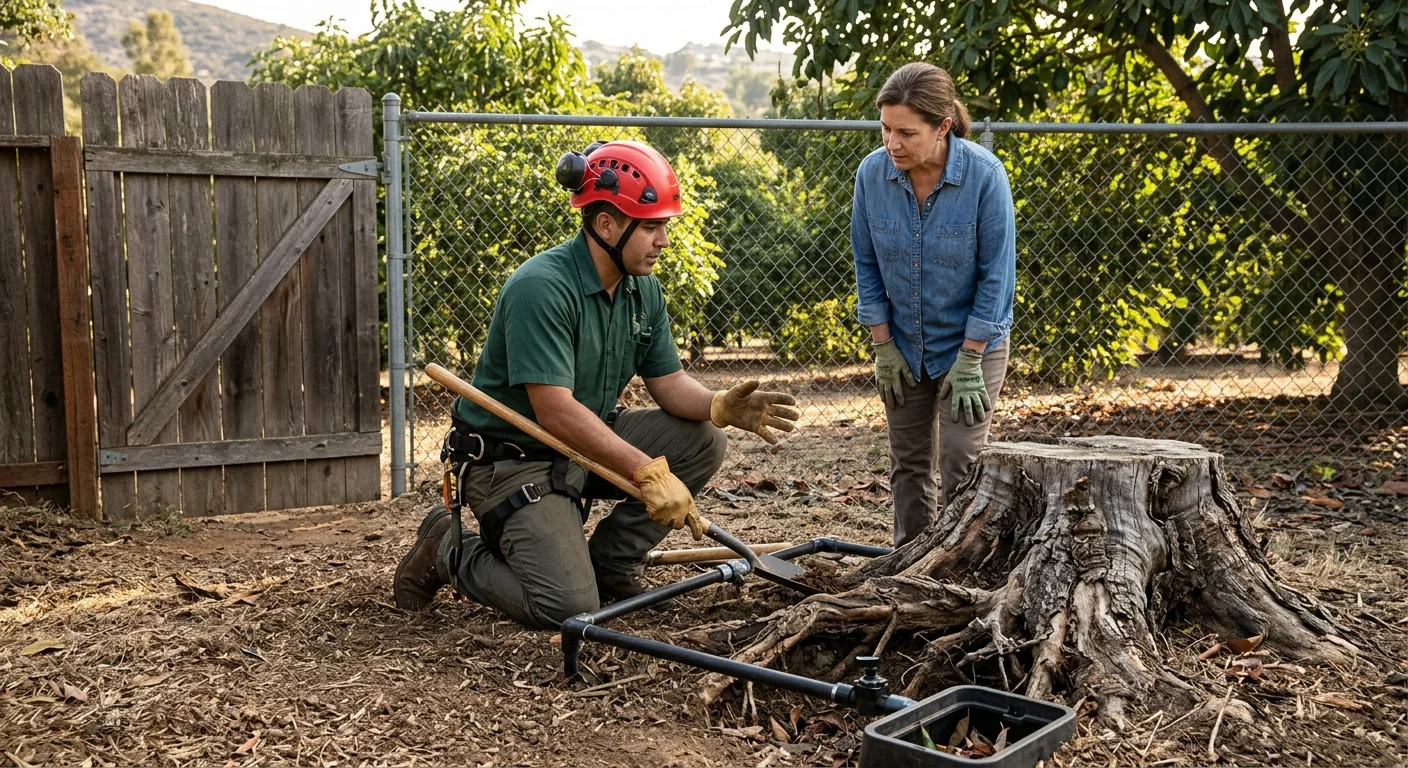
Decide how the cleared space will be used
Start with the patch, not the machine. Grass, a patio, a new tree, a parking pad, and a bare grove aisle are four different finish conditions. The independent pro you hire cannot guess which one you mean.
If you want turf, chips, sawdust, and root fragments still in the planting soil will fight seed and sod. Iowa State University Extension says decaying wood can leave voids, and that fill, compaction, moisture, and settlement need attention before you plant grass. Raking chips back into the hole and seeding the same week is not a reliable plan. San Diego’s calendar is not Iowa’s, so treat that as soil prep, not a local planting date.
If you want another tree in the same hole, grinding alone does not make the spot ready. Remaining roots, changed soil, and any pest or disease that affected the old tree still matter. A nearby planting location often avoids the original stump. Same-spot planting needs its own prep, agreed in writing, and it is a separate decision from how deep the stump is ground.
If you want hardscape, you are asking for a construction surface, not a lawn repair. Turf prep is not engineered slab or foundation prep. Tell the pro the intended end use before they quote. Ask who is responsible for final grade, and what stays in the ground.
Grove lots around East Grove, San Pasqual, and the older avocado and citrus rows off Bear Valley Parkway often keep the drip line. A stump in a working row is a turning problem and an irrigation problem. A stump in a small Old Escondido backyard is a gate and paving problem. Name the reuse so the scope matches the lot.
If the patch sits close to a house on a hillside near Lake Wohlford or along the I-15 rim, ask your fire authority what that ground must look like. Statewide Zone 0 rules were still under review as of early September 2026. Do not treat a five-foot bare-earth rule as already in force. Confirm the address with the agency that actually inspects it.
Document the stump, roots, irrigation, and nearby paving
Walk the stump from the ground. Do not climb it, dig around it, or pull on roots that still hold soil. Photos from a safe place help a licensed Escondido tree service pro see what you see.
Record the species if you know it, or at least the bark and the remaining wood. Coast live oak, eucalyptus, avocado, and queen palm leave different stumps and different follow-up. Some species can send shoots from remaining live tissue. Grinding reduces basal sprouts. It does not promise that every root away from the hole is dead. Black locust is a known root-sprouter. Coast redwood can sprout from stumps and root crowns. Do not assume every pine or every conifer never comes back. Identify the tree, then ask about follow-up.
Agree how the stump will be measured. Diameter, height above grade, and whether surface flare counts all change the conversation. There is no single published Escondido price table to lean on, and this page does not invent one. The written quote should say the measurement method, not a guess from the street.
Mark what you can see around it: drip emitters, PVC, valve boxes, low-voltage wire, a walk, a patio edge, a retaining wall, a pool deck. Public utility marks do not locate every private irrigation line or sewer lateral. Markers also do not tell you depth. DigAlert covers San Diego County. Powered grinding is not the homeowner exception that applies only when you stay on your own private property, skip a permit, and use no powered equipment. Have the excavator contact DigAlert, wait for responses, and treat private lines as a separate locate. Do not assume anything is deep enough to grind over.
Surface roots that lift a walk are not the same as laterals left after grinding. Ask which roots are in scope and which are excluded. A root near a crack is a reason to investigate. It is not proof the stump caused the crack.
Map gates, groves, slopes, and machine access
Escondido access is the job. A walk-behind grinder and a larger machine need different gates, turns, and ground. No source here proves which machine every independent crew will bring. The walk-through decides it.
Gated tracts off Citracado, Felicita, and the south side of town often have a vehicle gate, then a side yard that only a pedestrian gate can reach. Measure the clear opening, the latch side, and the path after the gate. Note steps, planter walls, and decomposed granite that ruts. Ask who opens the gate, where trucks stage, and whether the HOA or gate company has a check-in. This page does not invent those association rules. You confirm them for your address.
Grove yards are the other Escondido pattern. Rows, irrigation risers, and a slope toward a wash can stop a machine even when the stump looks small from the house. If the tree came down in a grove backyard, keep that felling plan separate from this grinding plan. Grove backyard tree-removal planning is the standing-tree problem. This page is the stump after that work.
Slope, compaction, and drainage matter for any heavy equipment. California crane-setup rules are about cranes, not grinders, but the same ground questions apply: is the soil firm, is there a void, is there a tank or a utility. Tell the pro about known septic, wells, or buried lines. Hidden Meadows and other county islands can sit next to an Escondido mailing address. A city name on the bill is not the jurisdiction. Use the parcel.
If the path crosses a neighbor’s driveway or a shared fence, stop and settle access in writing. Cutting on your side of a line is not a free pass to damage a tree you do not own.
Separate grinding, hauling, backfill, and excluded root work
Stump grinding versus full stump removal is the distinction to put in the quote. Grinding chips the stump in place. It does not pull the whole root plate. Excavation is a different method, with different disturbance, DigAlert needs, and finish work.
Write four lines, not one lump sum with no detail:
- Grind the stump to an agreed condition, with the measurement method named.
- Haul chips, leave chips, or spread chips only where you want them.
- Backfill and rough grade, or leave the hole for your landscaper.
- Root work that is excluded: laterals under paving, roots heading to a sewer, roots under a neighbor’s yard.
Iowa State’s grass-after-stump guidance is useful here too. Chips and sawdust in planting soil are a problem. Settlement can show up later. Decide who comes back if the grade drops.
Chemical stump products are not a substitute for grinding, and they are not instant. A potassium-nitrate product on one manufacturer’s label aids decomposition. It does not itself kill a fresh stump. If anyone proposes a chemical, the current container label and a qualified applicator control it. Do not mix household chemicals, and do not treat a label’s burn talk as permission to burn in Escondido. San Diego Air Pollution Control District does not issue burn permits. Local fire authorities do, for a specific place, time, material, and quantity. Some nearby fire jurisdictions have suspended permitted burning. Do not plan on a burn pile as your stump plan.
Sprouts after grinding are a monitoring issue, not a failure you can assume away. Match the agreed grind and haul to whatever you will plant or pave. Ask how the independent pro wants you to handle new shoots if they appear.
What to confirm before an independent pro starts
Branch Pro San Diego is a referral service. We match you with licensed, independent local tree companies. We do not grind stumps, own grinders, or hold a contractor license. The customer contracts and pays the professional directly.
Check the company on the CSLB license lookup before work starts. Tree service work of this kind is C-49 Tree and Palm Contractor territory, which includes stump grinding. An active legacy C-61/D-49 issued before January 1, 2024 can still be valid. Do not treat every legitimate crew as illegal because the card still says D-49. California requires a contractor license when the aggregate project price is $1,000 or more, including labor, materials, and all other items, unless a narrow casual-work exemption applies. Advertising as a contractor, employing others, needing a building permit, or splitting contracts to duck the threshold knocks that exemption out. Ask for the classification that matches this stump job.
ISA Certified Arborist is a personal credential, not a state license. You can verify an individual in ISA’s directory or by a digital certificate they share. An absent listing does not by itself disprove certification. It also does not prove that every referred worker holds it.
Ask Escondido Planning about the parcel if the original tree was a mature or protected tree, the lot is two acres or larger, the stump sits in required landscaping or sensitive habitat, or later construction will enter remaining driplines. Escondido’s code treats lots under two acres and lots two acres or larger differently. It defines mature oaks, other mature trees, and protected oaks by diameter at 4.5 feet. Those rules are about the tree and the lot, not a universal stump-grinding fee or a promised decision time. A homeowner calling a leftover stump dangerous does not create the official hazard exception. Confirm the address, tree category, lot size, and remaining work with Planning. Do not assume a private backyard stump is automatically exempt.
Get DigAlert responses before powered work. Confirm private irrigation and sewer laterals separately. Put access, chips, backfill, excluded roots, and the intended reuse in the written scope. The independent provider confirms how long they will be on site after they inspect the stump and the agreed grinding condition. That is not an arrival promise from this referral line.
Frequently asked questions
Does stump grinding take out every root?
No. Grinding addresses the stump and the wood in the agreed work area. Lateral roots can remain. Some species also sprout from roots away from the hole. If you need roots out for a patio, a sewer repair, or a new tree, say that. It may be excavation or a different trade, not a deeper grind.
Can I plant grass or a new tree in the same spot right away?
Not as a default. Remove chips and root fragments from planting soil, then deal with fill and settlement. A new tree often does better a short distance from the old stump. Same-spot planting needs a plan, not a hope that the grinder finished the horticulture.
Do I need a permit to grind a stump in Escondido?
It depends on the parcel, what the tree was, and what happens next. Public right-of-way trees follow a different path than a private yard. Protected and mature trees, lot size, required landscaping, and dripline construction all matter under Escondido’s published code. Confirm with Planning before you hire. This page does not publish a fee or a wait time because none is verified here.
Who actually runs the grinder?
An independent licensed tree company. Branch Pro refers. We do not send our own crew or our own machine. Verify the license, the written scope, and access before anyone starts.
When to call us
Call when the stump sits behind a gate, in a grove row, or against irrigation and paving, and you need a licensed tree company to grind it to a written finish. Call us at (858) 400-4423 and we’ll connect you with a licensed local tree company.