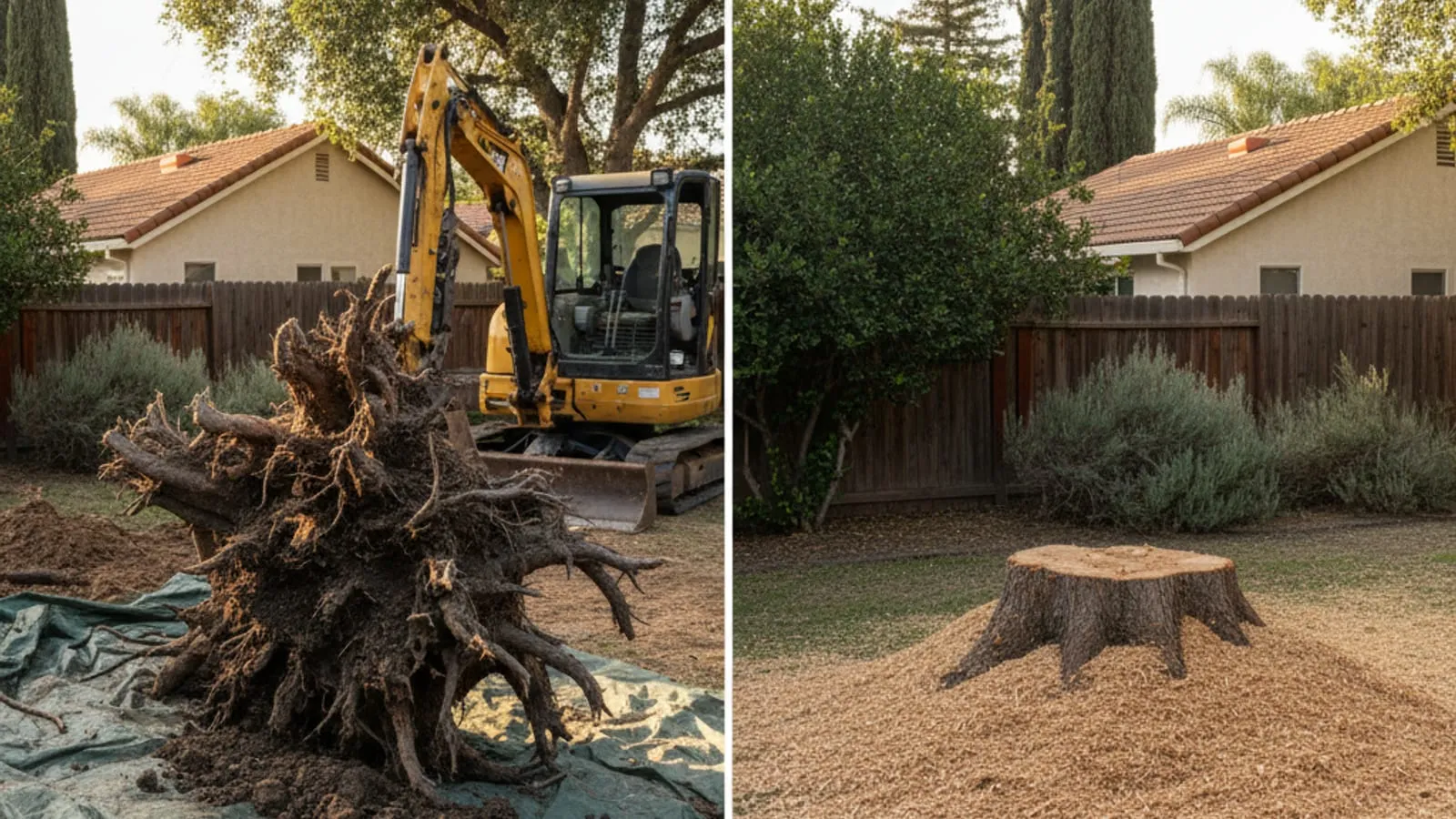
After the tree is down, choose the method by the next use of that ground. Grinding reduces the visible stump. Excavation takes a larger root mass. Leaving it is still a choice when you have not decided. None of those options clears every root or guarantees the tree will not send shoots.
Branch Pro San Diego matches you with licensed, insured, independent tree companies. You contract with and pay the company that does the work.
What grinding leaves you with
A grinder reduces the stump into chips below the surface you agree on in writing. Most of the root system stays in the soil. Chips can fill the hole. They are not planting soil and they are not structural fill.
Iowa State Extension’s after-stump guidance is the useful test for turf: remove chips, sawdust, and root fragments from the planting soil, then correct fill, compaction, moisture, and settlement before seed or sod. Decaying wood can leave voids later. That is lawn prep, not a recipe for a patio slab. Read planting grass after stump removal.
If you want another tree, a nearby hole with better soil and root room can avoid the old stump. Same-spot planting still needs that preparation. Grinding depth alone does not make the site ready. See replanting after a tree is removed.
What excavation leaves you with
Extraction takes the stump and a larger share of the root mass. It can be machine work or other qualified digging. It still does not promise every root is gone, and it does not permanently stop resprouts. It leaves a bigger hole that needs planned backfill and compaction if anything engineered will sit there. The contractor responsible for that finish, or an engineer where the job needs one, should set the grade.
Grind, extract, or leave
Match the method to the end use, not to a price formula.
| End use | Better starting method | What still remains |
|---|---|---|
| Lawn, mulch, or a bed where leftover roots are acceptable | Grind the stump to the finish named in the quote | Most roots, plus chips or a hole that still needs real soil work |
| Patio, slab, pool, or other engineered fill | Ask the engineer or installer which wood, backfill, and grade they need, then have the stump company confirm grinding or excavation | Roots beyond the work area, and a hole that is not a finished pad |
| No decision yet, or the stump is not in the way | Leave it, and note later access | The stump, the roots, and any later permit or utility checks |
Surface roots that already lift a walk need their own line on the scope. If a pipe may be involved, have a plumber assess the line. Chasing roots is not automatic with either method. For that follow-on work, see root work after tree removal.
How to compare bids
Ask each company to number the stumps and state grinding versus excavation. Have them write how they measure, which roots are included, where chips go, who finishes grade, and who restores the surface. A company may price per inch, per stump, or as one job. Those forms only compare when the finish matches.
Hauling, topsoil, sod, and irrigation repair belong on the page if you want them. Do not assume they ride along with stump grinding.
Will the stump send up new shoots?
It might. UC Cooperative Extension in Ventura County notes that root shoots can keep coming after the trunk is gone, while stored reserves run down. Repeated clipping can manage those shoots. It does not guarantee the living parent, or the leftover roots, will stop producing them.
Colorado State separates suckers connected to roots from seedlings that grew from seed. Treat those as different plants. Iowa’s chokecherry notes also warn that mowing can leave sharp woody stubs. Keep the mower off surface structural roots.
Do not pour a home herbicide, salt, or bleach recipe on the grind. UC IPM warns that systemic stump treatments can move through natural root grafts into nearby trees of the same species. Removing the trunk does not isolate the roots. If a company proposes pesticide work, that is a pest-control scope, not a substitute for a tree contractor license. Ask for the business’s current DPR authorization, the product label, and the qualifications that match that service.
If the wood may be infested oak, keep it on site and have the hired company handle it. Do not pass those chips around as harmless mulch.
Burning is not a backyard workaround. San Diego County Air Pollution Control District does not issue burn permits. Local fire authorities do, for a specific place, time, material, and quantity. A permissive air-quality day does not override a fire restriction. San Miguel Fire & Rescue has permitted burning suspended in its jurisdiction as of May 1, 2026. Do not treat that as a countywide rule, and do not assume your fire district will issue a permit.
Utilities, rentals, and who may run the machine
Stump grinding is powered work. In San Diego County, contact DigAlert before it starts. Premark, call in the ticket, and wait for every member response. Marks are not depth. Member utilities usually mark to the meter, not private irrigation, gas beyond that point, or nonpressurized drains. Arrange a private locate for those. A qualified excavator exposes a conflict before powered cutting. The homeowner exception is only for your own private property with no permit and no powered equipment, so it does not cover a grinder.
Powered grinding belongs with a qualified operator. A rental listing does not settle who may run it. If you still want the rental comparison, read walk-behind stump grinder rental versus hiring a pro.
A standing line conflict goes to SDG&E first. A downed line is 911 and SDG&E from a safe place. Stay away. Do not walk in for photos or measurements.
Check the hired firm on the CSLB license lookup. Paid tree work may be C-49 or an active legacy C-61/D-49.
Frequently asked questions
How soon can I plant after grinding?
When the chips, fragments, voids, moisture, and grade are actually corrected for that use. There is no calendar that makes the hole ready. Iowa’s turf steps are the checklist. They are not a San Diego planting date.
Does grinding stop pests in the remaining roots?
No. It reduces the stump. Infested oak wood still needs on-site professional handling before it moves.
Can I grind next to a gas or irrigation line if 811 marked the yard?
Marks do not give depth and do not show every private line. A qualified excavator exposes conflicts before powered work. Skip the job until that is done.
Is extraction the permanent no-sprout option?
No. A larger root mass can still leave roots, and shoots can still appear. Plan follow-up clipping or a later assessment instead of a one-and-done promise.
Should herbicide go on the fresh grind?
Not as a home recipe, and not as a guarantee it will spare neighboring plants. If chemicals are proposed, treat that as a separate pest-control scope with current credentials and a current label.
When to call us
Call (858) 400-4423 when you want a licensed local company to bid grinding, excavation, or leaving the stump against the next use of the yard. Pros in our network handle stump grinding across San Diego and inland cities such as Escondido. You hire and pay that company directly.