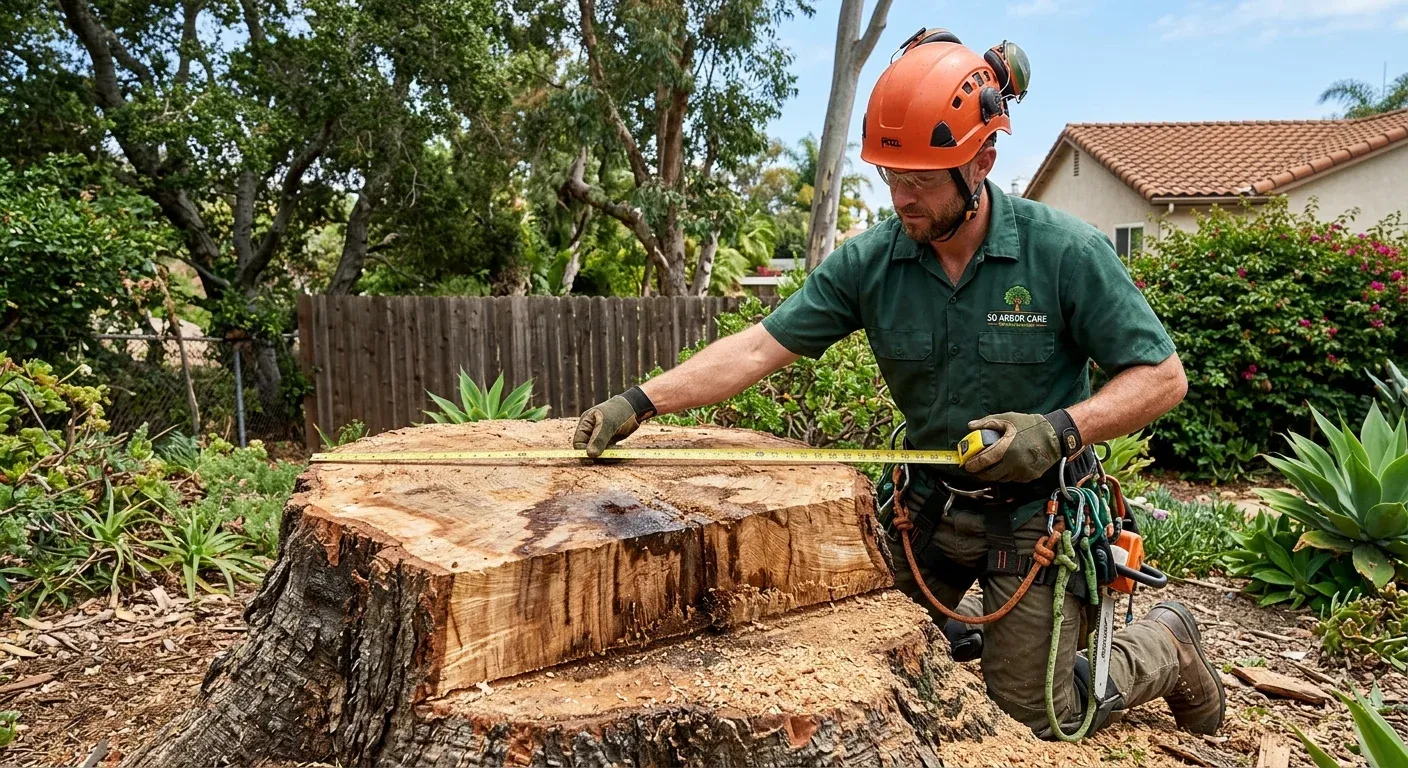
A walk-behind stump grinder rental can look cheaper than hiring a crew. Powered grinding is still ground-disturbing work. Buried utilities, leftover roots, and flying debris stay in the job even when the stump looks simple. ISA’s mature-tree guidance puts large-tree work, work above ground, and powered equipment with a professional arborist. Comparing a rental contract with a professional quote does not make you a qualified operator.
Branch Pro San Diego is a referral service. We match you with licensed, insured independent local tree companies. You hire and pay that company directly. Compare a rental contract and a professional quote on the same facts: access, utilities, remaining roots, chips, and the finish you actually need.
If you find a downed line, stay away and call 911 and SDG&E at 1-800-411-7343 from a place that is already safe. If anyone is hurt or life is in immediate danger, call 911. For a standing line conflict, call SDG&E before any grinding. A call does not authorize you to approach the wires. Private stump work near that hazard waits until SDG&E directs that it may proceed.
What you are really comparing
Ask the rental yard for its current machine, how you must transport it, the rental period, fuel, and the contract’s damage and repair terms. Ask what happens if teeth hit rock, metal, or a buried pipe.
Ask an independent stump-grinding company for a written job quote on the same stump. Providers may price by diameter, by stump, or as one job. Ask how they will measure the stump, which roots are included, whether chips are hauled or left, and who restores grade. How stump grinding is priced in San Diego walks through those line items. Do not assume every quote uses one billing formula, or that insurance on either side automatically pays for a nicked walk or irrigation line. Coverage follows the actual policy. A certificate is only a summary.
Cleanup is part of the comparison. Chips, sawdust, and root fragments are not planting soil and not structural fill. Iowa State Extension says to take that woody debris out of the planting soil, then deal with fill, compaction, moisture, nutrients, and settlement before seed or sod. Decaying wood can leave voids later. Do not plan to rake chips into the hole and plant over them.
If you want a new tree in that spot, grinding alone does not make the site ready. Iowa State’s replanting FAQ notes remaining roots, altered soil, and prior pests or disease. A nearby planting location can avoid the old stump. Same-spot planting needs its own preparation. There is no universal grind depth that proves the hole is ready.
Access, slope, and what the machine still cannot do
Walk the path from the street to the stump only on ground that is already safe. Note turns, slope, irrigation heads, and fence posts. Do not walk under a hazard, approach a wire, or try to measure a conductor. A rental being available does not mean it will fit the gate or stay stable on a terrace.
Grinding reduces the visible stump. It does not remove the whole root system. UMass Extension notes that some species still sprout from roots away from the old stump. Black locust is one example. UC documents that coast redwood can sprout from stumps and root crowns. Do not treat every needle-bearing tree as unable to resprout. Match the agreed grind or excavation to the next use of the ground, then plan follow-up with the company if shoots appear. A new seedling near the hole is not automatically the old tree returning.
For the difference between grinding and digging the root mass, see stump grinding vs removal. Other non-grinding stump options are a separate decision, not a home chemical or fire recipe.
Utilities and permits before anyone disturbs the ground
Have the licensed company contact DigAlert at 811 and follow DigAlert’s safe-digging steps before powered grinding, grubbing, or excavation. Premark the area, wait until every member has responded, respect the marks, and have conflicting utilities exposed by a qualified excavator. DigAlert covers San Diego County. Marks do not give depth, and they usually stop at facilities the members own, often to the meter. Private irrigation, sewer laterals, and other private lines need a separate locate.
A stump near a sidewalk or a sewer lateral can involve plumbing or paving, not only wood. A fence line does not by itself prove shared utilities. Our guide to tree roots, sidewalks, and sewer laterals separates plumbing, engineering, and tree questions. Do not cut live roots of a tree you still want to keep without a qualified assessment.
A dead stump on what looks like private land is not a blanket permit exemption. Confirm the parcel jurisdiction, not just the mailing address. If the tree stood in a parkway, easement, or right of way, the stump may still be a city or County tree. In the City of San Diego, street-tree trimming, removal, planting, and root pruning go through the City’s no-fee permit and inspection path. A private machine on site is not authority to grind a city stump. Other cities have their own public-tree rules. County rules apply in unincorporated areas, not at every address that says San Diego County. Use the tree removal permit guide to start that check, then confirm with the agency for that parcel.
When the professional quote is the clearer path
Hire the independent company when lines or hardscape sit close, when the next use is a slab or a new tree, or when you do not want to operate powered equipment. Ask for a qualified assessment with written inspection limits, not a claim that every root was visible. Ask whether the written price includes all listed stumps, surface roots in scope, chip haul, and finish grade. Ask what is extra. Licensed, insured companies in the referral network still need their current license, workers’ compensation record, and general liability checked for that business. Current tree classifications are C-49 or an active legacy C-61/D-49. Workers’ compensation rules depend on the actual classification and whether the firm has employees. Check the named company on the CSLB lookup rather than assuming one coverage pattern.
Call (858) 400-4423 to connect with local pros for stump grinding services. Compare their complete quote with the rental yard’s complete contract before you move a machine.
Frequently asked questions
How deep should a stump be ground?
Agree the depth with the company based on the next use of the soil. Lawn repair, a new tree, and construction do not share one number. Grinding does not remove all roots or prove the site is ready to plant or pour.
Can you grind a stump yourself?
A rental yard may rent you a machine. That does not qualify you to run it. ISA puts powered equipment with a professional arborist. Comparing rental terms with a professional quote is a cost check, not operator qualification. Hire a licensed company for the grinding.
Is a walk-behind grinder hard to operate?
It is rotating cutting equipment that throws debris. This page is not an operating manual. Hire a licensed company for powered grinding. A paper access plan does not make a homeowner a qualified operator.
Do you need a permit to grind a stump in San Diego?
It depends on whose tree it was and where it stood. Confirm city, County, easement, and right-of-way status for the parcel. City street-tree root work in San Diego uses the City’s inspection process.
Is a rental worth it for one small stump?
Only after you compare the rental’s full contract with a professional quote that includes locates, leftover roots, chips, and grade. Open, level ground with no nearby lines or paving is still powered work. It is not an automatic yes for a homeowner-run machine.