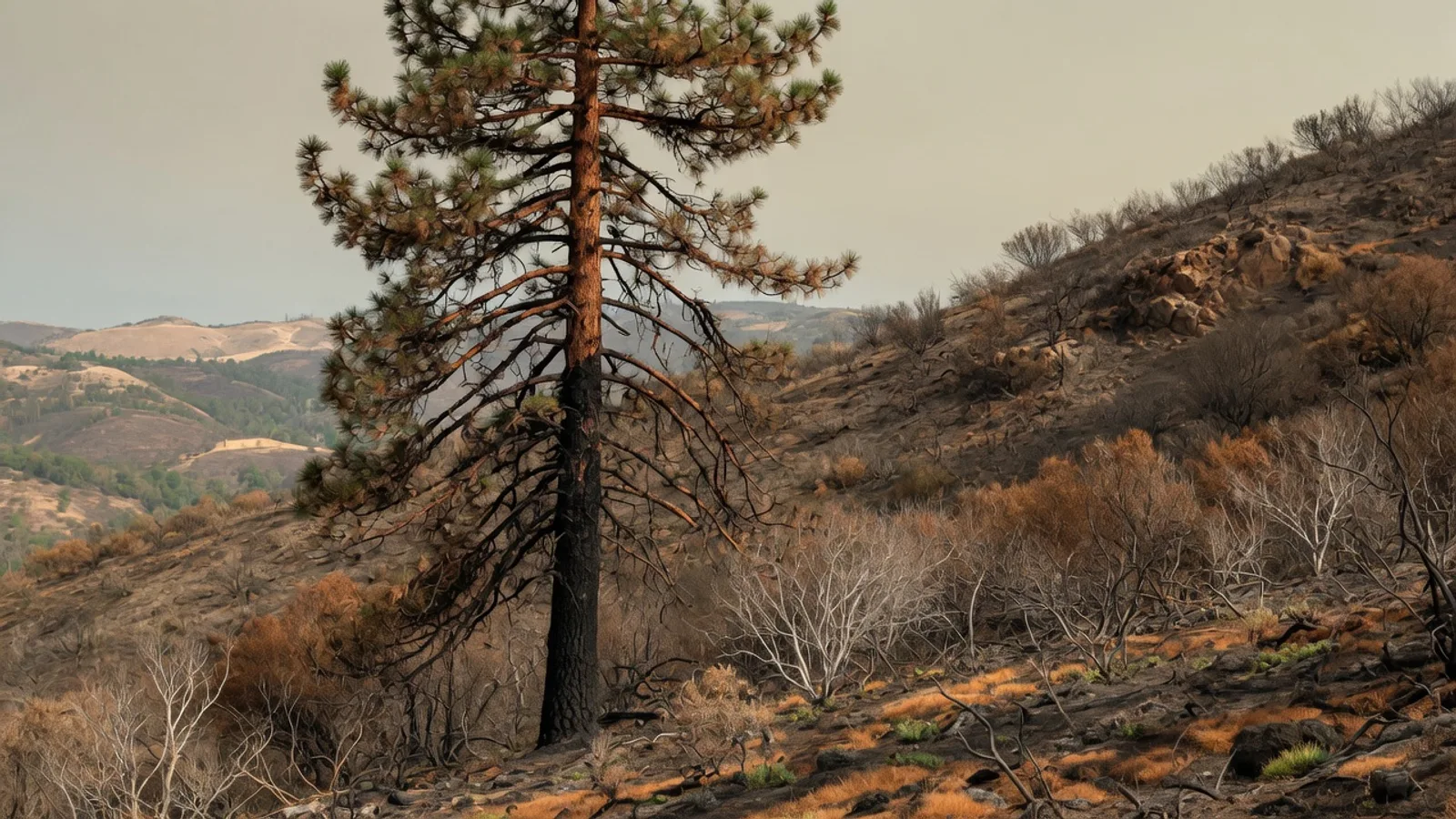
A scorched San Diego tree after a wildfire is a delayed-decision problem more often than an emergency takedown. Char on bark can hide live tissue. Some trees fail later as roots, trunks, and limbs decay.
USDA NRCS California hazard-tree guidance says only hazard trees should be considered for reduction or removal. Unless trees are clearly dead when identified by a professional, other fire-damaged trees should be left on the landscape at least through the first winter following wildfire. Many trees are not completely dead, and many will likely sprout back. The same sheet warns that burned trees may fall or drop branches with little warning, especially in wind, heavy rain, or saturated soils, and that in the years after the fire many damaged trees begin to fall on their own.
This page is that after-fire keep-or-cut question. For the near-house ember band, see Zone 0. For a tree already on a car or a roof, use the emergency fallen-tree guide.
Branch Pro San Diego is a referral service. We connect you with licensed, insured independent local tree professionals. You hire and pay the professional directly. We don’t release a burned parcel, file insurance, or salvage timber.
Do not walk under burned trees to scrape bark. Do not start a salvage cut until the parcel is released for private work.
What is a hazard tree versus a wait-and-see tree?
A hazard tree is one that can hit a target you still use: a remaining structure, a driveway you must travel, a neighboring house. NRCS says only those trees should be considered for reduction or removal in the burned landscape it describes.
A wait-and-see tree is scorched but not clearly dead, with no occupied target in the fall zone, or a tree a professional still wants to watch through the first winter. NRCS says many will sprout. That sheet does not give a homeowner a percentage to apply to a patio pine.
A Julian mixed-conifer slope and a Lakeside ornamental oak next to a surviving garage are different species, different fire intensity, and different targets. Don’t copy a forest salvage prescription onto a city lot.
If officials have not released the parcel, stay out. Debris programs and local fire authorities set that order, not a private crew’s schedule.
What should you record from a safe place?
From already-safe ground:
- Which trees still have a used target under them
- Whether the root plate moved
- Hung-up limbs over a remaining structure
- Whether the tree is a City street tree or on private land
- Photos for insurance, taken without walking under loaded wood
Don’t treat a deep bark scrape as a homeowner test. That can injure remaining tissue. Identification of dead versus live cambium belongs with a professional who is already cleared to be on the site.
If a hung-up limb is the immediate problem, see hung-up limbs.
What belongs in a written scope?
Ask the independent professional for a written scope that separates:
- Trees that are a current hazard to a named target
- Trees to reinspect after the first winter
- Access, crane, or sectional takedown if the drop zone is a remaining structure
- Chip and log handling, including any pest or firewood limits the professional names
- Stump work as a separate price
For paid tree work, look up the license on the CSLB license lookup. An active C-49 Tree and Palm license or an active legacy D-49 can both be valid. California’s current minor-work threshold is an aggregate price under $1,000, with extra conditions.
Confirm the fire authority’s current written standard if the work is also defensible-space clearing. See defensible space Zone 1 and Zone 2.
Frequently asked questions
If the bark is black, is the tree dead?
Not automatically. NRCS says many fire-damaged trees are not completely dead and may sprout. A professional identifies hazard versus wait.
Should we cut everything before the first rain?
NRCS says other fire-damaged trees should be left at least through the first winter unless they are clearly dead as identified by a professional, or they are hazard trees. Rain can also raise the chance of unexpected failure, so stay out of the fall zone.
Can we sell the logs as salvage?
That is a timber and permit question, not a default backyard job. Don’t start until the parcel is released and the independent professional names the legal path, if any.
Can Branch Pro tag keep-or-cut from a drive-by photo?
No. The independent professional inspects when the site is safe enough, explains options, and contracts with you.
Get connected with a local pro
If anyone is hurt or a burned tree is on a conductor, call 911 and SDG&E at 1-800-411-7343 first. After the parcel is released for private tree work, call (858) 400-4423. We’ll connect you with a licensed, insured independent local professional. Describe the remaining targets and whether officials have released the lot. You hire and pay that professional directly.