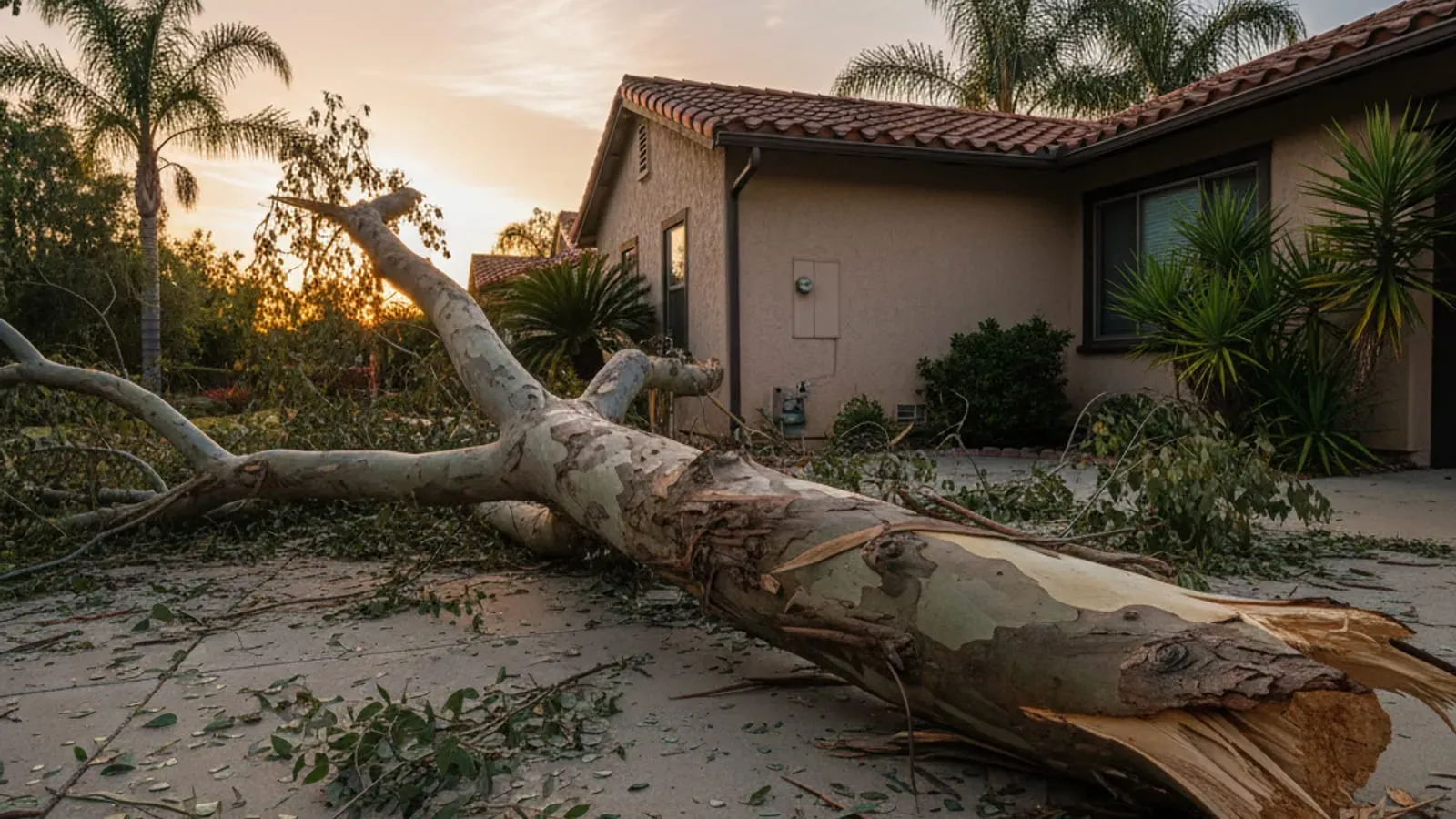
Keep everyone clear when a tree falls in San Diego. If a power line is down or involved, call 911 and SDG&E at 1-800-411-7343. Make both reports even if the line doesn’t spark or appear energized. Private tree work comes after emergency responders and the utility address the immediate hazards.
Don’t enter a house damaged by the tree until emergency officials say it is safe. Don’t walk beneath suspended limbs, touch loaded branches, climb onto the trunk, or attempt a test cut. Wood under tension can shift without warning.
Branch Pro San Diego connects property owners with licensed and insured independent local pros. We don’t remove trees ourselves. You hire and pay the matched professional directly.
Keep people away from the tree
Move people and pets away from the affected area. Use a safe route that doesn’t pass beneath damaged limbs or cross utility lines.
Call 911 when someone is injured, trapped, or facing an immediate threat. Tell the dispatcher whether a tree struck a building, vehicle, road, or utility line. Don’t attempt a rescue that requires cutting or moving the tree.
A fallen tree may still be supported by roots, another tree, a roof, a fence, or utility equipment. Those contact points can hold significant load. Leave stabilization and cutting decisions to the responders and professionals responsible for the scene.
Report every downed line to 911 and SDG&E
Treat every downed line as energized. Stay away and keep others clear. SDG&E instructs customers to report downed lines to both 911 and the utility at 1-800-411-7343.
The utility decides whether its lines must be de-energized, covered, moved, or handled another way before tree work proceeds. A tree contractor can’t promise an outage or independently declare utility equipment safe.
Follow current SDG&E downed-line guidance and power-outage safety instructions. A private quote call doesn’t replace either emergency report.
Don’t enter a damaged building
A tree through a roof or wall can leave unstable framing, broken glass, exposed wiring, and suspended wood. Stay outside until emergency officials clear entry.
Don’t approach only to take photographs. Safety comes before documentation. If you can photograph the scene from a safe public or cleared area, capture wide views and visible damage without crossing barriers.
Find out who controls the tree and work area
Ownership and location affect who can authorize work. A tree rooted in a private yard may involve the property owner, insurer, utility, or emergency responders. A street or right-of-way tree may also require city direction.
Within the City of San Diego, report City-maintained street trees through Get It Done. The City’s street-tree maintenance page says street-tree trimming and removal requests go through City inspection and its permit process. A private crew’s availability doesn’t authorize work on a City tree.
Processes differ in Chula Vista, Carlsbad, Encinitas, Poway, Vista, and other county jurisdictions. Confirm the parcel jurisdiction and whether the trunk, right-of-way, or affected work area is publicly controlled. A San Diego mailing address alone doesn’t settle that question.
Emergency responders may address an immediate public hazard without deciding the entire private cleanup scope. Once the scene is secure, identify who can approve the remaining work.
Document damage without approaching the hazard
When officials say the area is safe, photograph the scene before cleanup changes it. Useful records include:
- The entire tree and where it landed
- The trunk, root plate, and major broken unions
- Visible damage to the home, fence, driveway, or vehicle
- Utility lines, only from the cleared viewing area
- Nearby structures and access routes
- Personal property affected by the incident
Save emergency-report details, claim numbers, written estimates, invoices, and repair records together. Don’t move unstable wood for a better image.
Contact the correct insurer
The California Department of Insurance says damage from a fallen tree to an insured home is generally covered, subject to the policy’s terms and exceptions. Coverage for removing the tree, temporary work, debris, landscaping, and deductibles depends on the actual policy and claim.
A damaged vehicle is different. It requires optional comprehensive, also called other-than-collision, auto coverage. Homeowners insurance isn’t the source of vehicle coverage merely because the tree stood on residential property.
Review the California Department of Insurance guidance, then ask the relevant carrier:
- Which damaged property is covered?
- May safety work proceed before an adjuster visits?
- What photographs and documents are needed?
- Are stabilization, removal, hauling, and repairs handled separately?
- Which deductible and policy conditions apply?
- Does the carrier need separate estimates for the tree and building work?
Don’t delay a 911 or utility call while waiting for an insurer. Once the immediate danger is controlled, get claim instructions before authorizing work that can safely wait.
Define the work before comparing quotes
Emergency tree work isn’t one automatic package. The immediate hazard and the final property-restoration plan may require different scopes.
Hazard assessment
This identifies what is carrying the load, which areas remain unsafe, and what must happen before cutting. It doesn’t guarantee that every hidden defect or future failure can be predicted.
Temporary stabilization
Stabilization may be needed before removal or building access. The written scope should identify who is responsible, what will be stabilized, and when that temporary work ends.
Pruning or sectional removal
A damaged limb may require controlled removal while the remaining tree stays. A failed trunk or root plate may change the decision to full removal. Ask the provider to state which material is included and what remains.
Debris and wood handling
Cutting, chipping, hauling, log removal, and final raking aren’t interchangeable. Confirm each item in writing. If pest symptoms are present, ask whether material needs separate identification or handling guidance.
Stump and site restoration
Stump grinding, root excavation, fill, final grade, paving, fencing, and landscape repairs are separate decisions. Don’t assume emergency removal leaves the site ready for rebuilding or planting.
Insurer records
Ask what photographs, invoices, and scope notes the provider can supply. Documentation supports a claim record, but it doesn’t decide policy coverage.
What affects an emergency removal quote?
Providers should quote the actual site and scope. Important variables include:
- Tree size and current position
- Trunk, limb, and root-plate condition
- Loads resting on structures or other trees
- Utility restrictions and emergency-scene controls
- Crane, rigging, or lift access
- Ground slope, firmness, drainage, and hidden site features
- Traffic, sidewalk, neighbor, or right-of-way constraints
- Debris volume and wood-handling instructions
- Stump work and final site condition
Don’t compare only the total. Compare what each provider includes, excludes, and expects another contractor or the utility to handle.
A certificate of insurance is useful verification, but it doesn’t expand the underlying policy or transfer every project risk. California Insurance Code section 384 explains that policy terms and conditions control coverage. Ask for current proof tied to the provider and discuss property-protection responsibilities in the contract.
When should repairs begin?
Tree removal and building repair may overlap, but they aren’t the same job. Emergency officials, the utility, the insurer, the tree professional, and the repair contractor may each control a different decision.
Before repair work begins, confirm:
- The tree and suspended limbs no longer threaten the work area
- The utility has addressed involved equipment
- Emergency restrictions have been lifted
- The insurer has supplied any required claim instructions
- The tree scope states what remains onsite
- The repair contractor has inspected accessible damage
Don’t use a fixed deadline to decide whether a roof, wall, driveway, or fence is safe. The damage and professional findings should control the next step.
What about the trees still standing?
One failure doesn’t prove another tree will fall during the next wind event. It can justify a separate inspection of nearby trees, especially when they show broken limbs, new lean, root movement, crown decline, or recent impact damage.
An assessment can document visible conditions and recommend pruning, monitoring, support, or removal. It can’t promise which tree will fail next. Keep that evaluation separate from the emergency removal invoice so the scope remains clear.
Frequently asked questions
Should I call 911 when a tree hits a power line?
Yes. Report a downed line to 911 and SDG&E at 1-800-411-7343. Don’t wait to prove that the line carries current.
Can I enter the house to photograph damage?
Not until emergency officials say entry is safe. Take photographs only from an approved area and never pass beneath loaded limbs or damaged framing.
Will homeowners insurance pay for tree removal?
Policy terms control. Damage to an insured home from a fallen tree is generally covered subject to the policy’s conditions and exceptions, but removal allowances, debris work, and deductibles vary. Ask the carrier about the specific claim.
Does homeowners insurance cover a vehicle hit by a tree?
Vehicle damage requires applicable optional comprehensive auto coverage. Check the vehicle’s auto policy and contact that carrier.
Can a private crew remove a fallen street tree?
Not merely because the crew is available. Contact the responsible city or public agency. Within the City of San Diego, use Get It Done and follow the City’s street-tree inspection and permit process.
Should I accept the first emergency quote?
If responders require immediate action, follow their direction. For work that can safely wait, compare written scopes covering stabilization, cutting, hauling, stump work, restoration, and insurer documentation.
If a fallen tree remains after 911, SDG&E, or the responsible city has addressed the immediate scene, call (858) 400-4423. Branch Pro San Diego will connect you with a licensed and insured independent local pro. You hire and pay that professional directly.
Our emergency tree service page explains the referral process. How to read an emergency tree removal quote can help you compare written scopes. A cracked limb that hasn’t fallen yet requires a different decision, covered in cracked tree limbs in San Diego.