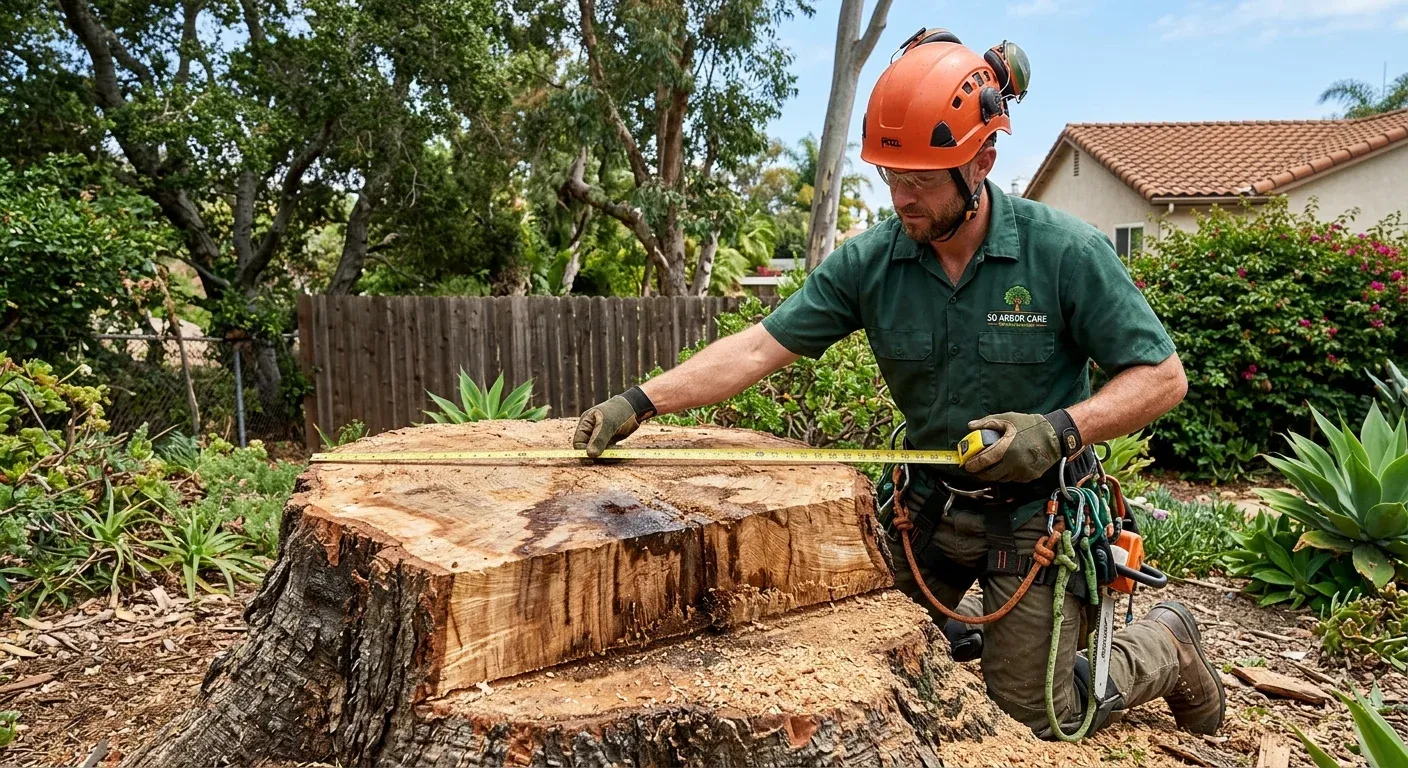
A San Diego stump grinding quote should define the stump, access, grinding depth, surface roots, debris handling, and your plans for the site. Providers may use diameter when building a quote, but the measurement alone doesn’t describe the whole job.
Branch Pro San Diego is a referral service. We match customers with licensed and insured independent local tree service pros. We don’t own grinding equipment or set prices. You hire and pay the matched professional directly.
What changes a stump grinding quote?
A useful written quote answers six questions before work begins.
How will the stump be measured?
Ask the provider to record each stump and explain the measurement used. The cut face, widest ground-level flare, and another agreed boundary can produce different measurements. Wide root flares or an irregular cut can make a single diameter unclear. Multiple stems should also be identified separately.
This gives you a consistent basis for comparing quotes. It also prevents one provider from describing only the cut face while another includes the full flare.
What grinding depth is included?
The quote should state the agreed depth and the area covered. The right scope depends on what will replace the stump.
A planting bed, lawn repair, walkway, utility project, and building project can need different site preparation. Grinding alone shouldn’t be described as concrete or foundation preparation. Ask the person responsible for the next project to define what must be removed.
Grinding reduces the stump to an agreed level. It doesn’t excavate the entire root system. Our stump grinding versus removal guide explains that distinction.
Are surface roots part of the scope?
Don’t assume visible roots are included. Mark the roots you want assessed and have the provider identify them in the quote.
The plan should distinguish the main stump from roots crossing a lawn, planting area, walkway, fence line, or irrigation route. It should also explain when a root will be left alone because grinding it could affect a nearby retained tree or another feature.
UC IPM warns that cutting or crushing established tree roots can contribute to delayed decline and instability. Excavation near a remaining tree needs a separate assessment before work begins. See UC IPM’s construction guidance and our guide to tree root removal after tree removal.
Can the equipment reach the stump?
Access affects the proposed method. Give each provider the same information:
- Gate and passage widths
- Steps, slopes, and tight turns
- Fences, pools, walls, and raised planters
- Soft ground or finished surfaces along the route
- Parking and equipment staging limits
A photo helps, but it may not show every constraint. The written quote should identify the planned access route and any property protection included.
What utilities or private lines are nearby?
Powered work shouldn’t begin until underground conflicts are addressed. Irrigation, lighting, pool equipment, septic components, and privately installed lines may not appear in a standard utility response.
DigAlert explains that utility members generally mark facilities they own or maintain, often only to the meter. Private facilities can require separate locating arrangements. Marks also don’t establish utility depth.
Ask the provider to state who will contact DigAlert, who will arrange any private locating, and what happens if a conflict is found. Don’t treat an unmarked area as proof that grinding or excavation is clear.
Who handles the chips and disturbed area?
A quote should say whether chips remain, are spread, or are hauled away. It should also state whether soil, backfill, grading, seed, sod, irrigation repair, or planting is included.
These are separate scope choices. A neat pile of chips isn’t the same deliverable as a prepared planting area.
How do you compare stump grinding quotes?
Put every quote against the same checklist.
| Written item | What to compare |
|---|---|
| Stumps covered | Count, location, and measurement method |
| Grinding boundary | Main stump only or identified surface roots |
| Grinding depth | The agreed depth for each location |
| Access | Equipment route, staging, and surface protection |
| Utility work | DigAlert contact and private-line locating responsibility |
| Debris | Chips left, spread, or removed |
| Site finish | Backfill, grading, planting, and repairs, if any |
| Changed conditions | How hidden metal, masonry, utilities, or other obstructions are handled |
A lower total may reflect a smaller scope. Compare the written work first, then compare price.
Grinding, excavation, or leaving the stump
Stump grinding isn’t the only possible plan. The intended use of the site should drive the choice.
Grinding
Grinding may fit when the goal is to reduce the visible stump without removing the entire root system. Confirm the depth, surface-root boundary, chip handling, and final grade.
Visit our stump grinding service page for the information to gather before speaking with a matched professional.
Physical excavation
Excavation removes more of the stump and root mass, but it also disturbs more soil. The plan must account for utilities, irrigation, nearby roots, access, and the resulting hole.
Excavation near a retained tree needs added care. Root damage can affect that tree after the site is closed and landscaped.
Leaving the stump or redesigning the area
Leaving the stump may avoid immediate excavation. A designer can assess whether the planting plan, path, or other site feature can move around it.
That choice should still account for the stump’s condition, access needs, and future maintenance. Don’t build over it based only on a grinding depth assumption.
Preparing the area for grass or another tree
Grass needs planting soil, not a mixture dominated by stump chips. Iowa State University Extension recommends removing chips, sawdust, and root fragments from the planting soil. Fill, compaction, moisture, nutrients, and settlement also need attention before seed or sod. Decaying wood can leave voids beneath the repaired area. Review its grass-after-stump-removal guidance.
Planting another tree creates a different decision. Remaining roots, altered soil, and the old tree’s pest or disease history may affect the location. A nearby planting spot can avoid some problems within the original stump area. Same-spot planting needs its own preparation, as explained by Iowa State University Extension.
Neither approach establishes preparation for a slab, foundation, or other engineered project. Give that project’s plans to the responsible professional before setting the stump scope.
Is renting a stump grinder cheaper in San Diego?
A machine’s daily rental rate covers a different scope from a professional stump-grinding quote. Before comparing totals, define gate width, slope, 811 locates, private irrigation, grinding depth, and chip handling. Ask who is responsible for protecting private lines and finished paving, and how damage would be handled. Branch Pro does not rent equipment or set prices. Compare the rental plan and written professional scope against the same next-use checklist above.
Chemical decomposition or burning
Natural decay is slow. Iowa State University Extension distinguishes commercial products intended to help stump wood decompose from products used to control sprouts. These are separate goals. Product directions and precautions vary, so follow the exact current container label rather than assuming one product does both. Review its stump-removal guidance.
Don’t treat label language about burning as permission to burn a stump. The San Diego County Air Pollution Control District says local fire authorities issue burn permits for a specific place, time, material, and quantity. An air-quality burn day doesn’t override fire restrictions or local prohibitions. San Miguel Fire & Rescue suspended permitted burning within its jurisdiction effective May 1, 2026.
Choose grinding when reducing the stump to an agreed level serves the next use. Choose excavation when more root mass and altered soil must be removed. Consider leaving or redesigning around the stump when disturbing the site would create a larger problem.
Our guide to removing a stump without grinding outlines questions to take to the appropriate professional.
How do you request a like-for-like quote?
Send every provider the same brief:
- Photograph each stump from several angles.
- Show the complete equipment route.
- Mark visible roots you want assessed.
- Describe the site’s next use.
- Identify known irrigation and private utilities.
- Ask for the measurement method, grinding depth, debris handling, and site finish in writing.
- Ask how changed conditions require approval.
A written scope makes exclusions visible. It also helps you avoid paying for a landscaping finish that another provider never included.
Before hiring, check the actual contractor and license status through the California Contractors State License Board lookup.
Frequently asked questions
Is stump grinding always priced by diameter?
No single pricing method applies to every provider. A company may use a per-inch, per-stump, or complete-job quote. It may consider diameter alongside access, grinding depth, roots, debris, equipment, and site conditions. Ask how the provider measured the job and compare the complete written scope.
Does grinding include every surface root?
Not automatically. The quote should identify which roots are included and where grinding stops. Roots near retained trees, utilities, hardscape, or structures may need a different assessment.
Can I place concrete over a ground stump?
Grinding depth alone doesn’t establish foundation preparation. Give the future project plans to the responsible designer or contractor. Have that professional specify the excavation and soil preparation needed before you approve the stump scope.
Does DigAlert mark irrigation and other private lines?
Not necessarily. DigAlert says member utilities generally mark facilities they own or maintain. Private irrigation, lighting, drains, and other facilities can require separate locating. Ask who is responsible for that work.
Is stump grinding included with tree removal?
It depends on the written quote. Treat tree removal, stump grinding, surface-root work, debris handling, and site restoration as separate scope items unless the quote clearly combines them.
Get a scope-specific stump quote
Call (858) 400-4423 to be matched with a licensed and insured independent local pro. Describe the stump, access route, known utilities, visible roots, and planned site use before comparing written quotes.
The local service pages for Rancho Bernardo, Carlsbad, and Escondido can help you organize location details. If the tree is still standing, request separate written scope for tree removal and stump work.