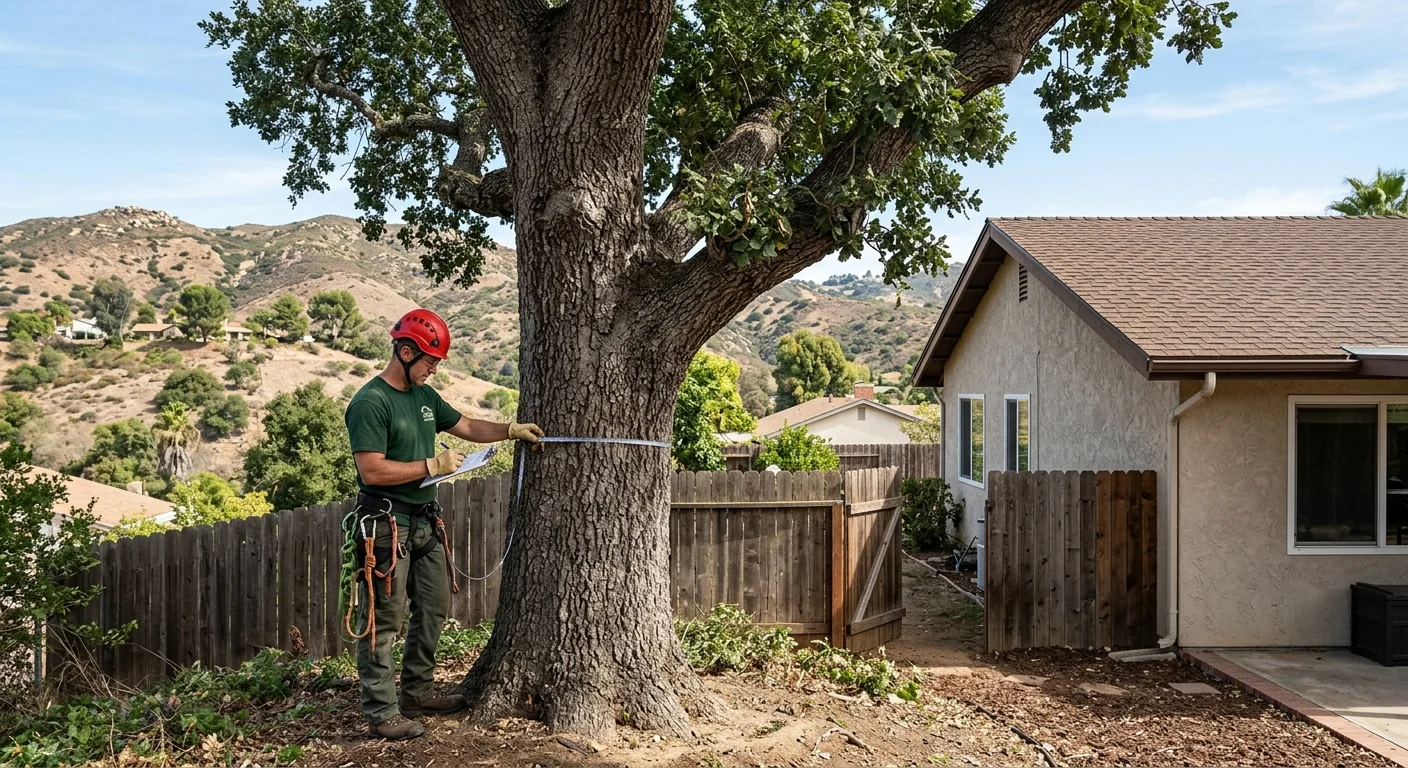
A tree beside an El Cajon home may need clearance, structural work, or a health look. Heat and wind can shape that decision. They don’t set the scope by themselves. Start with what you can see from already-safe ground.
What should you record before anyone writes cuts?
“The tree is too big” doesn’t tell a professional which branches concern you. Note what you can see without walking under failed wood or approaching lines.
A branch may extend over the roof. Lower growth may block a driveway or press against a fence. Deadwood may be visible in the crown. One side may look much denser than the other. These observations give the independent company a place to begin.
Name the result you want. Clearance from a structure, dead-branch removal, and a weak-looking union are different jobs. Appearance can matter. It shouldn’t replace an assessment of the tree.
Tree trimming and shaping and structural pruning aren’t interchangeable labels. Ask the professional to describe the proposed cuts and their purpose. TCIA treats trimming and pruning as work with named objectives.
If defensible space is the concern, say that before the inspection. Public Resources Code section 4291 applies in State Responsibility Areas. Locally designated Very High Fire Hazard Severity Zones follow Government Code section 51182. That isn’t a countywide 100-foot rule, and it isn’t automatic on every El Cajon mailing address.
CAL FIRE’s Ready for Wildfire guide describes Zone 1 as 30 feet from structures or to the property line, whichever is closer. It describes the first five feet as Zone 0 and says that statewide Zone 0 rule is not legally required yet. The Board of Forestry approved a final draft on August 19, 2026. As of September 5, 2026, OAL still listed that package as under review. Local rules may already apply. Confirm the map and the fire authority for the parcel before anyone writes a clearing scope.
The El Cajon tree service guide covers other reasons a property owner may contact a tree professional.
How should heat and wind show up in the assessment?
Heat and wind are exposure conditions, not diagnoses. From already-safe ground, show where afternoon sun reaches the tree. Note any side that moves in wind only if you can see it without entering a failure zone. Mention new dieback or a branch position that looks different.
UC IPM notes that too little water and too much water can produce similar foliar decline. Saturated soil can starve roots of oxygen. A brown canopy isn’t an automatic instruction to water more. Irrigation planning depends on species, season, soil, drainage, root depth, and the actual emitters. Demand generally rises in hot, sunny, windy, low-humidity weather. Ask the professional to assess root-zone moisture and irrigation coverage, not a citywide watering calendar.
Salt injury can also brown leaf margins inland, not only on the coast. UC IPM salinity guidance lists saline irrigation water, arid soils, fertilizer salts, and other sources. Symptoms overlap drought. Testing should establish salinity before anyone treats the canopy.
Canopy thinning isn’t a drought-water-saving prescription. Dead branches don’t consume the tree’s water. ISA’s mature-tree pruning brochure asks for a purpose on each cut, with foliage removal based on the tree’s size, species, age, and objective.
This guide to coastal and inland tree trimming compares site conditions without treating one regional label as a diagnosis.
What do roofs, fences, and El Cajon parkway trees change?
Nearby structures change how work is planned. They don’t reveal what’s wrong with the tree. Identify gates, steps, walls, and planted areas from a safe walk. Show which surfaces or access points belong to a neighbor. Mention locked areas or pets before a work date is arranged.
Ask the company to put access assumptions in writing. Don’t assume a fence opening fits a particular method. Don’t promise access through an adjoining parcel.
El Cajon Urban Forestry handles parkway pruning. Owners water those trees and must not independently trim or remove them. Condition and public-safety concerns are reviewed. They aren’t automatic removal rights. Report city-tree or public-policy issues to Public Works through the city’s requests and issues page. Backyard tree health is a separate question for an independent qualified assessment. An El Cajon mailing address can still be unincorporated county jurisdiction, which is not the same as County-owned land. Confirm the parcel before you treat County PDS as the office, or the city as the office.
Injury or an immediate threat to life is a 911 call, whether or not lines are involved. Power lines require a separate decision. Stay away from the tree and the lines. Call SDG&E before any affected private work. If a line is down, stay away and call 911 and SDG&E at 1-800-411-7343 from a safe place. Don’t use a distance table to decide whether you may approach. Qualified line-clearance personnel handle electrical tree work. A contractor license or ISA credential doesn’t create that qualification.
Check the company on the CSLB license lookup. Tree work may be performed under C-49 or an active legacy C-61/D-49 issued before January 1, 2024. CSLB bulletin 23-07 keeps those legacy licenses valid. You can also use our El Cajon service page to request a local match.
Why do topping and heavy thinning need careful review?
Topping and heavy thinning aren’t complete work scopes. Ask for the proposed cuts, their locations, and the reason behind them.
ISA’s guide to topping describes stubs, sun injury, decay, and weakly attached sprouts. Reduction to a suitable lateral is a different cut. Our tree topping in San Diego guide can help you prepare questions. It shouldn’t replace an on-site assessment.
Don’t approve a percentage that lacks a tree-specific objective. TCIA’s prescription discussion says a dose should fit objective, species, vigor, health, and interval.
Occupied nests and eggs receive protection throughout the year. CDFW describes February through August as typical for many species, with nesting possible year-round in some places. That isn’t a permit, and it isn’t permission to disturb an active nest after a calendar date. If birds could be nesting, CDFW recommends a consulting biologist’s pre-work survey. A biologist may set a buffer, or work can wait until nesting is complete. Don’t move nests to inspect them.
When should trimming pause for a health look?
Pause before approving routine shaping when an oak shows crown thinning, dieback, bark staining, D-shaped holes, or woodpecker injury. Those can be clues associated with goldspotted oak borer. They aren’t a diagnosis from holes alone.
Goldspotted oak borer primarily affects coast live oak and California black oak. Canyon live oak is also affected. Engelmann oak is rarely affected. UC’s current distribution maps record ongoing oak mortality in many areas throughout San Diego County, with isolated confirmed areas in Riverside, Orange, Los Angeles, San Bernardino, and Ventura. UC IPM distinguishes D-shaped exit holes from nonspecific thinning or staining. Management options differ for prevention, lightly damaged high-value trees, and heavily damaged trees. Suspect infested oak wood needs professional handling before it’s moved.
Bark beetles can attack trees weakened by drought, disease, injury, or other stress. Only a few aggressive species are sole causes of mortality. Healthy trees can withstand limited attacks. Unexplained dieback still deserves a health review before a cosmetic trim.
ISA Certified Arborist is an individual credential, not a California contractor license. A directory listing is voluntary. Ask for a digital certificate if that credential matters. Branch Pro San Diego matches homeowners with licensed, independent local tree professionals. The selected company performs the inspection and physical work. You contract with that company directly.
Frequently asked questions
Does every El Cajon lot need 100 feet of defensible-space trimming?
No. PRC 4291 applies in State Responsibility Areas. Local VHFHSZ rules follow Government Code 51182 and the fire authority for the parcel. Confirm the map before anyone writes a 100-foot scope.
Can I photograph a leaning El Cajon tree after wind?
Only from a place that’s already safe. If the tree is moving, splitting, or dropping wood, leave the area. Don’t circle an unstable tree, probe the trunk, or walk under hanging limbs. Injury or an immediate threat to life is a 911 call.
Who trims a parkway tree in El Cajon?
The city handles parkway pruning. Owners water those trees and shouldn’t trim or remove them independently. Report concerns to Public Works.
When to call us
Call when an El Cajon tree needs a licensed professional to assess trimming, access, structural concerns, or visible decline. Branch Pro San Diego is a referral service. We match you with a licensed, insured independent local tree company. You hire and pay that company directly.
Call us at (858) 400-4423 and we’ll connect you with a licensed local tree company.