African sumac should be identified and inspected before you blame it for roots or weak trunks. The species isn’t automatically brittle or destructive. Its actual form, defects, root space, and nearby construction should drive the decision.
Branch Pro San Diego connects property owners with licensed, insured independent tree service professionals. The professional who sees the tree sets the scope, availability, and price.
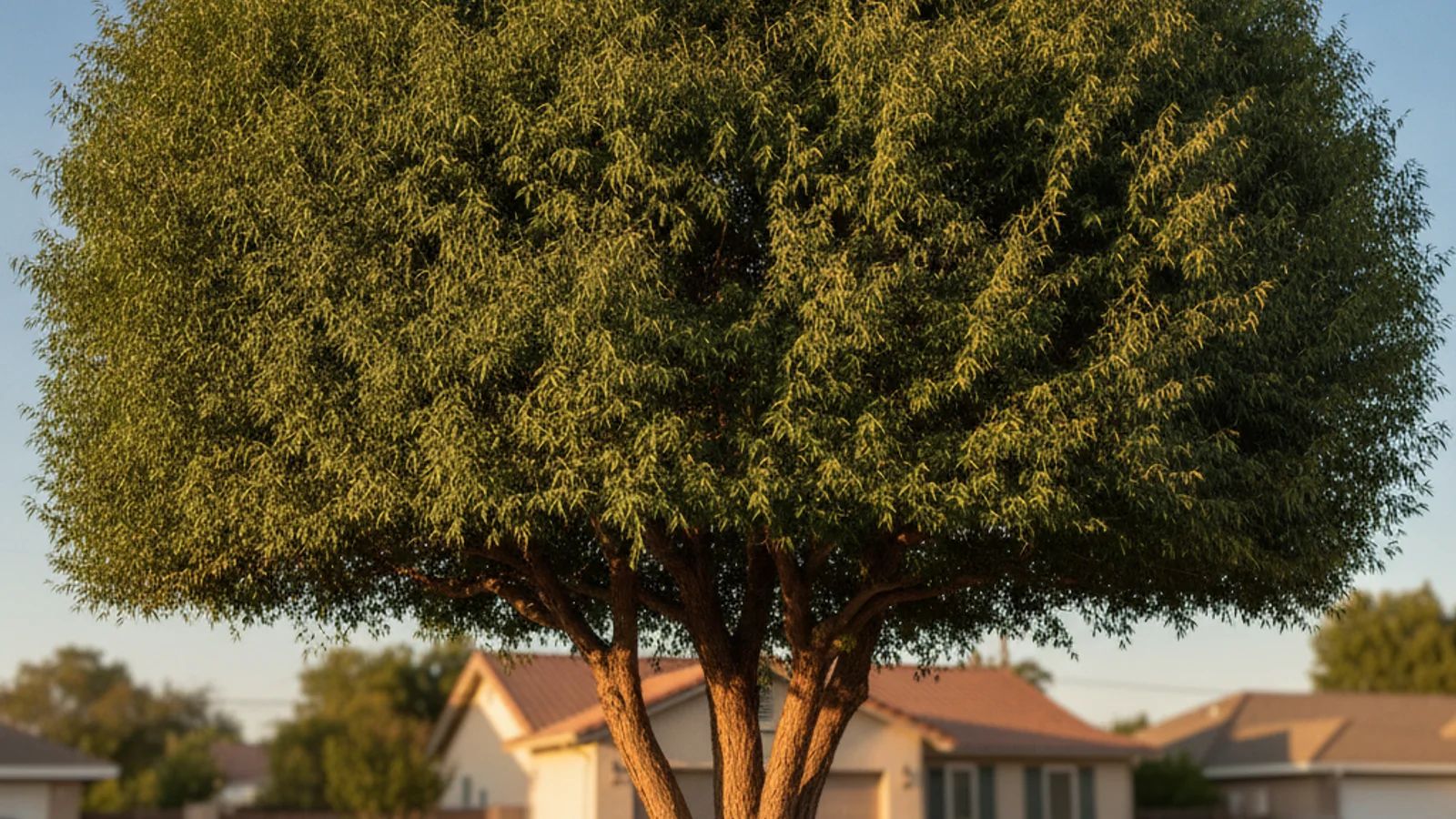
Illustration: a dense garden tree with a rounded canopy. The image doesn’t confirm the species or location.
How do you identify African sumac?
African sumac is now classified as Searsia lancea. Rhus lancea is its former botanical name. The South African National Biodiversity Institute describes an evergreen tree with narrow, leathery leaflets arranged in groups of three. Older wood has darker, rough bark, while young growth can appear reddish.
Its form varies. SANBI describes a usually single, low-branching stem and a dense, rounded crown. That means multiple trunks alone shouldn’t be treated as a defining feature.
Male and female flowers grow on separate trees. Female trees can produce small fruits. Flowering and fruiting dates published for southern Africa shouldn’t be used as a San Diego calendar.
How large can African sumac become?
Cal Poly’s SelecTree profile lists a maximum profile of about 30 feet high and 35 feet wide. Actual size depends on the site and care.
The same profile places African sumac in its very-low-water category. That classification can help with plant comparison, but it doesn’t establish a watering schedule for an individual yard. Irrigation, drainage, establishment, and nearby plants still matter.
For other landscape comparisons, see our guide to drought-tolerant trees in San Diego.
Are African sumac roots aggressive?
Cal Poly rates African sumac’s root-damage potential as low. That rating isn’t zero risk, and it doesn’t prove what caused an existing crack.
If roots appear beside lifted paving, document the root flare and damaged area. Check drainage, settlement, irrigation, and recent construction before choosing a repair. Our guide to tree roots near foundations explains why visible proximity isn’t the same as proven structural damage.
Root cutting also carries its own risk. UC Integrated Pest Management explains that cutting or crushing established roots can cause delayed decline. Damage to large roots may also reduce stability.
A root barrier can redirect growth in some settings. It can’t promise permanent protection, and installing one may disturb existing roots. Ask for the proposed trench location, affected roots, utility conflicts, and paving plan before approving excavation.
Does African sumac have brittle branches?
Cal Poly gives African sumac a medium branch-strength rating. Inspect the individual tree instead of predicting failure from species alone.
Look for conditions that can actually be inspected:
- Cracks at branch or trunk unions
- Hanging or broken limbs
- Cavities or decay at an attachment
- A recent lean or soil movement
- Major root cutting near the trunk
- Branches contacting structures or utilities
A dense canopy isn’t proof that thinning is required. Pruning should address a named defect, clearance need, or structural goal.
How should African sumac be pruned?
Start with the least foliage removal needed for the objective. The International Society of Arboriculture’s mature-tree guidance says mature trees generally tolerate less removal than younger trees. Species, age, condition, size, and purpose all affect the scope.
Avoid topping. ISA’s topping guide explains that indiscriminate cuts can stress trees and produce weakly attached sprouts. Proper reduction preserves suitable lateral branches and differs from cutting limbs back to stubs.
Set pruning timing from the tree’s condition, the specific objective, nesting activity, and site access. See our tree-pruning guide for scope questions.
Prune, manage, or remove: a decision guide
| What you find | Useful next step |
|---|---|
| Healthy crown with no specific conflict | Keep the tree and avoid unnecessary cutting |
| One damaged or poorly attached branch | Request targeted pruning options |
| Raised paving beside visible roots | Assess roots, drainage, and paving together |
| Proposed trench through established roots | Review stability and alternatives first |
| Split union, major decay, or recent movement | Request a prompt tree-risk assessment |
| Conflict that can’t be managed acceptably | Compare removal and site-restoration scopes |
| Tree in a parkway or right-of-way | Confirm city authority before private work |
Is fruit or volunteer growth a reason to remove it?
Fruit confirms that the tree is female, but fruit alone doesn’t decide whether removal is appropriate. Document the actual maintenance issue, such as unwanted volunteers or debris in a specific area. Then compare cleanup, targeted pruning, and removal without assuming every female tree creates the same problem.
Cal-IPC’s 2022 inventory update evaluated African sumac but didn’t add it to the inventory. It identified moderate potential risk for further evaluation. That assessment isn’t immunity, legal permission, or a reason to ignore the individual tree and site rules.
Does African sumac need a removal permit?
Species alone doesn’t answer the permit question. Jurisdiction, ownership, right-of-way location, protected status, and project conditions may matter.
Within the City of San Diego, the street-tree maintenance process covers permit requests for street-tree trimming, removal, planting, and root pruning. Other San Diego County cities have their own processes. Confirm the parcel jurisdiction and tree location before work. Our tree-removal permit guide can help organize that check.
Frequently asked questions
Is African sumac always a multi-trunk tree?
No. SANBI describes it as usually having one low-branching stem, although tree form varies. Identify the specimen from its leaves, bark, crown, and other visible traits.
Are African sumac roots dangerous to foundations?
Cal Poly rates the species’ root-damage potential as low. That doesn’t rule out a site-specific conflict. A foundation concern needs evidence from the structure and surrounding soil, not a species label alone.
Is African sumac a messy tree?
Female trees can produce small fruits. Base cleanup, pruning, or removal decisions on what the individual tree produces and where the material lands.
What does African sumac removal cost?
Ask each independent professional to quote the same tree, access, nearby targets, stump scope, roots, debris handling, and final site condition.
Should an African sumac be removed before wind season?
Species alone doesn’t justify preventive removal. Inspect actual attachments, decay, damage, lean, roots, and nearby targets. A documented defect can then guide pruning, monitoring, or removal.
Get help with an African sumac
Call (858) 400-4423 if you need pruning, root assessment, or tree removal. Branch Pro San Diego will connect you with a licensed, insured independent local professional who can inspect the tree and provide a job-specific quote.