A ficus beside raised paving or a troubled sewer line doesn’t automatically need removal. First identify the tree, confirm who controls the site, and determine whether roots caused the damage. Pruning, root management, pipe repair, and removal solve different problems.
Branch Pro San Diego connects property owners with licensed, insured independent tree service professionals. The professional who inspects the site sets the scope, availability, and price.
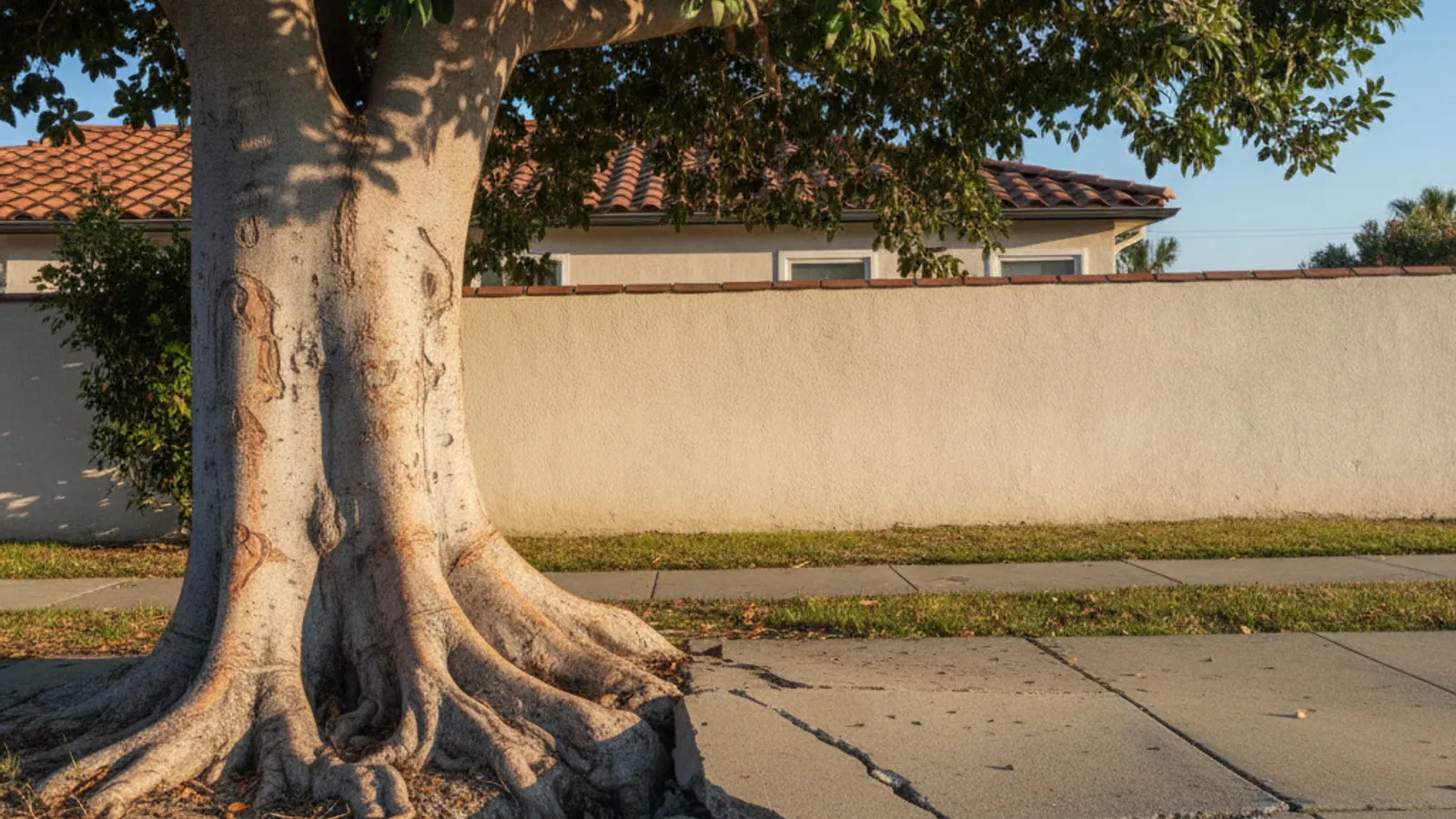
Illustration: a large evergreen tree with exposed roots beside raised, cracked paving. The image doesn’t confirm the species, location, or cause of the damage.
Which ficus tree do you have?
Two useful comparisons are Indian laurel fig and weeping fig. They look similar from a distance but have different forms.
Ficus microcarpa, also called Indian laurel fig, has glossy oval leaves and smooth gray bark. A mature landscape tree can develop a broad, rounded canopy. Cal Poly lists a maximum profile of 60 feet high and 55 feet wide. It also assigns the species moderate root-damage potential and marks it unsuitable beneath utility lines.
Ficus benjamina has drooping branchlets and glossy leaves with long, tapering tips. A clipped hedge may hide those traits, so compare several leaves and branches before deciding.
Is the Balboa Park Moreton Bay fig the same tree as a yard ficus?
Usually no. The landmark tree at Balboa Park is Ficus macrophylla, a Moreton Bay fig. Balboa Park’s Moreton Bay Fig page says it was planted for the 1915 Panama-California Exposition. A 1996 measurement recorded 78 feet in height, a 123-foot crown, and a 486-inch trunk girth. The park also notes it is one of the three largest Moreton Bay figs in California.
A backyard ficus lifting a sidewalk is more often Indian laurel fig or a clipped weeping fig. Don’t use the park tree’s size as a quote for a residential tree. Don’t climb the park tree. The park fenced it after soil compaction from foot traffic damaged surface roots.
Are ficus roots causing the damage?
Visible roots beside lifted paving make ficus involvement possible. They don’t prove the tree caused every crack nearby. Settlement, drainage, soil movement, and construction can also affect hardscape.
Start by documenting the root flare, paving movement, and distance between them. A tree professional can assess visible roots and tree stability. If a drain backs up, a qualified plumbing inspection should identify the pipe defect and obstruction. Tree appearance alone can’t show what’s happening inside a sewer lateral.
Avoid cutting large roots simply to flatten a slab. UC Integrated Pest Management warns that cutting or crushing established roots can cause delayed decline. Large-root damage can also reduce stability, especially in wet soil. Our guide to tree roots near sidewalks and sewer lines explains the separate tree and pipe questions.
Can a root barrier save the tree?
A barrier may redirect some new root growth, but it isn’t a permanent guarantee. Soil drainage and the barrier’s placement affect what roots do next. Installation may also require excavation through existing roots.
Before choosing a barrier, ask:
- Which roots would be cut or exposed?
- Could paving be adjusted without major root loss?
- Where are public and private utilities?
- Is the goal safer paving, pipe protection, or both?
- How will the work affect tree stability?
Root pruning, paving changes, and barriers should be considered together. One contractor’s paving plan shouldn’t be separated from the tree assessment.
Prune, manage, or remove: a ficus decision guide
| What you find | Useful next step |
|---|---|
| Dense growth without a specific defect | Define a pruning goal before approving cuts |
| Raised paving beside visible roots | Assess roots, drainage, paving, and ownership |
| Repeated drain trouble | Obtain a plumbing inspection before blaming the tree |
| Proposed trench or root barrier | Review root loss and utilities before excavation |
| Major root loss or structural defects | Request a tree-risk assessment and compare removal |
| Tree within a public right-of-way | Contact the responsible city before private work |
How should a mature ficus be pruned?
Each cut should have a clear purpose. Useful goals may include removing dead branches, improving clearance, or reducing a specific structural concern.
The International Society of Arboriculture’s mature-tree guidance says mature trees generally need less foliage removed than younger trees. Size, age, species, condition, and the pruning objective all matter. Routine thinning doesn’t automatically improve tree health.
Topping is different from proper reduction. ISA explains that indiscriminate cuts can stress a tree, expose tissue, and produce weakly attached sprouts. Ask the person writing the scope to name the branches and objective instead of requesting a generic percentage.
See our tree-pruning service guide and tree-trimming guide for those distinctions.
When does ficus removal make sense?
Removal becomes worth comparing when defects, root loss, or site conflicts can’t be managed acceptably. It may also be considered when a repair would repeatedly disturb important roots.
A useful removal quote should define:
- Tree and stump scope
- Access and protection for nearby surfaces
- Handling of visible surface roots
- Utility and irrigation conflicts
- Debris and chip removal
- Final grade and site restoration
Independent professionals price the actual site. Branch Pro doesn’t set removal prices or promise what every quote includes. Our tree removal guide covers the work categories to compare.
Is your ficus a City of San Diego street tree?
Don’t decide ownership from the species or the apparent edge of your yard. Trees in parkways and rights-of-way may fall under city control.
The City of San Diego’s street-tree maintenance page says No-Fee Permit requests cover street-tree trimming, removal, planting, and root pruning after City inspection. Report City-maintained tree concerns through Get It Done. A private crew’s availability isn’t permission to alter a street tree.
Rules differ elsewhere in San Diego County. Confirm the parcel jurisdiction, tree location, and any protected designation before work. Our San Diego tree-permit guide helps organize those questions.
Frequently asked questions
Are ficus trees always bad near paving?
No. Cal Poly rates Ficus microcarpa’s root-damage potential as moderate, not inevitable. Existing damage, available root space, drainage, and previous construction matter more than a label alone.
Does every ficus with exposed roots need removal?
No. Exposed roots call for a site assessment. Removal may be reasonable when root loss, structural condition, or an unresolvable site conflict creates unacceptable risk.
Can root cutting repair a sewer problem?
Root cutting doesn’t repair a cracked or separated pipe. A qualified plumbing inspection should determine the pipe’s condition and repair scope. The tree decision can then account for any roots near that work.
How far should a ficus be planted from paving?
Use the tree’s mature size, soil, drainage, utilities, and available root space to choose a location. Cal Poly lists a broad mature canopy and moderate root-damage potential for Ficus microcarpa.
Does a private ficus need a removal permit?
Private ownership doesn’t create a countywide exemption. Requirements depend on the jurisdiction, tree location, designation, and project conditions. Confirm those details with the city or county before cutting.
What does ficus removal cost?
Ask each independent professional to quote the same tree, access, nearby targets, stump scope, root work, debris handling, and site restoration.
Get an estimate for your ficus tree
Call (858) 400-4423 if you need pruning, root assessment, or removal options. Branch Pro San Diego will connect you with a licensed, insured independent local professional who can inspect the property and provide a job-specific quote.
Trying to distinguish similar evergreen trees? Compare the identification details in our guide to carrotwood trees in San Diego.