TL;DR
- Identify the oak and describe what changed before naming a pest.
- D-shaped exit holes are a GSOB clue. Crown thinning or bark staining is not a diagnosis.
- Keep suspect oak wood on the property until handling is arranged.
- Water from soil moisture, drainage, and the root crown, not a countywide hose schedule.
- Prune for a stated purpose. There is no universal November-only oak season.
- Confirm the parcel jurisdiction before removal. Native oaks are not one countywide permit class.
- Branch Pro San Diego refers licensed, insured independent local professionals.
Oak care in San Diego starts with the tree in front of you. Separate goldspotted oak borer signs from other decline. Then match watering, pruning, and wood handling to that tree.
Branch Pro San Diego is a referral service. We connect customers with licensed, insured independent local tree professionals. You hire and pay the professional directly. We do not inspect, prune, treat, or remove trees.
What should you look at before calling it GSOB?
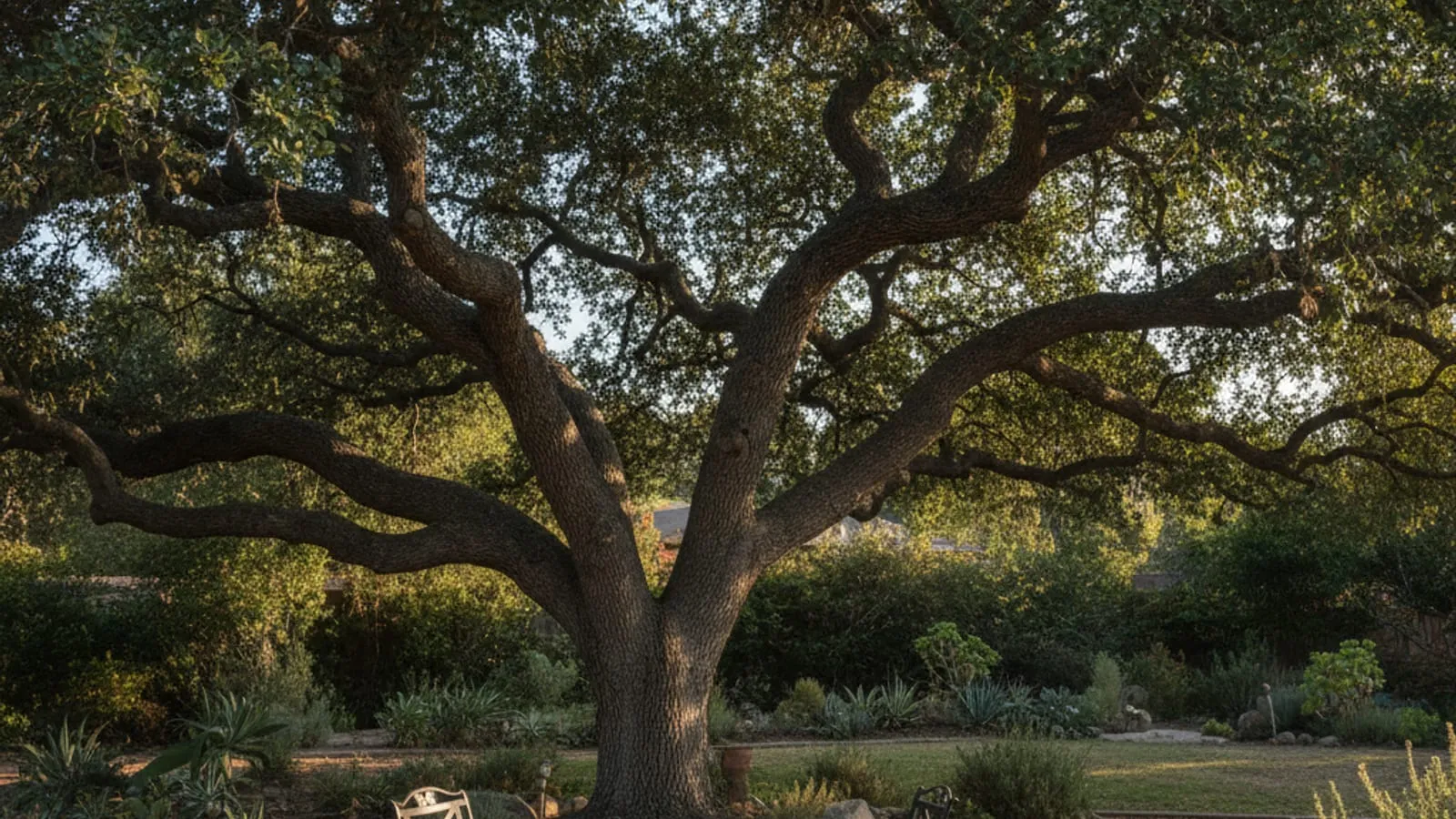
Name the oak if you can. Coast live oak and Engelmann oak both appear in San Diego yards. Species, size, and recent site changes belong in the notes you give an assessor.
Goldspotted oak borer, Agrilus auroguttatus, is present in San Diego County. UC ANR’s current distribution page also records infestations in Orange, Los Angeles, San Bernardino, and Ventura counties. Moving infested firewood is a likely route for new satellite infestations.
UC IPM distinguishes D-shaped adult exit holes from nonspecific crown thinning or bark staining. Thinning, staining, or woodpecker work can have more than one cause. Do not treat those signs as a home diagnosis or an automatic removal order.
From the ground, photograph the whole canopy, the trunk, and the root flare. Note broken limbs, new cracks, soil movement, and recent irrigation or construction. Stay away from unstable trees and any line contact.
If the tree is on or near a downed power line, keep clear. From a safe place, call 911 and SDG&E at 1-800-411-7343. SDG&E decides whether lines can be de-energized, covered, or moved. If a standing oak already touches or hangs into overhead lines, stay off the tree and off any ladder. Call SDG&E first. Do not prune toward an energized conductor.
How does UC describe GSOB management?
UC’s management options separate prevention and lightly damaged high-value trees from heavily damaged trees. Treatment may be discussed for low-level infestation or for prevention on an uninfested tree. Heavily damaged trees are a different case. Removal and correct wood handling may be needed.
Ask a qualified pest-control professional to identify the pest and explain the evidence. After diagnosis, that professional chooses whether treatment is appropriate and which current protocol to use. Do not start a home pesticide recipe from a photograph. Product names, rates, and intervals change.
Infested green wood can continue producing adults. Keep that wood on the property. Ask how it will be stored, chipped, or disposed of under the rules that actually apply.
What about other oak disease concerns?
Unexplained trunk staining or rapid canopy loss still needs a diagnosis. Those symptoms are not proof of goldspotted oak borer, and they are not proof of sudden oak death.
San Diego County’s agricultural program monitors sudden oak death in local nurseries. That is a diagnostic and exclusion contact path. It does not establish wildland infection on a particular oak, and it does not prove the disease is absent.
Keep disease labels off the tree until someone identifies the cause. Our guide to signs a tree is dying can help you describe decline without jumping to a name.
How should a San Diego oak be watered?
Check the soil, not a calendar. Feel moisture near the drip line and closer to the trunk. Note whether water ponds around the root crown.
UC’s summer irrigation discussion found that root-zone moisture matters for established oaks, and that supplemental irrigation can help during prolonged drought. That work studied valley oaks near Stockton. Do not copy its timing, soil, or water volumes onto a San Diego coast live oak or Engelmann oak.
Useful local observations are simpler. Note whether the oak sits in lawn spray. Note whether the root crown stays wet. Note whether the winter was dry, and whether grading or paving changed drainage.
Frequent shallow watering is a poor match for a tree that needs an assessed soil-moisture plan. Persistent wetness against the trunk is also a problem to flag. A qualified professional can judge whether this tree needs more water, less water, or a drainage change.
Root injury is a separate risk. UC IPM explains that cutting or crushing roots, and compacting soil, can cause delayed decline. Large-root injury can also reduce stability, especially in wet soil. Fence the root area before nearby construction whenever you can.
How should a mature oak be pruned?
Prune for a purpose. Dead, broken, or conflicting wood is a different job from cosmetic thinning.
ISA’s mature-tree guidance says each cut needs a reason. Mature trees generally tolerate less foliage removal than younger trees. Size, species, age, condition, and the objective all affect the plan. Routine thinning does not automatically improve health.
Do not use a universal November-through-January oak rule. UC’s coast live oak FAQ discusses summer timing after new foliage matures, and it notes that disease conditions change the plan. That is not an order to prune every San Diego oak in July. Evergreen versus deciduous oaks, the tree’s condition, and the pruning goal still matter.
Leave wound paint and home chemical mixes out of the plan unless a current professional protocol calls for a specific product. Do not treat fresh cuts as a guaranteed GSOB invitation or as permission to wait for a fixed rain-free window.
Avoid topping. ISA’s topping guide explains that indiscriminate cuts to stubs can stress trees, expose tissue, and produce weakly attached sprouts.
If birds could be nesting, CDFW recommends a consulting biologist’s survey. For many species, February through August is typical, and nesting can occur at other times. Do not move or disturb a nest to inspect it.
Large-tree work, climbing, and powered cutting belong with a qualified professional. See the San Diego pruning calendar for species timing, then still plan this oak individually.
What should you do with oak wood?
UC’s firewood guidance discourages moving infested oak wood out of local areas. It lists voluntary-quarantine material. That is not a countywide mandatory quarantine, and it is not a 10-mile transport rule.
Keep suspect wood on the property. Ask the professional how it will be handled, stored, chipped, or disposed of under the rules that actually apply. Do not treat kiln temperature claims as an approved home method. UC still describes that research as under investigation for GSOB.
When does oak removal enter the discussion?
Removal is a site-specific recommendation, not the default for a native oak. It may be discussed when a qualified assessment finds advanced damage, a failure-prone defect, or a conflict that pruning and site changes cannot manage.
Ask what was observed, what remains uncertain, and why removal fits better than monitoring or pruning. Get the recommendation in writing. A second opinion is reasonable when the tree is large and the diagnosis is still thin.
If removal proceeds, a tree removal quote should name the tree, access, nearby targets, wood handling, stump work, and the finished grade. Branch Pro does not set prices. The independent professional quotes the job. You approve payment directly.
Who controls permits on this parcel?
A mailing address is not enough. Confirm the parcel jurisdiction, whether the oak is private, public, or in a right-of-way, and whether a protected designation or project condition applies.
La Jolla is a City of San Diego community, not a separate tree city. City street-tree trimming, removal, planting, and root pruning use the City’s inspection and no-fee permit process. Report City-maintained trees through Get It Done. Read the City maintenance process.
Poway is different. Poway Municipal Code section 12.32.150 requires a private-tree removal permit for native or heritage trees. Native species in that code are coast live oak, canyon live oak, Engelmann oak, and California sycamore. Heritage status is a City Council designation, not every large oak. Public trees go through Poway Urban Forestry.
Rancho Santa Fe and Alpine are unincorporated. Start with County Planning & Development Services. Native vegetation clearing can be a separate review from a city street-tree permit. Fire-district clearing still stops at property lines and recorded easement conditions.
Our tree removal permit guide can help organize that check. Do not assume every native oak needs a permit, and do not assume none does. If permit filing is part of the job, put in writing who prepares and who submits it. The matched crew may handle paperwork only when that is in the agreed scope.
What should you ask before hiring oak work?
An ISA credential belongs to a person, not a company. If someone claims it, ask for that person’s name and a current digital certificate. You can also check the ISA credential directory. A missing listing does not, by itself, disprove certification.
Ask what California contractor classification covers the proposed work. Current C-49 holders and qualifying legacy D-49 holders can both be legitimate, depending on the license history. Verify the license on the CSLB lookup.
Useful scope questions include:
- What condition was observed, and what supports that reading
- Whether treatment, pruning, monitoring, or removal is proposed, and why
- How suspect wood will be handled
- What root-zone or irrigation changes are recommended
- Who confirms permits and who stays off City or utility property
An arborist consultation referral can start that written assessment. It does not promise a particular credential or a one-visit answer.
Frequently asked questions
How do I know if my oak has GSOB?
Look for D-shaped exit holes, then get the finding identified. Crown thinning, bark staining, or woodpecker work can have other causes. A qualified professional should separate what was seen from the diagnosis.
Can I water my oak tree?
Yes, when the soil and tree actually need it. Check moisture, drainage, and the root crown. Do not run a lawn schedule against the trunk, and do not copy a soaker-hose recipe from another region.
When should a San Diego oak be pruned?
When there is a stated objective and a plan for this tree. UC does not support a countywide winter-only oak rule. Hazard wood can need attention outside any cosmetic season. Watch for nesting birds before work.
Does every native oak need a removal permit?
No. Jurisdiction, tree location, protected status, and project conditions decide the path. Confirm the parcel with the city or County PDS before contracting removal.
How is oak removal priced?
The independent professional quotes the specific tree, access, nearby targets, wood handling, stump work, and restoration. Branch Pro does not set prices or permit fees.
Call (858) 400-4423 to request an oak assessment or tree removal referral. We will connect you with a licensed, insured independent local professional. Ask that person for a written scope before you decide.
Coast live oak is one of San Diego’s native trees. Native trees of San Diego covers other local species and trees that only look native. If the tree’s identity is still unclear, start with how to identify the tree in your San Diego yard.