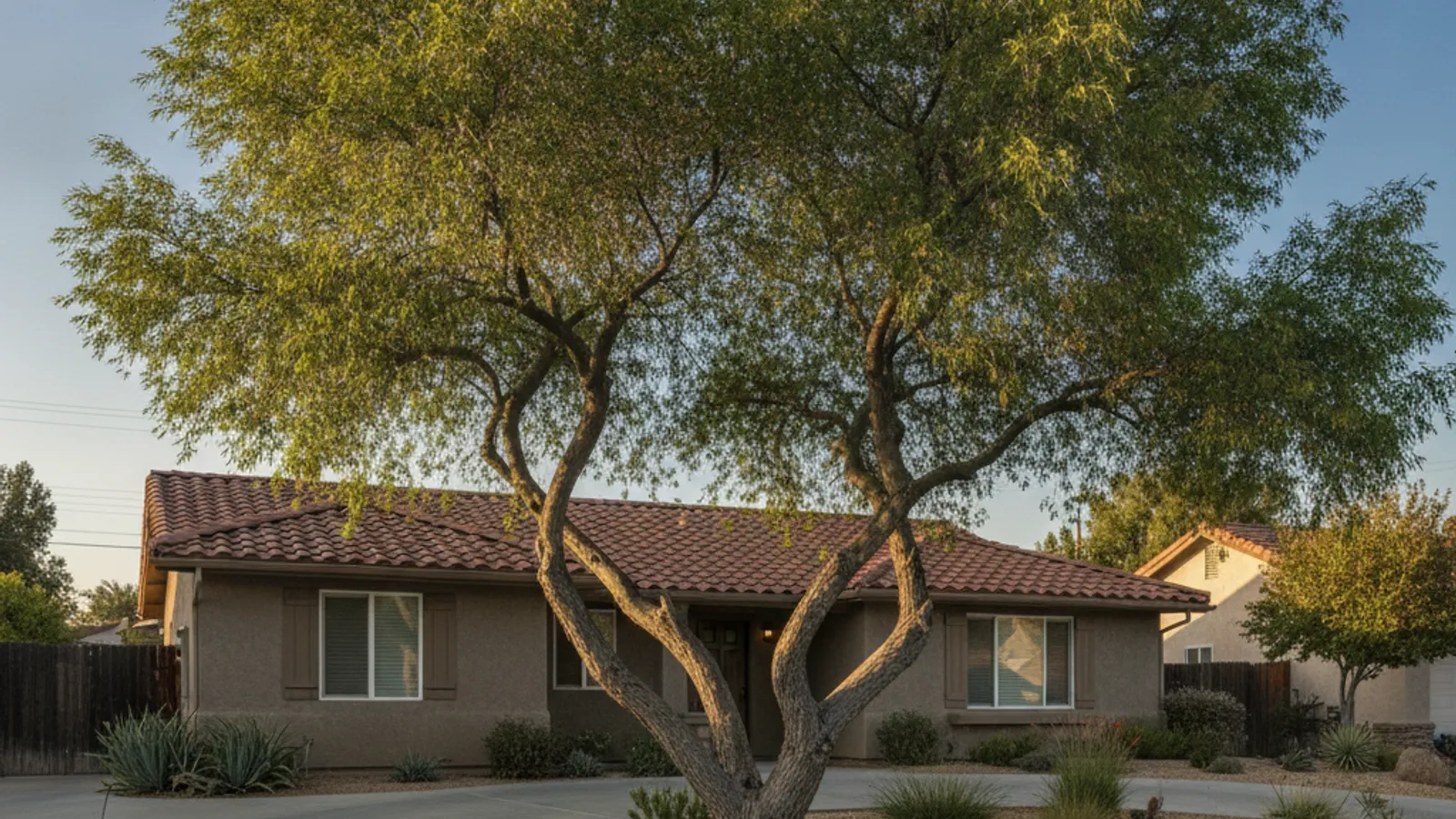
Chilean mesquite can suit an inland San Diego yard when its canopy, thorns, and actual defects fit the site. The useful questions are whether the tree’s structure needs inspection, whether roots already conflict with paving or pipes, and whether pruning or removal matches those findings.
Branch Pro San Diego is a referral service. We connect customers with licensed, insured independent local tree professionals. You hire and pay the professional directly. We do not prune, grind roots, or remove trees, and we do not promise species experience on every job.
What is a Chilean mesquite tree?
Chilean mesquite is Prosopis chilensis, also listed as Neltuma chilensis. Cal Poly’s SelecTree profile describes a South American tree with fine compound foliage, yellow spring flowers, and pods. It is typically multi-stemmed. The species hybridizes readily, and thornless varieties exist. The species is not uniformly thornless.
Cal Poly describes the tree as deciduous in the field and semi-deciduous in other profile text. Do not treat every San Diego specimen as evergreen year-round. Confirm the actual foliage pattern, thorns, and seedpods on your tree before planning work.
Cal Poly rates the species in a Low water category. That rating helps explain why this tree is used in hotter inland yards such as El Cajon, Santee, Lakeside, Poway, Escondido, San Marcos, and Ramona. Assess the actual site moisture, drainage, and available canopy room, including the Cal Poly 30-foot canopy figure, before planting or keeping one on the coast or inland.
How large can Chilean mesquite get?
Cal Poly lists a maximum profile of 30 feet high and 30 feet wide. It also lists an approximate maximum growth rate of 36 inches per year. Those are species-profile figures, not a measured San Diego timeline and not a promise for your yard.
Plan around the tree you have. From a safe place on the ground, note the current canopy, whether it already reaches a roof or paving, and whether it already reaches or hangs into overhead lines. Do not use a measuring tool near lines, and do not approach a conductor to check clearance. Cal Poly does not classify the species as suitable under utilities. If limbs already enter that space, stop and use the utility path below rather than pruning toward a line.
Our guide to identifying trees in San Diego can help you compare a suspected mesquite with other fine-leaf shade trees.
Do multiple trunks mean the tree is unsafe?
No. A multi-stem habit is typical for the species. It is not, by itself, a reason to remove the tree.
From the ground, look at the unions for cracks, included bark, decay, hanging limbs, a new lean, or soil movement. Do not climb, probe, or walk toward overhead lines to inspect them. Note what sits under the canopy: a roof, a driveway, a play area, or a neighbor’s property.
Cal Poly rates branch strength as medium. That is not brittle-wood certainty, and it is not a local wind-failure rate. Santa Ana season is a reason to inspect known defects. It is not a prediction that this tree will split.
If a limb or whole tree is on a downed line, stay away. Call 911 and SDG&E at 1-800-411-7343. SDG&E controls whether the line can be de-energized, covered, or moved. If a standing mesquite already touches or hangs into overhead lines, stay off the tree and off any ladder. Call SDG&E first. Do not prune toward an energized conductor. Overhead work near energized lines belongs with authorized personnel.
For wind-season planning around a documented defect, see Santa Ana wind tree prep. Structural pruning explains objective-based correction. It does not mean every mesquite needs a recurring cycle.
Do Chilean mesquite roots always damage concrete and pipes?
No. Cal Poly rates root-damage potential as low. Low is not zero, and it does not prove that this tree caused an existing crack.
If paving has lifted, document the root flare, the damaged area, and the distance between them. Check drainage, settlement, irrigation leaks, and recent construction. A tree professional can assess visible roots and stability. A plumbing inspection is the right tool for a sewer backup. Tree appearance cannot show the inside of a pipe.
UC IPM warns that cutting or crushing established roots can cause delayed decline. Large-root injury can also increase windthrow risk, especially in wet soil. Do not order root cutting just to flatten a slab.
Before powered excavation, use DigAlert. Marks cover member-owned facilities, usually to the meter, not every private line. Markers do not establish depth. Private irrigation, lighting, and sewer laterals need their own locating plan.
The same inspection logic is in our guide to tree roots near sidewalks and sewer lines. Match the current root flare and the Cal Poly 30-foot canopy figure to the paving, pipes, and utilities you actually have.
Can a root barrier prevent the conflict?
Sometimes a barrier redirects new roots, and sometimes it does not. Gilman’s 2006 sidewalk-barrier research found that outcomes vary by barrier, site, and drainage. Roots may return toward the surface. Earlier work described rapid return in poorly drained clay. That trial did not establish vertical barriers as superior on well-drained soil.
Installing a barrier can mean trenching through existing roots. That work cannot promise survival, zero damage, or permanent protection. Ask for the trench location, affected roots, utilities, drainage, and the paving repair plan before approving it.
How should Chilean mesquite be pruned?
Start with a named objective. Clearance, deadwood, a cracked union, and young-tree structure are different jobs.
ISA’s mature-tree brochure says mature trees generally tolerate less foliage removal than younger trees. Each cut needs a purpose. Routine thinning does not automatically improve health. Excessive foliage removal reduces energy reserves.
Do not top the tree. ISA’s topping guide explains that cuts to stubs can stress the tree and produce weakly attached sprouts. Planned reduction to suitable laterals is a different operation. Our tree topping article covers that distinction.
Choose pruning timing from the tree’s condition, the named objective, access, and nesting. A cracked union over a target does not wait for a seasonal window. CDFW recommends a biologist survey when birds could be nesting. For many species, February through August is typical, and nesting can occur at other times. Do not disturb a nest to inspect it.
Large-tree work, climbing, and powered equipment belong with a qualified professional. Compare tree trimming and tree pruning scopes by the intended result, not by a promised interval.
Cal Poly’s Low water category is a general comparison, not a watering clock. Check soil moisture and drainage. Keep watering matched to this tree’s soil. Drying the root zone is not a method for stronger wood.
Prune, manage, or remove: a decision guide
| What you find | Useful next step |
|---|---|
| Sound attachments and enough room for the canopy | Keep the tree. Prune only for a named need. |
| Multiple stems with no crack, decay, or target | Inspect unions. Do not remove for form alone. |
| A cracked union, hanging limb, or recent movement | Request a prompt tree-risk assessment. |
| Roots beside lifted paving or a pipe problem | Separate tree, drainage, and plumbing questions. |
| A proposed barrier or large-root cut | Review stability, utilities, and drainage first. |
| A conflict that cannot be managed acceptably | Compare removal and site-restoration scopes. |
| A parkway, easement, or right-of-way tree | Confirm city or County authority before private work. |
When does removing a Chilean mesquite make sense?
Removal makes sense when a qualified assessment finds a defect or conflict that pruning, root management, or site repair cannot handle. Past topping, repeated splitting, or roots in a repair that cannot be redesigned may lead there. Species identity alone should not.
A tree removal quote should identify the trunks included, access, nearby structures, debris handling, stump work, roots, and final grade. Multi-stem takedowns and tight side yards change the method. They do not come with a published price here. Branch Pro does not set prices.
If you replace the tree, compare mature room, water category, thorns, litter, and utilities. Our drought-tolerant tree guide and the tipu tree article are useful comparisons. They are not automatic replacements.
Who should confirm permits and fire rules?
Species does not decide the permit. Confirm whether the parcel is a city lot or unincorporated County land, and whether the tree is private, public, or in a right-of-way. El Cajon parkway trees are a City maintenance issue. Lakeside and other unincorporated communities start with County PDS.
If the property is in a mapped fire-hazard area, ask the local fire authority what vegetation rules currently apply to that address, including any first-five-foot guidance. Do not treat a mesquite as automatic defensible-space removal. Parcel boundaries and easements still limit clearing.
Frequently asked questions
Are Chilean mesquite trees messy?
They can drop leaflets, flowers, and pods. Cleanup depends on what this tree produces and where the canopy hangs. A pool or patio makes litter more noticeable than an open planting bed.
Do Chilean mesquite trees have thorns?
Some selections are thornless, but the species is not uniformly thornless. Check the actual trunks, watersprouts, and lower growth before working around the tree.
How much water does a Chilean mesquite need?
Cal Poly places it in a Low water category. That is not a weekly schedule and not a no-water guarantee. Check soil moisture, drainage, and competing irrigation.
How far should a Chilean mesquite be planted from a house or driveway?
Compare the Cal Poly 30-foot profile maximum, the current root flare, paving, and utilities with the space you actually have.
When is the best time to prune a Chilean mesquite in San Diego?
When the objective, tree condition, access, and nesting status support the work. A cracked limb over a target can be assessed when it appears, not after a seasonal window.
How is Chilean mesquite trimming or removal priced?
The independent professional quotes the tree, trunk count, access, nearby targets, debris, stump work, and restoration. Branch Pro does not set prices.
Call (858) 400-4423 if you need pruning, root assessment, or tree removal. We will connect you with a licensed, insured independent local professional who can inspect the tree and give a job-specific quote.