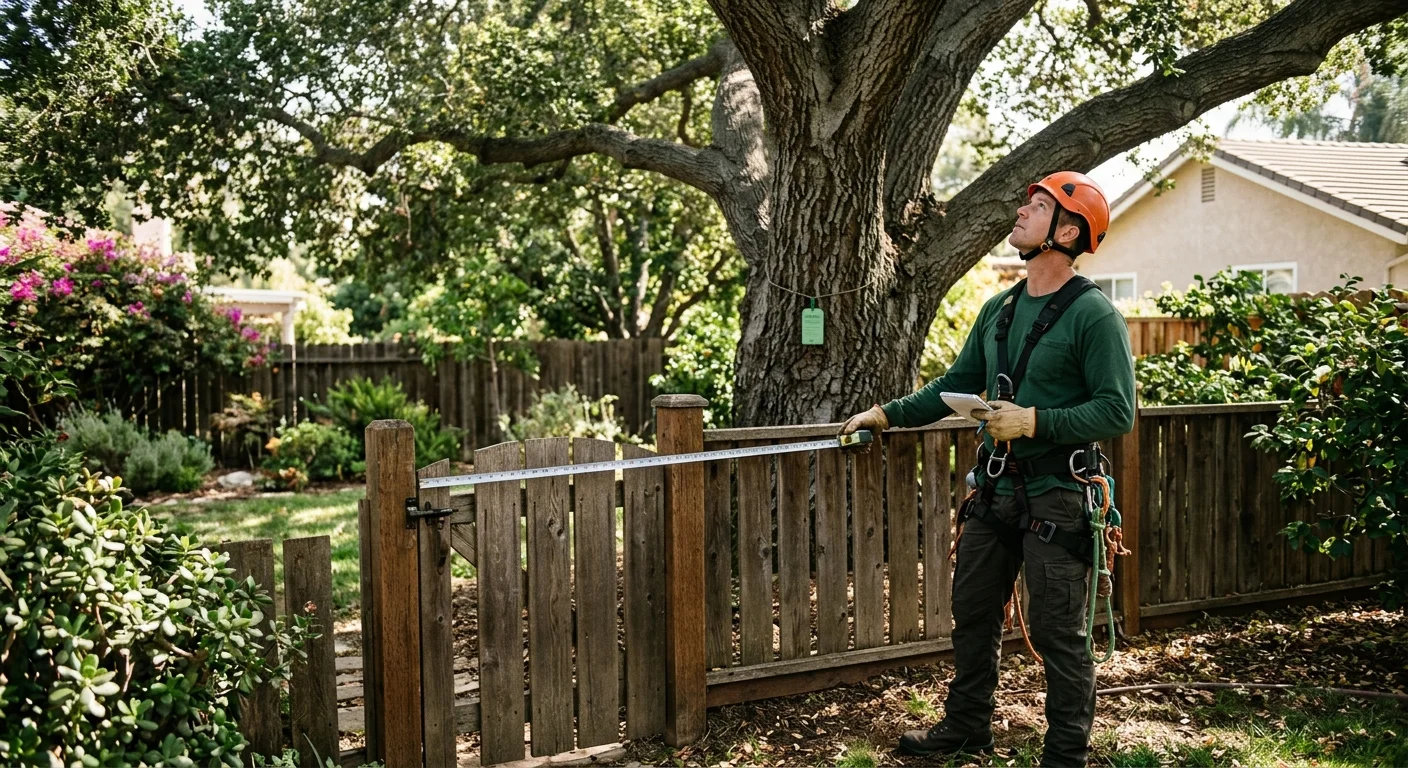
A narrow gate can change a Bonita trimming job before anyone starts cutting. Compare written scopes that name the pruning goal, the route in and out, and what cleanup includes.
What should a Bonita trimming scope name first?
Ask for a result, not a generic trim. Roof clearance, fence separation, dead-limb review, and canopy size are different jobs.
Name the branches or conditions that prompted the call. Ask the independent tree company to identify the tree when it can. The scope should say which canopy parts are included.
Keep the goal separate from the cutting method. Tell the company what needs attention. Then ask how the proposed cuts address it.
Our tree trimming and shaping service connects Bonita homeowners with licensed, insured independent local tree companies. For branch selection and tree structure, review structural pruning. Tree trimming versus pruning can produce different written proposals on the same tree.
TCIA’s pruning and trimming summary treats both as work with named objectives. Appearance, clearance, structure, and risk can all be valid reasons.
ISA’s pruning guidance for mature trees asks for a purpose on each cut. Routine thinning isn’t automatically healthier.
If it’s already safe to stay on the ground, photograph the tree from several viewpoints. Include the trunk, canopy, nearby structures, and the access route. Don’t walk under a failed branch. Don’t measure or approach power lines. Give every company the same photos and notes.
How do you document a tight Bonita access route?
Walk the full route from the street to the tree only if that walk is already safe. Don’t stop at the narrowest gate. Note overhead clearance, turns, steps, planted beds, fences, and surfaces that need protection.
Photograph the latch, posts, and nearby obstacles from a safe place. Note whether furniture, bins, or parked cars currently block the path. Don’t remove fencing or alter the property until the selected company writes its access plan.
Show each professional the same route during an assessment. Ask what must enter the yard and how cut material will leave. A blocked gate doesn’t always mean every piece is carried by hand. The company should assess equipment, staging, and the actual turns.
Roofs and neighboring property need their own notes. From already-safe ground, photograph branches over your roof, a patio cover, a shared fence, or another parcel. If work or access would cross a neighbor’s land, talk with the neighbor and the tree company before anyone schedules. A property line isn’t a cutting prescription. In Booska v. Patel, the court rejected an absolute right to cut encroaching roots regardless of harm. Agree on ownership, access, and proposed cuts in writing.
Use the Bonita tree service page when you request a local match. Put the gate width, enclosed yard, or restricted cleanup route in the first description.
Which authority applies to a Bonita parcel?
A Bonita mailing address doesn’t settle jurisdiction. Much of Bonita is unincorporated county jurisdiction in the Sweetwater area. That is a planning-authority question, not a claim that the County owns the lot. Some edges sit in the City of Chula Vista. Fire service and a postal label don’t choose the planning office.
For unincorporated parcels, start with County Planning & Development Services and the actual APN. Native vegetation, easements, and planned disturbance can trigger county clearing review. Confirm requirements with PDS and the fire district that serves the address.
If the tree is a Chula Vista parkway tree, a designated street tree in a Tree Planting and Maintenance Easement, or another right-of-way tree, Chula Vista Urban Forestry reviews removal. Private ownership in the right-of-way doesn’t cancel that review. An easement can reach past the sidewalk strip.
Ask the tree company which authority it believes applies. Confirm that office yourself before authorizing work. Branch Pro San Diego doesn’t pull permits and doesn’t perform the work.
How should species and condition change the assessment?
A pruning recommendation should start with identification and visible condition. Don’t pick a scope from a familiar name alone.
On oaks, crown thinning, bark staining, woodpecker injury, or D-shaped exit holes can be clues associated with goldspotted oak borer. That insect is not a disease. UC ANR records infestations in many areas throughout San Diego County, and has also confirmed isolated areas in Riverside, Orange, Los Angeles, San Bernardino, and Ventura counties. See the current UC GSOB distribution maps. Coast live oak and California black oak are primary hosts. Canyon live oak can also be affected.
Those signs aren’t a diagnosis by themselves. UC IPM’s GSOB notes distinguish D-shaped holes from nonspecific thinning or staining. Ask for a health assessment before accepting a trim-only answer. Low-level infestation on a lightly damaged high-value tree can have management options. Heavily damaged trees are a different question. Suspect infested oak wood needs professional handling before it’s moved.
UC IPM on bark beetles says drought stress can raise susceptibility. It doesn’t say every borer attack follows drought, or that every infested tree dies. Healthy trees can withstand limited attacks. Extensive trunk infestation is a different problem from a few affected branches.
Occupied nests and eggs receive protection throughout the year. CDFW describes February through August as typical for many species, with nesting possible year-round in some places. There’s no calendar date that makes an active nest inactive. If birds could be nesting, CDFW recommends a consulting biologist’s survey. A biologist may set a buffer, or work can wait until nesting is complete. Don’t move nests or disturb them to inspect.
ISA Certified Arborist is an individual credential, not a California contractor license. The ISA credential directory is a voluntary listing. An absent listing doesn’t disprove certification. If that credential matters for your job, ask the person for their current digital certificate.
Why do topping and heavy thinning need a closer look?
If a scope says top, thin heavily, or cut back, ask for exact cuts before you sign.
ISA’s guide to topping explains the problem with stubs and weakly attached sprouts. Reduction to a suitable lateral is a different cut. Neither brochure sets a universal canopy percentage.
Ask which limbs, where the cuts land, and what remains. If two companies propose very different canopy changes, pause. Have each restate the objective, cuts, access method, and exclusions.
Our tree topping in San Diego guide can help you prepare those questions.
Injury or an immediate threat to life is a 911 call, whether or not lines are involved. Branches near overhead lines are a utility issue first. Stay away from the tree and the lines. Call SDG&E before any affected work. If a line is down, stay away and call 911 and SDG&E at 1-800-411-7343 from a safe place. Don’t classify wires by height or color. Ordinary roof clearance in a trimming quote isn’t permission to work near energized conductors.
How should pruning, cleanup, and exclusions appear in writing?
Split the proposal into pruning, access, cleanup, and excluded work.
For pruning, name the tree and the intended result. Describe the selected canopy area. Note what stops if onsite conditions differ.
For access, name the approved entry route and known obstacles. Record any preparation assigned to you. If a crane is proposed, ask how the company will evaluate slope, ground support, and underground conflicts under DIR section 4991.1. A tight lot doesn’t automatically require a crane.
For cleanup, ask what happens to cut branches. Confirm staging and how material leaves. Don’t assume hauling or surface cleanup is included unless the proposal says so.
Ask whether stump work, root work, utility coordination, permit research, fence removal, or repairs are excluded. Compare those lines with the tree-trimming scope comparison guide. If grinding or excavation is later in scope, the qualified contractor should call DigAlert 811, premark, wait for all responses, respect the marks, and have a qualified excavator expose conflicts. Public marks are not depth and do not locate every private line. Grinding leaves roots and possible resprouts. Chips aren’t planting soil or structural fill.
Each independent company sets its own price from its assessment. Ask for the complete figure in writing, and ask what could change it. Compare included and excluded items rather than a formula.
Before hiring, check the company on the CSLB license lookup. Tree work may be performed under a C-49 Tree and Palm Contractor license, or under an active legacy C-61/D-49 issued before January 1, 2024. CSLB bulletin 23-07 lets those legacy holders keep working under that classification.
California Business and Professions Code section 7048 exempts only an aggregate project price of less than $1,000, including labor, materials, and other items, when the work is casual, minor, or inconsequential and no building permit is required. Advertising as a contractor, employing others, or splitting jobs to stay under that figure disqualifies the exemption.
Check license status, the $25,000 contractor bond or allowed security, and workers’ compensation records. Current BPC 7125 excludes D-49 from the no-employee exemption. It doesn’t list C-49. Confirm the actual workforce and coverage with CSLB and the insurer. A certificate of insurance isn’t the policy. Insurance Code section 384 says coverage follows the policy, not the certificate.
Frequently asked questions
Does a narrow Bonita gate mean every branch is carried out by hand?
No. A tight gate is a planning constraint, not a single method. Ask the company how equipment, staging, and debris will actually move through the route you photographed.
Can I trim a tree that leans over my neighbor’s fence?
Not from a property line alone. Confirm trunk ownership, needed permission, and any public-tree or easement rules. Get the proposed cuts in writing before work starts.
Who do I call if a branch is on a power line?
If someone is injured or life is at risk, call 911. Stay away from the tree and the lines. Call SDG&E before ordinary tree-provider coordination. If the line is down, call 911 and SDG&E from a safe place.
When to call us
Call (858) 400-4423 when tight access, overhead branches, tree condition, or neighboring property makes scopes hard to compare. Branch Pro San Diego is a referral service. We match you with a licensed, insured independent local tree company. You hire and pay that company directly.