A brown canopy in San Diego is not an instruction to water more. Decide when to water by the root ball on a new tree, the actual root zone on an established tree, whether emitters reach that soil, and whether the ground can drain. A La Jolla marine layer and an Escondido afternoon dry soil at different rates.
Branch Pro San Diego is a referral service. We connect customers with licensed, insured independent local tree professionals. You hire and pay the professional directly. We don’t diagnose watering problems, set irrigation schedules, or treat trees.
If people are hurt or in immediate danger, call 911. If a line is down, stay away. From a safe place, call 911 and SDG&E at 1-800-411-7343. Don’t walk closer for photos. SDG&E decides whether lines can be de-energized, covered, or moved. If a standing tree already touches overhead lines, call SDG&E first.
How do you tell a new root ball from an established root zone?
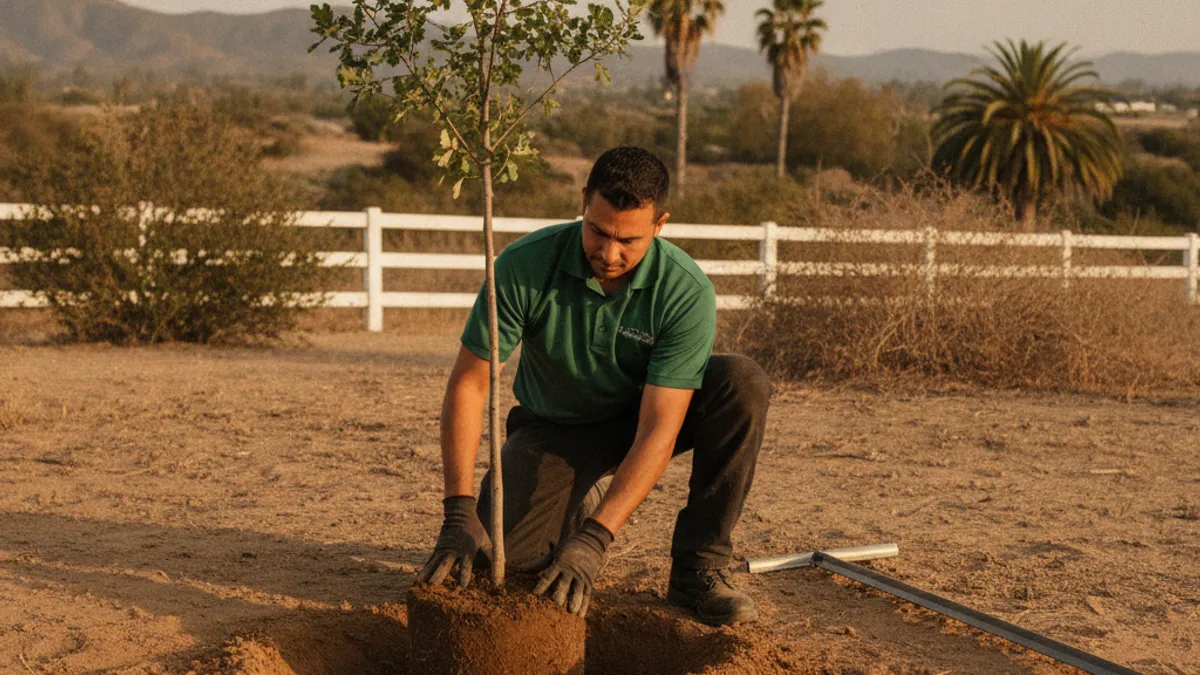
A nursery tree still drinks from the soil it arrived in. That root ball can dry while the surrounding yard still feels damp. Water the ball and the soil next to it, then watch whether moisture moves into native ground. Shallow sprinkling keeps roots near the surface. Don’t soak the trunk. Keep the root collar dry.
An established tree uses a wider root zone. UC’s water-management page says established plants should be watered around the drip line, with the root collar kept dry. Roots can also extend beyond that line. Water the ground where the roots actually are, not only a ring of mulch, and not the bark. Our planting guide covers the young-tree setup. There is no set year when every San Diego tree is fully established.
If turf irrigation used to wet those roots and the lawn water stopped, the tree may now be missing water it had been using. That is a site history question, not a reason to flood the collar.
How do you check that water is actually arriving?
Look at the irrigation hardware before you add runtime. Are emitters present, clogged, or aimed at paving? Does sprinkler spray wet only the lower canopy on one side? After a cycle, check whether water moved through mulch into the intended soil. Surface wetness does not prove the root zone is wet.
UC ties frequency and volume to species, season, microclimate, soil texture, structure, depth, rooting depth, drainage, and the irrigation system. Water demand generally rises in hot, sunny, windy, low-humidity weather. Use those conditions when you decide whether to water.
From safe ground, note wilt, soggy soil, standing water, or dry dust at the surface. You can feel accessible soil without probes, drilling, or trenching near roots or utilities. If the root-zone moisture is still unclear, have a qualified professional assess it.
Why can too little and too much water look alike?
UC’s water deficit and excess guide says both drought and saturated soil can produce decline and similar foliar symptoms. Saturated soil deprives roots of oxygen and can stop uptake. A brown or yellow canopy is not an automatic instruction to water more.
Feel the soil only at the surface you’re already standing on. Soggy, sour, or algae-stained ground next to limp leaves is a reason to check drainage, not to run a longer soak. Crispy margins with dust-dry surface soil are a reason to look at emitters and recent watering, not a complete diagnosis. Wind, salt, root disease, and recent construction can look similar.
If drainage is poor, don’t pour extra water into that ground. Fix the wetting pattern and the drainage question first.
How do coastal and inland sites change the decision?
They change heat, humidity, wind, and sometimes salt. They don’t hand you a monthly coastal schedule and an inland twice-as-often rule.
A lingering marine layer in La Jolla or Ocean Beach can slow drying. Inland lots in Escondido or San Marcos can be hotter, sunnier, and windier on the same afternoon. Use those conditions when you check soil and emitters. Don’t copy a neighbor’s timer. Our coastal versus inland trimming guide is about exposure and work planning, not an irrigation calendar.
Salt can injure foliage from sea spray or saline sprinkler water, and it can injure roots through saline soil. UC’s salinity guide says those pathways differ. Inland lots can see salt too, from arid soils, saline irrigation water, fertilizer, or salty amendments. UC’s conditions list makes that comparison. Coastal location alone is not a diagnosis. Ask your water provider for its water-quality results, and test soil or irrigation water before anyone treats. Don’t leach a poorly drained yard. Don’t assume gypsum is the answer without a sodic-soil test.
Look up your water district’s current outdoor rules before you change a timer. Supplier restrictions are local and they change.
Species still matters. A high-water native sycamore is not a low-water desert willow. If you’re choosing a tree for a dry lot, our drought-tolerant trees guide compares named species. Native status does not mean skip every dry-season check.
How watering relates to pest treatment
Appropriate watering supports tree vigor. It is not a pest treatment. UC IPM on bark beetles says drought stress can predispose trees to boring insects. Only a few aggressive species are sole causes of mortality. Healthy trees can withstand limited attacks.
Goldspotted oak borer is a different insect. Watering is not a GSOB treatment. See our goldspotted oak borer guide and, for other borers, pine bark beetle in San Diego. Don’t thin a live canopy as drought-water management. Live foliage supports energy reserves. Dead branches don’t consume the tree’s water.
When does watering need a professional assessment?
Call when decline continues after you correct obvious emitter gaps, when soil stays wet, or when the tree could hit a target. Tree health diagnosis and arborist consultation are how you request that assessment.
Stay on the ground. Don’t climb to inspect wilt. Don’t trench near roots or utilities to “check” moisture.
Frequently asked questions
Is morning always the right time to water trees?
No. Timing depends on your system, the weather, and disease or salt risk on that site. The useful test is whether water reaches the intended root zone without wetting the collar.
Should I water the trunk and the drip line?
Keep the trunk and root collar dry. Water the actual root zone, which often includes the drip line and can extend beyond it. On a new tree, include the root ball and the soil next to it.
How long should drip irrigation run?
Runtime depends on emitter flow, soil, root depth, and drainage. Confirm that water moved into the intended zone, not that the clock hit a set number.
Do native San Diego trees need summer water?
Some natives still need the right moisture for the species and the lot. Others are damaged by summer irrigation at the collar. Check the species, the soil, and your water district’s rules. Don’t put every native on a monthly summer soak.
Can Branch Pro tell me the exact watering cause by phone?
No. The independent professional inspects the tree and the irrigation layout, then contracts with you.
Get connected with a local pro
If the tree is on a conductor, use the utility steps above first. For an irrigation or decline question bigger than a ground-level check, call (858) 400-4423. We’ll connect you with a licensed, insured independent local professional. Describe the tree, what you can see at the soil surface, and any line or safety issue. You hire and pay that professional directly.