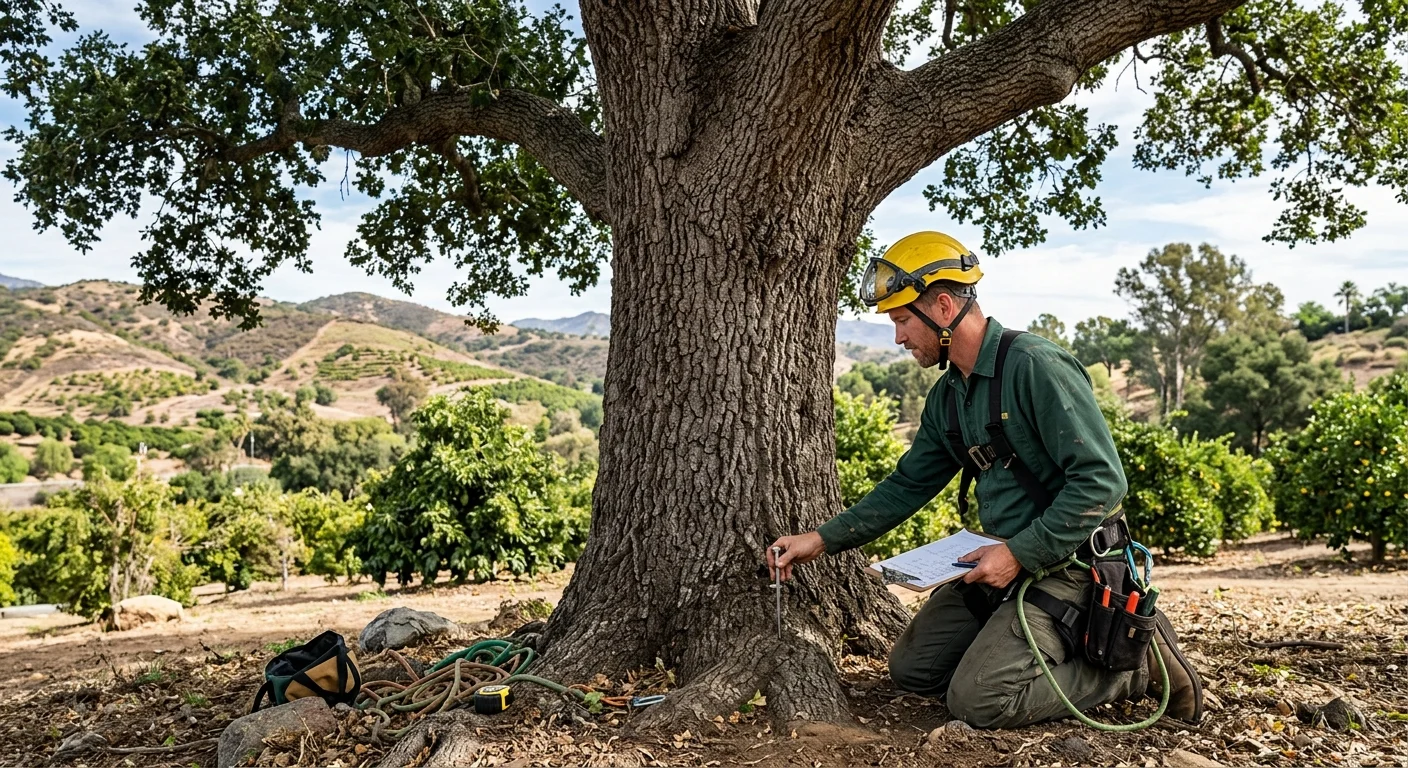
Tree trimming in Escondido should fit the actual tree, exposure, and access route. Fruit trees may need minimal cutting. A backyard behind a narrow gate needs a different work plan from an open grove row.
How should sun exposure change pruning decisions?
Show the professional when the canopy receives direct sun. Point out nearby pavement, walls, roofs, bare soil, and recently exposed branches. Also describe irrigation changes or construction near the roots.
This is especially important for avocado trees. UC IPM guidance explains that newly exposed bark and fruit can suffer sunburn after canopy loss. A proposal should consider the remaining shade before removing productive foliage.
Separate the work goals before branches are marked. Roof clearance differs from fruit access. A low limb over a walkway differs from unexplained canopy decline.
Ask which branches would leave, why each cut is needed, and how much foliage would remain. ISA’s mature-tree pruning guidance says mature trees generally need less foliage removed than younger trees. Each cut should have a defined purpose.
Our tree trimming and shaping service connects customers with licensed and insured independent local providers. The matched provider assesses the site and proposes the work. You hire and pay that provider directly.
How much pruning do avocado and citrus trees need?
Avocado and citrus trees shouldn’t receive a standing order to thin the entire canopy.
UC Cooperative Extension says most avocado trees need little or no pruning. Removing productive foliage can reduce fruit production. Retaining shade over exposed trunks and limbs also matters.
UC IPM’s citrus guidance says citrus doesn’t require pruning to remain productive. Useful work may include removing rootstock suckers or addressing a specific structural, clearance, or access problem.
Ask the professional to identify each tree before writing the scope. Keep fruit access, appearance, structure, and health concerns separate. That prevents a general shaping request from turning into unnecessary canopy removal.
For grove work, label the included trees. A numbered map or photo set can prevent confusion between rows. It should show which trees receive work and which remain untouched.
Ask these questions before approving the proposal:
- Which branches are included?
- What purpose does each cut serve?
- How much useful foliage will remain?
- Does any tree need a health assessment first?
- Is there a lower-removal option?
- How are included trees marked in the field?
Our avocado tree pruning guide can help organize the first conversation. For branch arrangement and long-term structure, review the tree pruning service.
How should slopes, gates, and grove access be planned?
Walk the entire access route with the contractor. Start where workers and equipment would enter. Continue to the tree, then follow the proposed debris route out.
Point out:
- the narrowest gate and tightest turn
- stairs, slopes, walls, and planting beds
- irrigation components and utility lines
- paving or surfaces needing protection
- areas that must remain open
- the boundaries of each grove row
Have the provider record the route and assumptions in the proposal. The contractor decides which equipment fits the site. Branch Pro doesn’t select equipment or direct crews.
A grove scope should identify whether the work covers one tree, one row, or a marked group. Avoid descriptions such as “the trees near the back.” Labels and photographs give both parties the same boundary.
The Escondido tree service page covers available local service categories. Our broader Escondido tree service guide addresses other project types.
Why do topping and heavy thinning need another look?
“Topping” and “heavy thinning” aren’t complete scopes. Ask the contractor to identify the branches, purpose, and canopy that would remain.
ISA’s topping guidance explains that indiscriminate cuts to stubs or undersized lateral branches can stress a tree. They can expose tissues to sun injury and decay and produce weakly attached sprouts.
Appropriate reduction differs from topping. It uses selected lateral branches and may preserve the tree’s form. Replacement can be the better option when the desired size conflicts with the tree or site.
Ask for two written choices when possible. One may address immediate clearance only. Another may cover broader work after assessment. Each option should identify the included branches and expected remaining canopy.
Read our tree topping guide before approving a major canopy change.
When does Escondido require a tree review?
Escondido’s rules depend on the parcel, tree category, lot size, and proposed work. The City’s published municipal code has different provisions for lots under two acres and lots of two acres or more.
Protected trees, required landscaping, sensitive habitat, and construction within tree driplines can affect the review. Routine maintenance has a defined exemption, but a homeowner’s description of a tree as hazardous doesn’t establish the official exception.
The code defines diameter at breast height as a measurement taken 4.5 feet above grade. It defines mature oaks at four-inch DBH, other mature trees at eight-inch DBH, and protected oaks at ten-inch DBH. Those definitions serve different code categories. They aren’t one universal permit threshold.
Before work, give Escondido Planning the parcel, lot size, tree identity, location, and proposed scope. Ask whether photographs, a site plan, tree survey, or supporting report is required.
When should trimming pause for a health assessment?
Pause when unexplained decline is the main concern. Reshaping a thinning canopy won’t identify the cause.
Goldspotted oak borer is contributing to ongoing oak mortality in many areas throughout San Diego County. UC’s current distribution page records isolated confirmed areas in Riverside, Orange, Los Angeles, San Bernardino, and Ventura counties.
Crown thinning or bark staining alone doesn’t confirm the pest. UC IPM’s goldspotted oak borer guidance describes D-shaped emergence holes as more distinctive evidence. Ask the assessor to identify the oak and evaluate the damage.
UC’s management guidance distinguishes lightly damaged trees from heavily damaged trees. Treatment or preventive work may fit some lightly affected, high-value trees. Heavy damage may lead to removal and a specific wood-handling plan. A qualified pest-control professional should evaluate treatment choices.
Bark beetle findings also need context. UC IPM explains that only a few aggressive species are sole causes of mortality. Healthy trees may withstand limited attacks. Extensive trunk infestation is different from a few affected branches.
Ask the assessor to identify the pest, affected area, tree vigor, and extent of damage before recommending pruning, treatment, or removal.
Which credentials should you verify?
An ISA Certified Arborist credential belongs to an individual. It’s separate from a California contractor license. Check the person through ISA’s credential directory and ask for current proof.
California’s current C-49 classification covers tree and palm work. Existing C-61/D-49 holders issued before January 1, 2024 may retain that classification, according to CSLB Industry Bulletin 23-07.
Use the CSLB license lookup to match the proposal with the named business or person. Review the current status and classification for the actual scope.
When to call us
Call Branch Pro San Diego at (858) 400-4423 when an Escondido tree needs a trimming scope, access plan, or health review. We’ll connect you with a licensed and insured independent local provider. You hire and pay that provider directly.