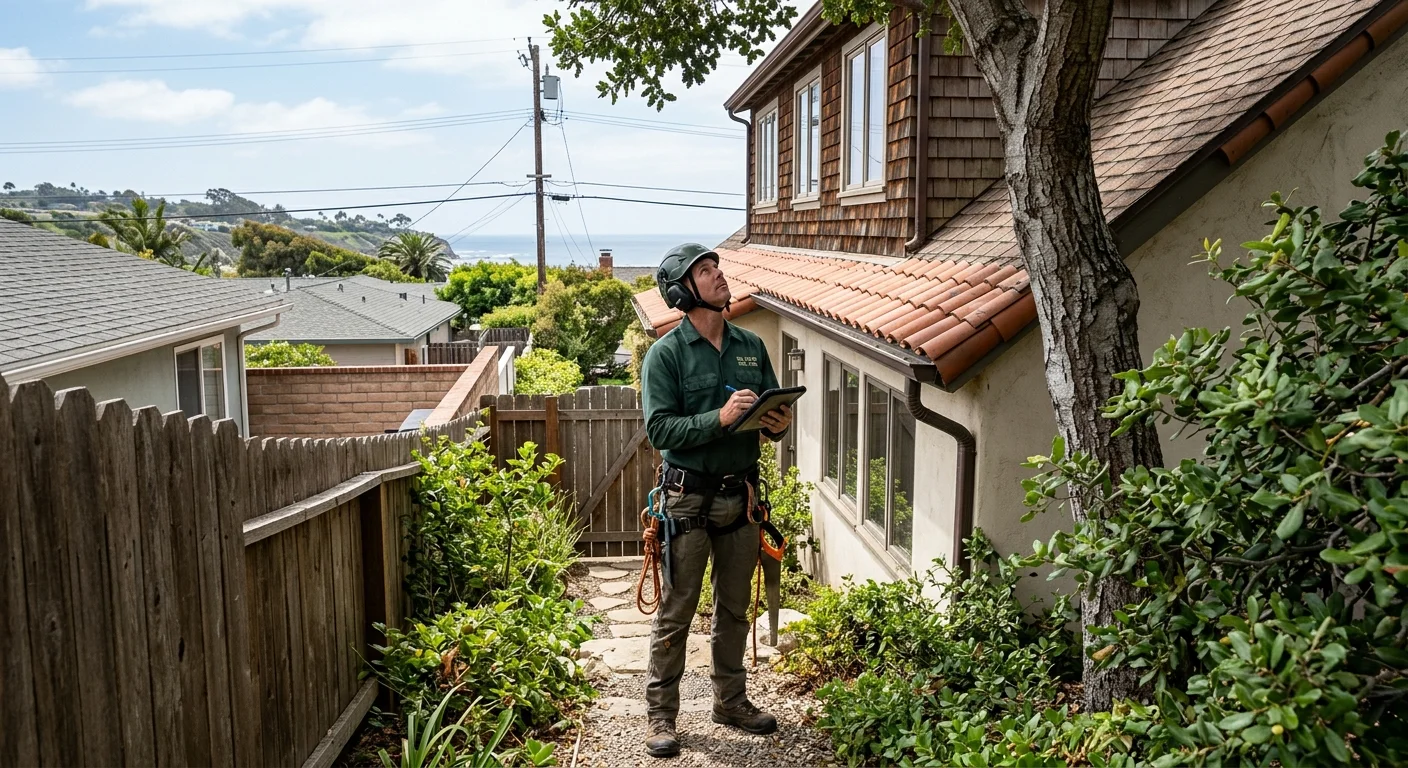
A tight Del Mar lot makes pruning a planning job. Your quote should name the goal and the access route. Roofs, fences, slopes, and the debris path all belong in that plan.
Branch Pro San Diego connects you with licensed, insured independent local tree professionals. You hire and pay the selected company directly.
Define the pruning goal for this tree
Start with the result you want on this tree. Point to the limbs or canopy areas that concern you. Name roof clearance, a blocked path, dead wood, or a shape change if that is the point.
A mature tree beside a roof needs a different written scope than a smaller tree crowding a fence. Branches over a neighbor’s lot need their own note. Ask the company to mark each proposed pruning area before you approve work.
Ground-level photos from a safe place help both sides mark the same limbs. Stay outside the fall zone. Do not walk under damaged wood, climb, or measure conductors.
If the goal is branch structure over time, ask about structural pruning. If the request is clearance or shaping, review tree trimming. The company should say which approach fits the tree and your stated goal.
Skip phrases like “trim as needed.” A usable scope answers these points:
- Which branches or canopy areas are included?
- What should remain untouched?
- Is this pruning, or a separate condition assessment first?
- How will finished clearance be described in writing?
- Does the plan depend on access through another property?
Each cut should have a purpose. Routine thinning does not automatically improve health. Heavy live-wood removal can reduce the tree’s energy reserves. Mature trees usually need a lighter plan than a young one. ISA’s mature-tree pruning guidance says the right cut depends on the tree, species, age, and objective.
How coastal exposure fits the assessment
Show which side faces open coastal weather. Mention thinning foliage, broken wood, bark damage, or a canopy shift you have actually seen. Coastal air is one site factor. It is not a diagnosis by itself.
Salt can injure leaves through spray or saline irrigation water. Damage often shows as brown tips or margins. It can be stronger on the ocean-facing side or on foliage the sprinkler wets. Root-zone salts make water uptake harder. Those symptoms also overlap drought and other disorders. UC IPM advises testing soil or irrigation water before treating salinity. Do not strip live salt-marked foliage just because the lot is coastal. Read the salt-injury guide and the water deficit and excess guide before assuming the tree needs more water. Too little water and too much water can look alike.
Species, visible condition, attachments, and placement should drive the plan. An ISA Certified Arborist credential is an individual certification, not a California contractor license. Ask for the person’s digital certificate, or check ISA’s credential directory. An absent listing does not, by itself, disprove certification.
If the tree is an oak, treat staining, thinning, or holes as clues, not a home diagnosis. UC’s GSOB distribution maps record the pest in San Diego County and other Southern California counties. UC IPM’s goldspotted oak borer notes distinguish D-shaped exit holes from nonspecific crown thinning or bark staining. Keep suspect oak wood on the lot until the company explains lawful handling. UC GSOB firewood guidance advises against moving infested oak wood out of local areas.
Birds can nest in more than one season. CDFW nesting-bird guidance describes February through August as typical for many species, with nesting possible in other months. If birds could be nesting, have a consulting biologist survey before work. The biologist may set a protective buffer, or work can wait until nesting is complete. Do not move nests or pull branches apart to inspect them.
Our coastal and inland trimming guide helps frame that wider discussion. For this job, keep the decision on the tree in front of you.
Map access around roofs, fences, and slopes
Walk the access route from already safe ground. Start where people and equipment could enter. Continue past gates, steps, beds, roof edges, fences, and slopes. Finish at the loading or cleanup point. Do not enter the fall zone to map the job.
Ask where cut wood will be controlled, placed, reduced, and carried out. The written proposal should match that method. Crane, climbing, or another approach is a site choice for the company, not a default.
Mark anything that cannot move: a fixed fence, built-in seating, a narrow gate, or a roof under the canopy. For movable items, decide who relocates them before work starts. Do not assume prep is included.
Neighbor access needs written permission from that owner. A quote should not rely on a neighboring driveway or yard without that agreement. Keep permission separate from the pruning price.
If setup would occupy a street, sidewalk, or other public area, confirm that arrangement with the City of Del Mar before approval. Use the Del Mar tree service page when you request a match. Share photos of the tree, the narrowest passage, the roofline, and the debris route, all taken from safe ground.
Separate pruning, hauling, and cleanup
Ask whether lowering, debris handling, hauling, and final cleanup are included. If something is out, it should sit under exclusions.
The pruning line should identify the tree and the intended result. It should also name canopy areas that will not be cut. Then ask whether branches will be chipped, hauled, stacked, or left. Cutting a limb does not automatically include removing it. Confirm where material can be staged without blocking the agreed route.
Cleanup needs its own boundary. A side yard, patio, roof edge, and street edge may need different steps. Put the agreed surfaces in writing.
List excluded work: roots, stumps, plant replacement, pest treatment, irrigation, fence work, and roof repairs. Those stay out unless the proposal adds them. If the recommendation changes from pruning to removal, request a new scope. Our La Jolla and Del Mar removal-planning guide covers that separate decision. Compare the same requested scope on every quote.
Check city trees, neighbors, and utilities
A trunk near a fence or sidewalk does not prove who controls the tree. Del Mar’s Planning tree FAQ treats Torrey pine, Monterey cypress, public right-of-way trees, and trees in specified commercial or open-space overlay areas as distinct cases. An exemption path, when it applies, still needs a Notice of Intent and staff verification. You cannot declare a tree exempt on your own. Give the City the address and the exact tree location, then ask whether the proposed pruning needs city review. Private-yard trees are not automatically free of review, and unlisted species are not automatically exempt.
If a limb is in conflict with an overhead line, stay away and call SDG&E before hiring ordinary pruning on that wood. Stay away from a downed line. From a safe place, call 911 and SDG&E at 1-800-411-7343. SDG&E’s downed-power-line guidance explains that the utility decides whether a line can be de-energized, covered, or moved. Ordinary pruning with no line conflict does not wait on the utility.
Check the company on the CSLB license lookup. Verify an active C-49, or an active legacy C-61/D-49, plus current status and the workers’ compensation record. Coverage requirements depend on that record and the company’s workforce. A certificate of insurance is not the policy, and it does not enlarge coverage.
Frequently asked questions
Do I need a Del Mar permit to prune a private-yard tree?
Ask Planning with the address, tree location, and proposed cuts. Public right-of-way trees, Torrey pine, Monterey cypress, and overlay sites follow the City FAQ. Staff verification, not a homeowner label, decides an exemption path.
Can the crew use my neighbor’s driveway?
Only with that owner’s written permission. Put the agreed route, hours, and restoration in writing before work starts.
Should salt-browned leaves be cut off first?
Not as a default. Have the company assess the tree and the irrigation pattern. Salt injury and water stress can look similar, and live foliage still has a job.
When to call us
Call 911 for injuries or an immediate life threat. For a downed line, stay away and, from a safe place, call 911 and SDG&E. For a standing tree against a line, stay away and call SDG&E first. For other tight-lot pruning, call us at (858) 400-4423. We’ll connect you with a licensed local tree company.