The leftover stump sits tight against a wood fence in a North Park side yard, a Clairemont canyon lot, or a Chula Vista backyard. You want it gone so you can mow, plant, or reset the boards. Tree stump removal in San Diego gets messy when the wood sits on, or next to, a line you share with a neighbor.
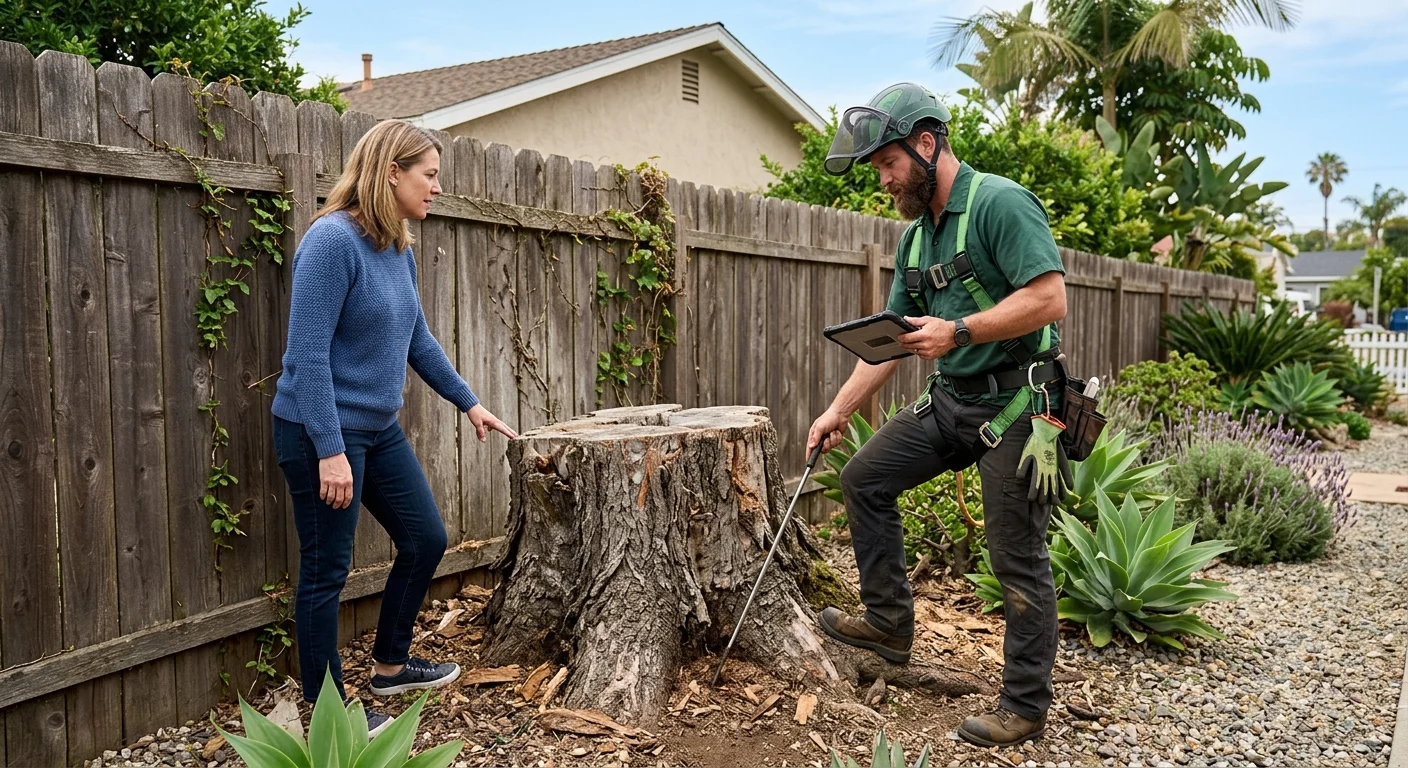
Confirm the stump location and planned use of the space
Start with where the stump sits, not where the fence looks like it sits. A fence can run on one lot, straddle both, or sit in a parkway. Walk the area in daylight. Note whether the wood is clearly on your grass, clearly on theirs, or jammed into the posts.
If the tree stood in the strip between sidewalk and curb in the City of San Diego, treat it as a possible street tree. City-maintained street trees are not a private grinding job. Report those through Get It Done and wait for City inspection. A private contractor’s calendar is not permission to grind a City stump. Other cities in the county run their own public-tree rules. Confirm the parcel, not just the mailing city. Lake San Marcos is not the City of San Marcos. Rancho Bernardo is in the City of San Diego, not Poway.
Write down what you want the space to become. Lawn is one job. A new fence is another. A patio or walk is a third. A new tree in the same hole is a fourth, and grinding alone does not make that hole ready. Remaining roots, chips, and old soil still matter. If the tree is still standing, settle tree removal first, then the stump. If the trunk is already down, you’re shopping stump grinding plus any extra root work as a written scope.
Measure the stump the way you and the pro will both use later. Agree on height above grade and width across the cut. Photograph the face of the cut, the nearest posts, and the path from the street. Name the species if you can from the ground: coast live oak, eucalyptus, ficus, California pepper, queen palm. Some of those send new shoots from leftover roots.
Lots in San Diego are not interchangeable. Coastal side yards in Pacific Beach and Ocean Beach are often a walk-behind width. Inland lots in El Cajon and Santee may have block walls and slope. Say the end use out loud before anyone prices the grind.
Document the fence, roots, paving, and irrigation
The quote should describe the site, not just the stump. Stand on your own ground and photograph the fence from both ends. Capture post spacing, a concrete mow strip if you have one, and any lean. Note whether boards already touch the wood. A stump hard against a redwood fence in Mission Hills is a different protection job than a stump two feet off a block wall in El Cajon.
Look for surface roots, irrigation heads, drip tubing, and valve boxes. San Diego yards hide PVC in the first few inches, especially along older lawns in Clairemont, Allied Gardens, and Rancho Peñasquitos. Flag what you can see. Tell the pro about lines you know. Public utility marks do not show every private sprinkler, landscape wire, or sewer lateral.
Powered grinding and digging count as excavation in practice. Before a crew uses powered equipment, the excavator should contact DigAlert. Public members mark facilities they own, usually to the meter. They do not mark every private line, and paint on the ground does not prove depth. There is no safe rule that utilities sit deep enough to grind over. If a line is in conflict, it has to be exposed and identified before powered work continues.
Paving next to the stump matters too. A patio edge, a walk, or a driveway apron can sit on the same roots that hold the fence posts. Uplifted paving is a reason to inspect. It is not proof that the stump cracked a house foundation. Keep plumbing questions with a licensed plumber. Keep structural questions with an engineer. Keep the tree and root questions with the tree company.
Write a short site list: stump size, fence type, visible roots, irrigation, paving, slope, and the access path. Hand that list to every company you talk to so the written scopes match.
Compare grinding and excavation within the written scope
Most residential jobs beside a fence are grinding, not full excavation. Grinding chips the stump and the main flare into small wood. The hole is not empty dirt. Chips, sawdust, and root pieces remain. Lateral roots can stay in the ground. That is why grinding is often the right fence-side method: less trenching next to posts, less soil collapse under a neighbor’s grade.
Excavation pulls more wood and more soil. Next to a shared fence, that extra digging can undercut posts, irrigation, and paving. It can still be the right method when you need the space for a footing, a new wall, or a tree that cannot sit in leftover roots. Do not treat either method as a promise that every root is gone. Some species, including black locust, can send shoots from roots away from the old stump. Coast redwood can sprout from a stump or root crown. A seedling that germinates near the hole is not the old tree coming back. Ask the pro how they will handle visible surface roots, and put that in writing.
Read a method comparison before you pick a line item. Our stump grinding vs removal guide walks through that choice. If roots still heave walks or send shoots after the grind, that is a later root removal question, not a hidden extra you should assume is included.
No public agency publishes a San Diego stump price. Skip directory averages. Ask each company how they measure diameter, whether they quote per stump or as one job, and what is excluded: extra roots, chips hauled off, fill dirt, sod, and fence repair. The written number should follow the written scope. Our stump grinding pricing walkthrough covers the questions that belong on that quote.
Skip chemical shortcuts and fire. A potassium-nitrate stump product is a slow decomposer, not an instant kill, and the current container label is the rule if you even consider it. Open burning needs a local fire authority permit for the place, time, and material. The air district does not issue that permit. San Miguel Fire & Rescue has had permitted burning suspended in its jurisdiction. Do not treat a burn pile as the San Diego default.
California tree work of $1,000 or more generally needs a contractor license, with a C-49 Tree and Palm classification or a valid legacy C-61/D-49. Check the name on CSLB’s license lookup before you approve the job.
Clarify access, debris, backfill, and fence protection
A shared-fence stump is often an access problem first. Many San Diego lots feed the backyard through a three-foot side yard, a locked gate, or an alley. Pacific Beach, Ocean Beach, and Coronado lots can be tight. Inland properties in Lakeside or Valley Center may have slope, decomposed granite, and long hose runs instead. Ask the company which machine they plan to use and whether it fits the actual path. Do not guess from a photo of a truck on the street.
Agree who protects the fence. That can mean boards pulled and reset, plywood on the face, or a grind path that stays a stated distance from posts. None of that is automatic. If a post sits in the root flare, say so. If the neighbor’s concrete already leans on your side, say so. Put fence protection in the quote as a real task, or admit that a carpenter may be needed after the wood is gone.
Debris is a separate line. Grinding leaves a mound of chips. Some owners want those chips left. Some want them hauled. Chips are not a planting mix. You should not rake chips into the hole and seed the next week. Wood in the soil can settle and leave voids. If you want lawn, plan fill, compaction, and a later grade check. If you want a new tree, the same-spot hole may be the wrong hole.
Backfill belongs in writing: who brings dirt, who rakes, who waters the patch, who returns if the hole sinks. Turf prep is not the same as preparing for a slab. If a patio or footing is the end use, the tree company is not your soils engineer. Keep people and pets out of the work area. The crew, not the homeowner, runs the grinder.
Check ownership or permission questions before approval
Do not treat the fence as a survey. It might sit on your lot, their lot, or both. It might be an old courtesy fence that never matched the recorded line. If you are not sure whose stump it is, pause. Pull what you can from your grant deed, a plat, or the county parcel map. If the line is disputed, a licensed surveyor settles location. A tree company does not. For the broader neighbor-tree picture, see our property-line tree guide.
Talk with the neighbor before anyone rolls a machine down the side yard. Share the photos, the planned method, and how the crew will enter. Ask whether they object to work against the boards, and whether any irrigation on their side is live. Get the scope in writing: stump, method, protection, chips, and fill. A handshake over the fence is not a contract.
Public trees stay with the public owner. City of San Diego street-tree removal and stump grinding follow City inspection and Council Policy 200-5. You cannot authorize that work because you mow the parkway. Other cities, including Chula Vista, Vista, and Carlsbad, have their own right-of-way rules. Confirm the agency that actually owns the tree.
HOA and rental properties add another layer. An association may control common-area trees even when the stump looks like it sits in your yard. A landlord’s access into a dwelling unit is a separate question from a backyard grind. Have the manager or owner confirm who may approve the work.
If the job will cost $1,000 or more, or the company holds itself out as a contractor, verify the license. Branch Pro San Diego is a referral service. We match you with licensed, independent local pros. We do not grind, haul, or rebuild fences. The contract and payment run between you and the company that does the work. Ask that company for current insurance documents, and remember a certificate is not the policy.
When the line, the stump, or the permission is still fuzzy, stop. Confirm it through records or a qualified professional. Then hire.
Frequently asked questions
How much should it cost to remove a tree stump?
No government source publishes an official San Diego stump price. Compare written quotes that name the measurement method, access, grinding versus excavation, chips, fill, and fence protection.
Who is the best tree removal company in San Diego?
There is no official ranking. Verify the company on CSLB, match the scope to the fence-line site, and hire the independent pro who puts utilities and fence protection in writing.
Can seniors get a tree removed for free?
We could not confirm a countywide free senior tree or stump program from the sources used for this page. Check any City or County program that applies to your address. A referral service does not waive a contractor’s price.
How do I remove an old tree stump in the yard?
For a stump against a shared fence, the usual professional choice is grinding, with excavation only when the written end use needs the extra soil work. Do not run a rented grinder along a neighbor’s boards, and do not burn the stump.
When to call us
Call when the stump sits against a shared fence, the access is tight, or the line of ownership is unclear and you still need the wood gone. A licensed tree company should inspect the stump, the fence, and the path before anyone grinds. Call us at (858) 400-4423 and we’ll connect you with a licensed local tree company.