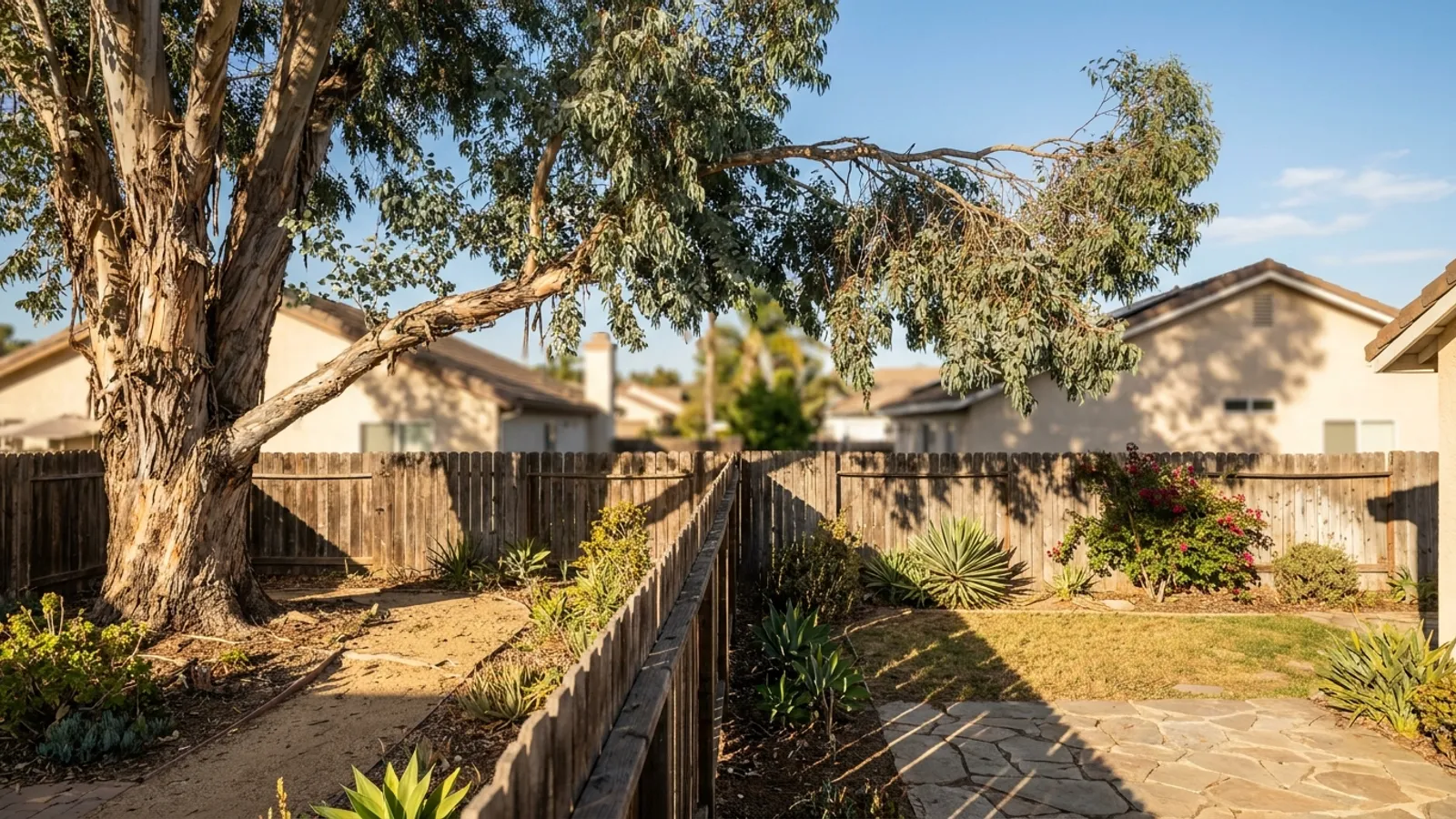
A branch hanging over your fence is not automatically yours to cut. California Civil Code locates ownership by the trunk, not by where limbs or roots travel. Before any cut, confirm whose land the trunk sits on. Confirm whether the tree is public. Confirm whether the planned work needs permission.
If the tree just shifted, the wood is breaking, or people are in danger, stay away. Call 911 for injuries or any immediate threat. If a line is down, call 911 and SDG&E at 1-800-411-7343 from a safe place. A standing tree or limb into an overhead line goes to SDG&E first.
Who owns a tree that sits near the property line?
Civil Code section 833 is the starting point. If the trunk stands wholly on one owner’s land, that owner owns the tree. Roots or branches on the other lot do not change that. Civil Code section 834 covers the other case. If the trunk stands across both parcels, the neighbors own the tree in common.
A fence is not a legal survey. If the line itself is in dispute, a licensed surveyor can locate boundary evidence. That does not necessarily settle contested legal rights. An arborist can assess the tree’s condition and what a cut would do. A California attorney advises on rights, and a court decides a contested claim. Those are different jobs. A matched tree pro cannot tell you exactly where you stand legally.
Can I cut branches that hang over my yard?
There is no safe statewide rule that lets you cut anything on your side of the fence. A property line is not a cutting prescription. It is also not immunity from liability.
Booska v. Patel, decided in 1994, is the case people cite here. A neighbor excavated roots on his own side of the line. The Court of Appeal rejected an absolute right to sever those roots no matter the harm. Ordinary care and reasonableness still apply. The court reversed summary judgment and sent the case back. It did not award damages. It did not decide whether those particular cuts were lawful. It did not ban every root cut.
The practical point is narrower. Staying on your own land does not make a cut lawful. Avoiding the tree’s death is not the only limit. Stability, unreasonable injury, access, ownership, permits, and the actual cuts all matter.
Do not climb the neighbor’s tree. Do not put a ladder over the fence. Do not trench roots yourself. Do not take a chainsaw to limbs from a ladder. If qualified ground work is needed, the independent company you hire should do it after the legal and permit questions are settled.
What about roots cracking a driveway or slab?
The same limits apply to roots. Encroaching roots do not become yours to sever at will. A cut drawn to the line can also be poor arboriculture. Cutting every root that crossed the fence can destabilize the tree. It can also injure a tree you do not own.
A jointly owned boundary tree is a further constraint. Shared ownership is not permission for one owner to make destructive cuts alone. Neither owner should treat a shared trunk as a solo removal project.
If hardscape damage is the actual problem, start with a condition assessment, not a DIY trench. Our guide on tree roots damaging a foundation covers what to inspect before anyone cuts near a structure.
For utility-adjacent digging, DigAlert covers San Diego County. Call 811 before powered ground work. Member marks usually run to the meter. They do not locate every private irrigation line, sewer lateral, or other private facility. Marks do not establish depth. Private lines need a separate locate.
A homeowner exception exists only for work on your own private property, with no permit and no powered equipment. Powered work or work that needs a permit falls outside that exception. A qualified excavator should handle locates and exposure. Don’t do that digging yourself.
Do I have to tell my neighbor before any work?
Civil Code section 3502 lets a person abate a private nuisance. That right is limited. You still have to avoid a breach of the peace and unnecessary injury. It is not permission to declare any unwanted tree a nuisance and take it down.
Civil Code section 3503 requires reasonable notice in a narrower situation. It applies when the nuisance comes from an omission, and you cannot abate it without entering the other person’s land. It does not create a written-notice rule for every overhanging branch. It does not grant a general right to enter a neighbor’s lot.
Talk with your neighbor and agree on the proposed scope before anyone cuts. Common ownership of a boundary tree does not create a right to enter the other lot. Actual notice and access duties depend on the facts, local rules, and legal advice.
Can I be sued for trimming a neighbor’s tree?
Yes, depending on the facts. Wrongful injury to someone else’s tree can cost more than ordinary compensation.
Civil Code section 3346 sets enhanced damages for wrongful tree injury or removal on another’s land. The measure changes with the circumstances. Subsection (b) has a qualified exception when someone relied on a licensed boundary survey. This is not a rule that every accidental cut automatically triples the bill.
Code of Civil Procedure section 733 is a statutory provision that authorizes a civil action for unauthorized cutting, removal, girdling, or other injury to trees in listed private and public settings. It provides for potential enhanced damages. A court applies it to the facts. It is not an instruction to stack a second multiple on top of section 3346.
A California attorney has to apply those statutes to the actual facts. An ISA credential, if the person doing the work holds one, does not make the work lawful. Staying on your own land does not either.
If a neighbor’s tree falls on my house, who pays?
Ownership, insurance, and legal liability are three different questions.
The California Department of Insurance says a fallen tree’s damage to the insured home is generally covered, subject to the policy’s terms and exceptions. Ask your insurer which coverage applies to structure damage, debris, remaining trunk or stump, and any replacement planting. Ask which named perils, limits, and deductibles control. Don’t assume the declarations page is the whole policy.
Vehicle damage is different. That generally runs through optional comprehensive or other-than-collision auto coverage, not the homeowners policy.
A healthy tree that fails in wind is not automatically an act-of-God defense. An ignored complaint is not automatically negligence. A visible defect does not settle who pays. Those questions depend on the tree’s condition, what the owner knew, the policy, and the facts. A tree report can inform a claim. It doesn’t guarantee coverage or payment. The insurer still considers the current policy and the evidence.
For a fuller policy walkthrough, see does homeowners insurance cover tree removal.
If the tree is already failing, keep your distance. Our posts on signs a tree is dying and leaning trees cover what to watch from a safe place.
What if the tree is in the street, an easement, or a protected setting?
Growth that crosses a fence can still be legally constrained. Public right-of-way trees, heritage designations, nesting birds, and recorded easements can block work even when limbs hang over a private yard.
In the City of San Diego, street-tree trimming, removal, planting, and root pruning go through a no-fee permit after City inspection. City staff decide immediate safety. Other City street-tree removal requests are evaluated under Council Policy 200-5. That policy does not govern every private yard tree. A private contractor’s availability is not authority to remove a City street tree. Report City-maintained trees through Get It Done.
That City process does not apply to every private yard in the county. It also does not mean every private tree is exempt. Confirm the parcel jurisdiction, whether the tree is public or private, and any protected designation before hiring work. A mailing address is not enough.
If you are in an HOA, the declaration and Civil Code rules add another layer. We cover that separately in HOA tree disputes.
California Department of Fish and Wildlife guidance treats February through August as typical nesting for many species. Timing varies by species and location, and nesting can occur in other months. Do not disturb an active nest to inspect it. A consulting biologist can survey before vegetation work when birds may be nesting.
How should I handle this without making it worse?
Work through these steps before anyone is hired.
Identify the tree and gather boundary evidence you already have. A fence is a clue, not proof.
Photograph the concern only from a safe place on land you control. Do not approach an unstable tree, a damaged building, or a line.
Share the concern and the proposed scope with the neighbor.
Get a tree-condition assessment from a licensed, independent tree professional. Confirm the company’s current license on CSLB’s lookup. If a written report is needed, agree that in writing with the company. It doesn’t guarantee coverage, payment, or acceptance by an insurer, board, or court. An arborist consultation is one way to get that assessment. If someone claims an ISA credential, that belongs to the person. Ask to see it. It doesn’t settle the legal questions above.
Settle permission, public-tree status, and permit questions with the agency that controls the parcel.
Agree in writing who pays, what will be cut, where debris goes, and who handles restoration.
If the job is defined property-boundary branch work, start with licensed tree trimming. Utility line conflicts are a separate SDG&E matter. If the tree itself is the hazard, that may be tree removal instead. Neither service is a legal opinion. Neither promises a cut exactly to the property line that also preserves the tree.
Frequently asked questions
Do I have to tell my neighbor before I trim overhanging branches?
Sometimes you do, and the facts control. Civil Code section 3503 requires reasonable notice in a narrower case. It applies when the nuisance comes from an omission. It also applies only if you cannot abate it without entering the other land. It does not require written notice for every overhanging limb. It does not authorize entry. Talk with your neighbor and agree on the scope. Ask a California attorney if the access or notice question is contested.
Can I make my neighbor pay to trim their tree?
Not as an automatic rule. Ownership of the trunk does not by itself shift the bill. Cost allocation, negligence, and insurance are separate questions. An ignored request does not create a trimming invoice. A California attorney has to evaluate a cost-recovery claim.
Is a tree on the property line automatically half mine?
Only if the trunk itself stands across both parcels. Civil Code section 834 treats that as common ownership. If the trunk is wholly on one lot, section 833 gives that owner the tree, even when branches or roots cross. A fence line is not the trunk.
Does homeowners insurance cover a neighbor’s tree falling on my property?
Ask your insurer. The California Department of Insurance says fallen-tree damage to the insured home is generally covered, subject to policy terms and exceptions. Limits, deductibles, debris, stump work, and replacement planting are policy-specific. Vehicle damage generally needs comprehensive auto coverage. See does homeowners insurance cover tree removal.
Can I be forced to remove a tree my neighbor doesn’t like?
Not merely because it blocks a view or drops leaves. A neighbor’s preference is not a removal order. A hazardous condition, a local ordinance, an HOA restriction, a public-tree rule, or a court order is a different matter. Confirm the actual rule that applies to that parcel.
Can a crew trim exactly to the property line and keep the tree healthy?
No one can promise both. A property-boundary cut can remove too much canopy or too many roots. The independent company you hire can assess whether a defined scope is sound. They cannot guarantee that a legal property-line cut is also good arboriculture.
This article is general information, not legal advice. If you are already in a dispute, talk with a California attorney before anyone cuts.
Branch Pro San Diego is a referral service. We connect homeowners across San Diego County with licensed, insured, independent tree professionals. You hire and pay the matched company directly. For coverage, see tree service across San Diego County, or call (858) 400-4423.
If you are weighing a paid assessment, when an arborist consultation is worth it explains what that visit can and cannot settle.