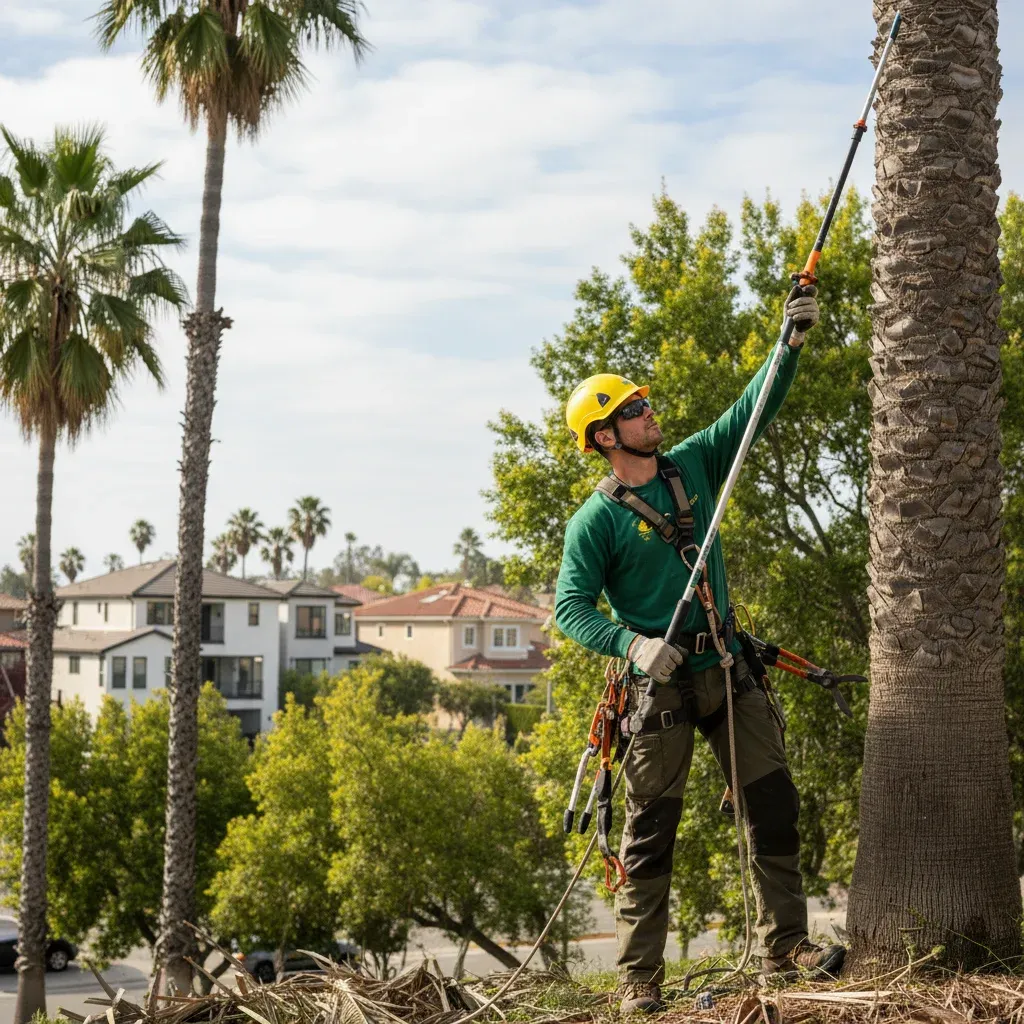
A letter from the HOA about a tree is a records problem before it is a cutting problem. Name who owns the trunk. Name who must approve work. Then keep a written file. A view fight in Del Mar is not a parkway-tree fight in Chula Vista, and a private-yard oak is not a City street tree.
Branch Pro San Diego is a referral service. We connect customers with licensed, insured independent local tree professionals. You hire and pay the professional directly. We don’t represent you before a board, decide liability, or perform the work.
If people are hurt or in immediate danger, call 911. If a line is down, stay away. From a safe place, call 911 and SDG&E at 1-800-411-7343. Don’t walk closer for photos or to inspect a leaning trunk. SDG&E decides whether lines can be de-energized, covered, or moved. If a standing tree already touches overhead lines, call SDG&E first. Safety and utility calls come before HOA paperwork.
Who owns the tree, and who maintains it?
Start with the trunk, then the governing documents, then the public right-of-way.
Civil Code section 833 says a trunk wholly on one owner’s land belongs to that owner, even if roots enter another property. Section 834 says a trunk across adjoining parcels belongs in common. Those are ownership rules. They don’t automatically assign repair costs, grant access, or authorize pruning. A fence is not a proved survey line. Use the recorded survey if you have one.
HOA documents add another layer. Civil Code section 4775 sets default maintenance duties unless the declaration says otherwise. The association generally maintains, repairs, and replaces common area. The owner of a separate interest generally handles that interest. Exclusive-use common area can split owner maintenance from association repair and replacement. Read the actual designation in the declaration. Don’t guess from a planting strip.
Confirm whether the tree sits on the private lot, common area, or the public right-of-way. City street trees follow the city’s process. In the City of San Diego, Urban Forestry uses a no-fee permit after City inspection for street-tree trimming, removal, planting, and root pruning. City staff decide immediate safety conditions. A private crew’s availability is not authority to remove a City street tree. Report City-maintained trees through Get It Done.
Civil Code section 4205 puts the law above conflicting governing documents. The declaration then prevails over articles, those over bylaws, and all of those over operating rules. CC&Rs matter. They don’t outrank statute.
A Torrey pine on City of San Diego public land is not the same case as a private-yard pine. Confirm the parcel, the tree’s exact location, and any protected or heritage designation before anyone cuts. Our tree removal permit guide helps you line up those questions. It does not replace the authority that governs that lot.
What kinds of HOA tree fights show up here?
Every dispute needs the same file: photos from safe ground, the tree’s location, and the written rule you think applies.
Common subjects include a blocked view, cracked paving, a dead or hanging limb, fallen fruit or fronds, and an architectural-review demand to prune or remove. Tree removal and tree trimming are different scopes. Don’t send a removal quote to answer a pruning notice, or the reverse.
If decline is part of the argument, use signs your tree is dying to describe what you see. That is not a diagnosis. If defensible space is part of the notice, confirm the fire authority for the address. PRC 4291 applies in State Responsibility Areas. Locally designated Very High Fire Hazard Severity Zones follow Government Code 51182. See defensible space tree requirements.
What written file should you build first?
Request the current CC&Rs, the architectural rules, and any tree or view policy from management. Read the landscaping, architectural control, maintenance, and use-restriction sections. Note whether planting, major pruning, or removal needs committee approval.
Keep communication in writing. Ask a specific question. Attach the photos, the survey if you have one, and the rule you are citing. Date every email. Summarize any phone call in a follow-up note. Don’t prune a protected or right-of-way tree to “cure” a notice without the required permissions.
If the association is pursuing covered discipline or a common-area damage charge, Civil Code section 5855 requires written notice at least 10 days before the meeting, a chance to address the board, an opportunity to cure, and a written decision within 14 days if a discipline or charge is imposed. That timeline is not a notice period for every tree-work request. Contested deadlines belong with a California attorney.
How does internal dispute resolution work?
For covered association and member disputes, Civil Code section 5910 requires a fair, reasonable, and expeditious internal process. Invoke it in writing. If a member invokes it, the association must participate. A member may decline if the association invokes it. The association can’t charge a participation fee. Your own attorney or adviser costs are separate.
Civil Code section 5930 makes an ADR attempt a prerequisite for specified superior-court enforcement relief, with scope limits and exceptions. Small claims is excluded. This is not a promise that you can sue immediately, and it is not a rule that every tree quarrel must go to mediation first. Refer disputed legal rights to a qualified California attorney.
What can a tree report actually do?
Use a written tree report when the dispute needs an assessment. Agree in writing on the assessor’s name, what will be observed, what may be inferred, and what the limits are. Species, visible defects, and recommended work belong in that scope.
ISA certification belongs to an individual. An absent ISA directory listing does not by itself disprove it. Ask for that person’s digital certificate if the credential matters.
Arborist consultation and tree health diagnosis are separate scopes from cutting. Compare them against the question the board actually asked.
For paid tree work, verify the contractor on the CSLB license lookup. An active C-49 or an active legacy D-49 can both be valid. The crews we connect you with can pull a required permit when that task is in the agreed scope.
Frequently asked questions
Does the HOA automatically own the tree in the sidewalk strip?
No. Confirm the parcel, the right-of-way, and the declaration. City street trees stay on the city’s process even when an HOA wants them trimmed.
Do CC&Rs outrank California law?
No. Civil Code section 4205 puts the law above conflicting governing documents. Then read the declaration, articles, bylaws, and rules in that order.
Is the 10-day board notice required before every tree job?
No. The 10-day and 14-day timelines in section 5855 apply to covered discipline and specified charges. They are not a statewide tree-work notice.
Will an arborist report make the board accept my plan?
No. A scoped written report can support a discussion. It does not bind the board.
Can Branch Pro settle the dispute?
No. Legal disputes belong with a California attorney. Licensed, insured independent professionals handle assessment or work you hire directly.
Get connected with a local pro
If the tree is on a conductor, use the utility steps above first. For an assessment or scoped work after you know ownership and approval, call (858) 400-4423. We’ll connect you with a licensed, insured independent local professional. Describe the tree, the HOA request, and any line or safety issue. You hire and pay that professional directly.