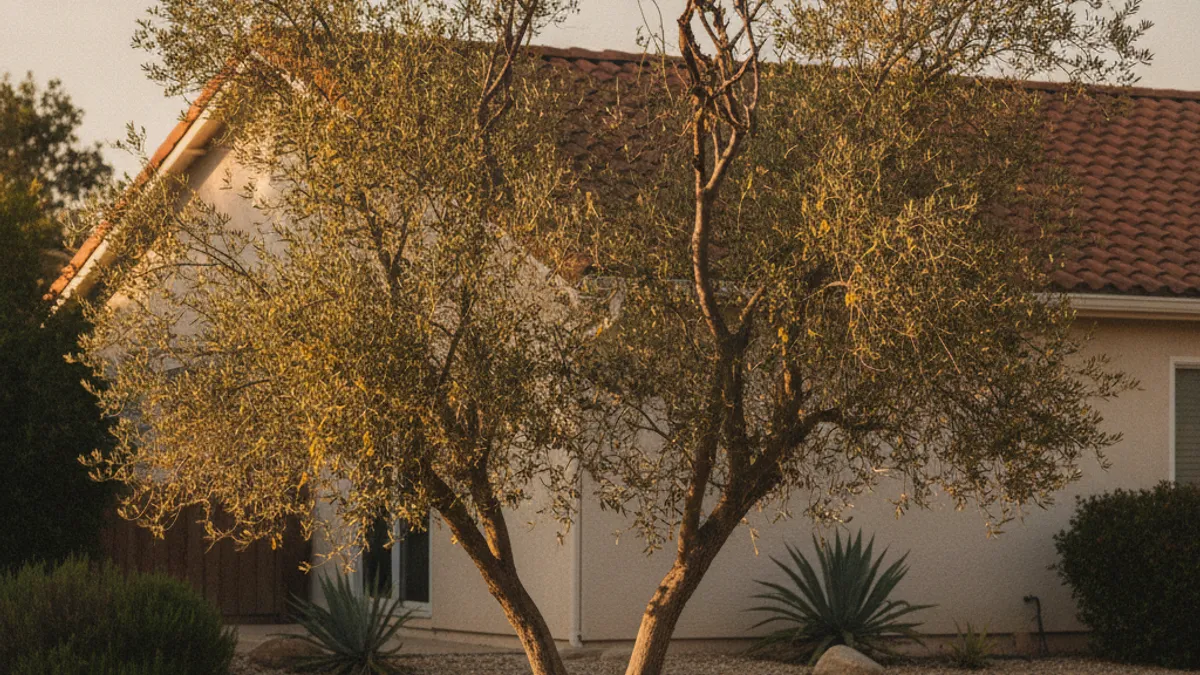
A thinning olive canopy can come from wet roots, dry roots, wilt, scale, or sunburned bark. The pattern on the tree, plus soil moisture and recent irrigation changes, is what points to the next check. Symptoms overlap, so one look is not a diagnosis.
What should you look at before you change the watering?
UC IPM notes that too little water and too much water can produce similar foliar decline. Saturated soil starves roots of oxygen and can block uptake. A brown canopy is not an automatic cue to water more.
Check the actual root zone, not the calendar. Note drainage, recent construction, and whether the olive still sits on a lawn sprinkler that used to keep it wet. UC also notes that mature trees can suffer when turf irrigation is shut off, because that program was part of their water supply. Separating an olive from a wet lawn zone can help if the root zone stays soggy. Turning all nearby water off without checking moisture can swing the tree the other way.
Salt injury can mimic drought. UC’s salinity page describes leaf-tip and margin browning from spray, saline irrigation, or salty soil. A coastal lot is not proof of salt damage. Soil or irrigation-water tests answer that question. Don’t strip live salt-spotted foliage as a treatment.
Photograph the whole canopy from the ground, outside the fall zone. Use zoom for a typical leaf or the trunk flare. Don’t climb, and don’t walk in for a closeup.
What does Verticillium wilt look like on olive?
UC’s olive Verticillium guide describes sudden wilt on one or more branches. The pattern is not always a neat half-and-half canopy. Olives often lack the dark wood streaks people expect on other hosts. Don’t scratch or cut the trunk looking for a stain.
Some trees recover. Some die. Strain, cultivar, and how much of the pathogen is in the soil all matter. Prior susceptible crops in that soil raise planting risk. There is no reliable post-plant control. Pruning dead wood can be a safety choice. Landscape Verticillium wilt can also overlap Fusarium and other wilts, so a lab test may be what settles the cause.
If a large limb is failing toward a target, stay back. Injury or immediate danger to life is a 911 call. A standing tree or limb near an overhead line is an SDG&E call first. A downed line means stay away, then call 911 and SDG&E at 1-800-411-7343 from a safe place.
How do black scale and peacock spot differ?
Black scale (Saissetia oleae) is a soft scale. Adults are dark and convex, often with an H-shaped ridge. They produce honeydew. That honeydew can grow a black sooty film on the leaf surface. The film shades leaves. It does not invade the leaf tissue the way a leaf-spot fungus does. Other honeydew insects can make a similar film, so the film alone is not proof. Dense, humid canopies, including many coastal sites, can favor black scale. Natural enemies often keep numbers down. Ants protect scales. Broad, persistent insecticides can make that worse. Targeted removal of heavily infested wood is a pest-specific option, not a yearly thinning quota.
Peacock spot makes dark circular leaf lesions, sometimes with a yellow halo. Leaves can drop early, and twigs can be lost. Wet leaves and rainfall favor new infection, mostly in fall and winter. High summer heat limits it. Wetter coastal olive sites see more pressure than dry interior sites. Peacock spot is a leaf disease. It is not the removable sooty film from honeydew. A copper spray belongs to a current professional plan after the leaf disease is identified.
Can heavy pruning sunburn an olive?
Olives shade their own bark. ISA’s mature-tree guidance says each cut needs a purpose. Excessive foliage removal reduces energy reserves and is not a health treatment. Newly exposed bark can sunburn, crack, and invite later pests. There is no routine seasonal thinning recipe that keeps olives safe.
If you can see a root circling the flare, or wood-boring dust on a weakened limb, record it for the independent pro. Those findings need identified evidence. They are not the default cause of every thin olive.
What should a professional assessment include?
Ask for a tree health diagnosis that starts with soil moisture, irrigation history, drainage, and the actual canopy pattern. Supportive care, targeted pruning, or removal should follow that assessment. Removal is not required after every decline. Don’t cut structural roots as a home experiment. Treatment, if any, follows identification of the pest or disease and a current professional plan.
Our guide to signs a tree is dying helps you separate normal leaf drop from a tree that needs a hazard look.
Frequently asked questions
Can a declining olive be saved?
It depends on the cause and how much live canopy remains. Irrigation and drainage problems are often adjustable. Verticillium wilt has no reliable post-plant cure, and outcomes vary. Scale and peacock spot need the pest or disease identified before anyone treats.
Should I stop watering the lawn under my olive?
Only after you know whether the olive root zone is wet or dry. A shared lawn zone can keep olive roots too wet. Shutting that zone off can also remove water the tree had been using. Check moisture, then change the program.
Does one-sided dieback always mean Verticillium?
No. UC describes wilt on one or more branches, and other stresses can look similar. Don’t treat the pattern as a confirmed diagnosis.
How much water does an olive need in San Diego?
There is no countywide monthly schedule. Frequency follows species, soil, drainage, weather, and whether lawn irrigation still reaches the roots. Check the root zone before you add water or take it away.
When to call us
Call when an olive is dropping leaves, dying back, or carrying a sticky black film, and you want a licensed independent tree professional to sort the cause on site. Branch Pro San Diego is a referral service. We match you with licensed, insured local tree companies. We don’t diagnose trees or perform the work. You hire and pay the selected pro directly.
Call us at (858) 400-4423 and we’ll connect you with a licensed local tree company.