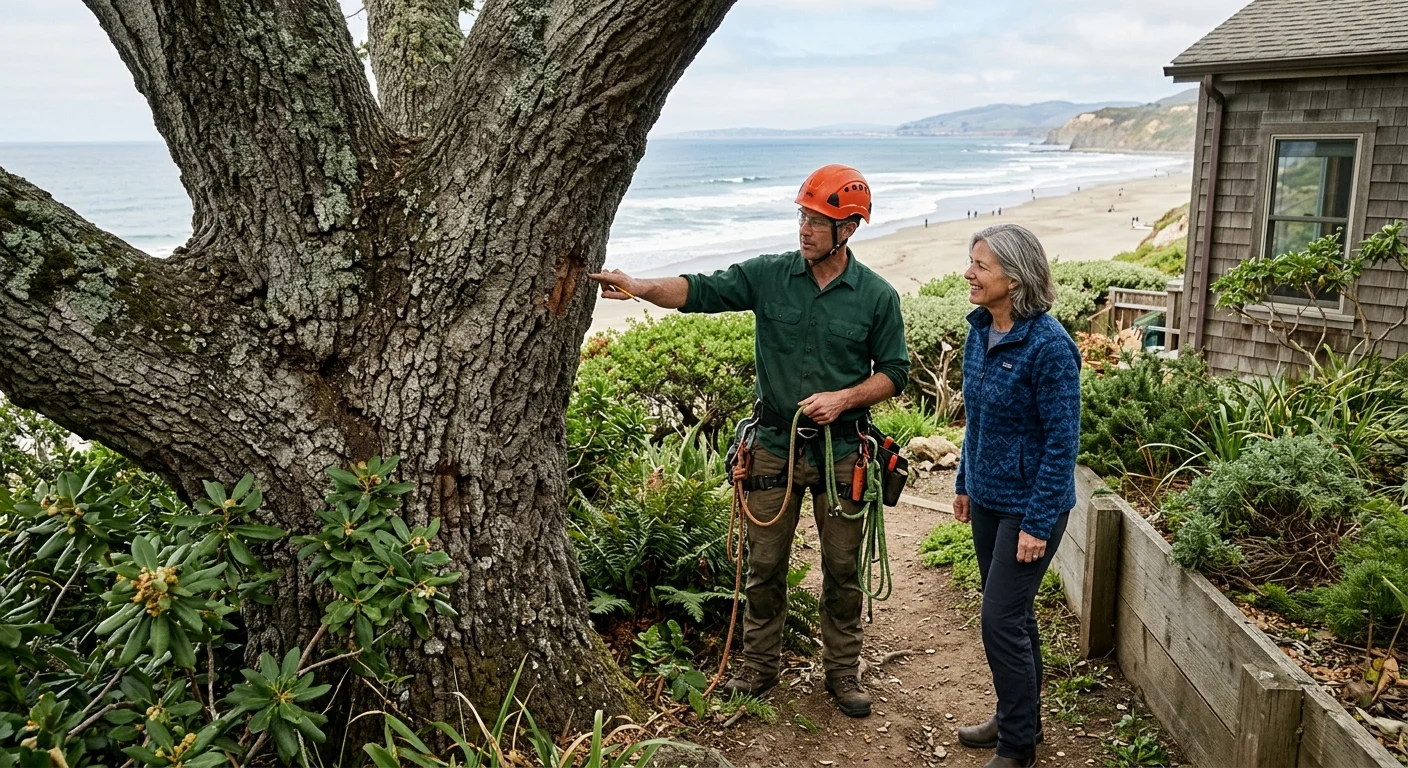
An Ocean Beach tree needs an arborist when the cause isn’t obvious, a prune depends on diagnosis, or you want findings in writing. Ocean Beach is a City of San Diego community, so a street tree and a private-yard tree follow different paths.
Branch Pro San Diego connects homeowners with licensed, independent local tree professionals. Start with an arborist consultation when the problem needs investigation before anyone cuts, treats, or removes the tree.
City street trees versus a private Ocean Beach yard
Ocean Beach isn’t its own city. It’s a City of San Diego community planning area. Street trees follow the City’s Urban Forestry program, not a private crew’s schedule.
If the tree sits in the street or parkway as a City tree, a private crew’s availability isn’t permission to remove it. After City inspection, a no-fee permit request can cover street-tree trimming, removal, planting, or root pruning. Other City street-tree removal requests are evaluated under Council Policy 200-5. Report a City-maintained tree through Get It Done. If the conflict is a power line, call SDG&E rather than asking a tree company to manage the line.
A backyard tree on a private parcel is a different check. Protected status, coastal or development conditions, and easements depend on the actual lot. From a safe place, record setbacks, parking, and whether overhead lines are present. Don’t measure conductors. The utility measures clearance when lines are involved.
Utility first, then observations from the ground
If someone is hurt or a falling tree threatens life, call 911. If a line is down, don’t walk in for a photo. Stay away, call 911, and call SDG&E at 1-800-411-7343 from a safe place. Don’t try to decide whether the line is energized.
If lines are standing near the tree, tell SDG&E before anyone plans overhead work. Don’t step closer to measure clearance. From a stable place, note what you can see: which side of the canopy looks different, whether soil has lifted, and whether limbs already failed.
Don’t clear clutter from under a tree that may move. Don’t climb, probe the trunk, or pull bark.
When diagnosis should come before pruning
A thinning canopy, peeling bark, a cavity, or a hole in the trunk is a starting point. It isn’t a diagnosis.
Ask for an assessment before pruning when you notice:
- A lean that looks new or has increased
- A crack where a large limb meets the trunk
- Dieback in one section of the canopy
- Bark staining, loose bark, or unusual openings
- Mushrooms or other growth at the trunk or root area
- Leaves changing differently on separate parts of the tree
- Branches dropping without an obvious recent storm
- Soil lifting or cracking near visible roots
Take dated photos from the same safe spots outside the fall zone. Capture the whole tree and nearby ground from there. Don’t walk in for a trunk or base inspection. A short record helps the professional compare change. It doesn’t replace a site visit.
If the job is ordinary cutting with a known objective, compare this process with our Ocean Beach tree service guide. An assessment asks what’s wrong. A pruning scope describes proposed cuts. Not every health question means removal, and not every cut needs a formal report.
Salt, water, and site history that can look alike
Coastal air doesn’t prove salt injury. UC IPM describes two salt paths: spray or saline sprinkler water on foliage, and salts in the root zone. Spray can brown leaf tips and margins, sometimes more on the ocean-facing side or on lower leaves the sprinkler hits. Root-zone salts make it harder for the tree to take up water. Excess sodium can also damage soil structure.
Those symptoms overlap drought, irrigation problems, and other disorders. Inland yards can have saline irrigation, leftover fertilizer salts, or poor drainage too. A brown canopy isn’t an automatic instruction to water more. Saturated soil can starve roots of oxygen and produce similar decline.
Record what you can: where water lands, whether the schedule changed, whether lawn irrigation used to wet the roots, and any pooling at the trunk. Don’t label the tree overwatered or underwatered yourself. A professional can check root-zone moisture and irrigation coverage. Soil or water testing is how salinity gets confirmed, not a beach ZIP code. Don’t strip live foliage because you assume salt is the cause. Confirm the moisture and salt source first.
Recent digging, paving, fence posts, grade changes, or stored materials around the roots belong in the same notes. So does prior pruning, with the written scope if you have it. Don’t guess at percentages.
Homeowners elsewhere in the city can start from our San Diego service area page.
Oak clues that still need a site diagnosis
On oaks, UC IPM lists crown thinning, bark staining, woodpecker foraging injury, and D-shaped emergence holes as clues associated with goldspotted oak borer. Coast live oak and California black oak are primary hosts. Canyon live oak can be affected. Engelmann oak is affected rarely. Thinning or staining alone doesn’t prove the insect. D-shaped holes are a better clue than a general canopy change, and they still need qualified identification.
Don’t treat those signs as a removal order. Our tree health diagnosis and treatment service can connect you with a local professional for that next step.
Ask what you’ll receive before the visit
Don’t assume every visit produces a formal report. Ask in advance whether you’ll get a verbal assessment, notes, or a written report, and what that will include if you order it.
If you order a written report, agree on the output. It should identify the tree, separate observations from inferences, and state access or visibility limits. It should speak to prune, monitor, treat, or request a removal scope. Recommendations should name the affected part and the next action. Remaining questions are a valid result.
How to check credentials without mixing them up
“Arborist” and “licensed contractor” aren’t the same thing. ISA Certified Arborist is a professional credential held by a person, not a California license and not a company certification. Check the person who will assess the tree. Listings on ISA’s credential directory can be omitted, so a missing listing doesn’t by itself disprove a credential. Ask for that person’s current digital certificate.
If the same business will perform paid tree work, verify the contractor on the CSLB license check. Look for an active C-49, or an active legacy C-61/D-49 issued before January 1, 2024. A contract of $1,000 or more needs a contractor license. That total includes labor, materials, and all other items. A narrower exemption can apply only below $1,000, and only for casual, minor, or inconsequential work that doesn’t need a building permit. Advertising as a contractor, employing another person, or splitting a larger job knocks that exemption out. That $1,000 figure has applied since January 1, 2025.
On workers’ compensation, current law excludes D-49 from the no-employee exemption. C-49 isn’t on that current exclusion list. Read the actual CSLB coverage or exemption record for the company you will hire. Don’t assume every C-49 is exempt, and don’t assume every C-49 must carry a policy. Confirm employees, the record, and general liability separately. A certificate of insurance isn’t the policy. The required contractor license bond is $25,000, and a cashier’s check deposited in lieu of the bond is allowed.
Our guide to hiring a certified arborist in San Diego walks through comparing the person, the license, and the proposed scope.
Frequently asked questions
Who do I call for a City street tree in Ocean Beach?
If someone is hurt or a tree threatens life, call 911. For a downed line, call 911 and SDG&E at 1-800-411-7343. Report an urgent City-maintained street-tree hazard through Get It Done. Don’t wait on a private inspection while people are in danger. Other City street-tree requests still go through City inspection. Don’t hire a private crew to remove a City street tree on a contractor’s schedule.
Should I prune salt-browned leaves off myself?
Don’t strip live foliage because you assume salt is the cause. Confirm whether moisture or salt is the actual problem, and where that salt is coming from, before anyone cuts live leaves.
Does an ISA credential replace a contractor license?
No. The credential is individual. Paid tree work still follows California contractor licensing, including an active C-49 or a valid legacy D-49 when that classification fits the job.
When to call us
Call when your Ocean Beach tree shows unexplained changes, or when you want diagnosis before pruning, treatment, or removal. Call us at (858) 400-4423 and we’ll connect you with a licensed local tree company.