A private lane off Highland Valley Road or Dye Road can vanish under ceanothus, dead eucalyptus, and fallen oak limbs until a truck cannot make the last turn to the house. Land clearing services along that corridor are not a backyard trim. They are a scoped cut through your driveway, a shared lane, a recorded easement, or all three, and the first mistake is treating it like one pile of brush.
Confirm who controls the road and work area
Start with the paper, not the chainsaw. In unincorporated country around Ramona and Valley Center, a mailing address does not prove who may clear the lane. The road you drive may sit on your parcel, a neighbor’s parcel, a dedicated easement, or a strip the County still treats as public right-of-way.
Pull the assessor parcel number and the recorded map. The County Recorder holds deeds, easements, and road-maintenance covenants. San Diego County Planning & Development Services (PDS) can tell you whether the parcel is County-controlled. A city-name mailbox in Hidden Meadows, Twin Oaks Valley, or Lake San Marcos does not make it city land.
Do not assume you may cut to the centerline. Civil Code sections 833 and 834 locate tree ownership by the trunk, not by roots or branches that reach across a fence. A fence is not a surveyed line. If the trunk sits on a neighbor’s side, that tree is not yours to take down. If you cannot settle the line, hire a licensed surveyor before anyone fells a coast live oak or a mature eucalyptus.
Shared private roads often have a road association, an informal rotation, or nothing in writing. Ask who pays for the surface, who holds the gate code, and who already hired work on the same stretch. Get written consent from every owner whose land the crew will occupy, stage on, or haul across.
Open-space easements and habitat overlays still bind fire clearing. County PDS form PDS-800 treats clearing as destruction or removal of natural vegetation, including brushing and grubbing. Existing dwellings, previously improved acreage, MSCP/PAMA status, vacant land, and easement language all change whether a clearing review applies. Fire-district written limits stop at your property line. They do not authorize work on a neighbor’s chaparral.
If the corridor is a City of San Diego street tree or parkway tree, that is a different path. Private-road work in the backcountry is not a city street-tree job. Confirm the jurisdiction on the actual APN before you approve a cut.
Map vegetation, slopes, drainage, gates, and structures
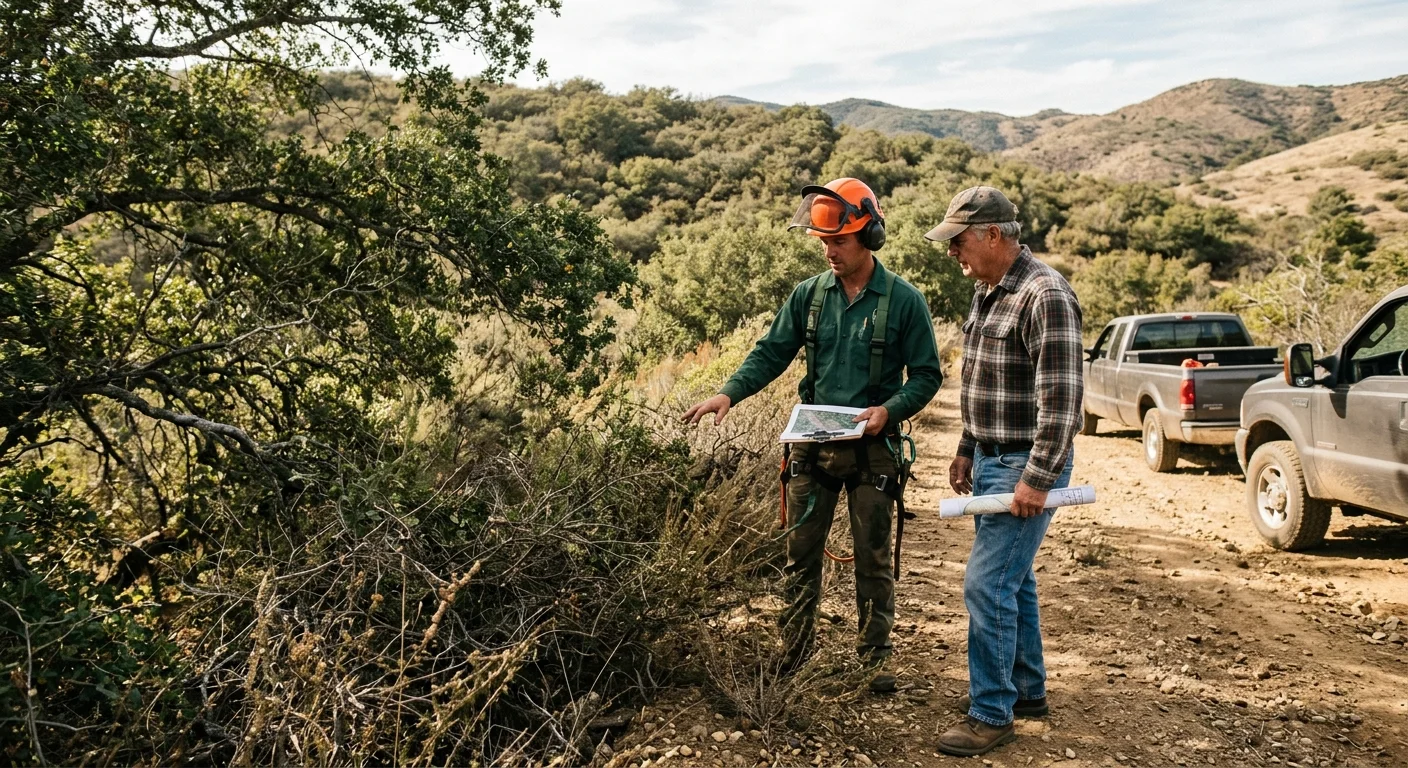
Walk the full length with the independent pro, not just the last 100 feet by the house. Photograph from a safe place on the ground. Note where brush closes to a single track, where a live oak canopy hangs into the travel way, and where a wash has undercut the edge.
Backcountry lanes in Ramona, Valley Center, Rainbow, Bonsall, and Fallbrook often drop into a drainage, then climb a decomposed-granite bank. Slope, ruts, and soft shoulders decide whether a chipper, a trailer, or a larger machine can even reach the work. Tight canyon access has the same problem as a steep lot: if the truck cannot turn around, the scope changes. That is the same access logic as tree and brush removal on canyon lots.
Mark every hard object the crew must not hit. Gates, cattle panels, well heads, propane tanks, irrigation risers, mailboxes, and low eaves all sit closer than they look once brush is gone. Overhead service drops and SDG&E primary lines are a stop, not a trim target. Stay away from downed or sagging conductors. Call 911 and SDG&E at 1-800-411-7343 from a safe place. The utility decides whether a line can be de-energized, covered, or moved. An ordinary tree crew is not line-clearance authority.
Before any powered digging, stump work, or trenching, contact DigAlert. San Diego County is in that system. Public marks usually run to the meter, not through every private irrigation line or septic lateral. Markers do not show depth. Private facilities need a separate locate.
Drainage is part of the map. Brush in a swale may be holding soil in place. Clearing the travel way is different from scraping a bank down to bare dirt. Agree which water bars, culvert inlets, and roadside ditches stay untouched. Erosion after a Santa Ana blow and a winter storm is a road problem, not a bonus from over-clearing.
Keep a simple list: start and end of work, trees to retain, trees to remove, brush limits, staging, turnarounds, and the haul route. That list is the quote.
Separate brush, tree, and debris-removal scopes
Land clearing services along a private road are several jobs sold as one sentence. Split them on paper or you will argue about leftovers.
Brush and understory is one scope: ceanothus, sage, dead limbs on the ground, ladder fuel beside the travel way. Mature tree removal is another: a leaning eucalyptus over the gate, a coast live oak with a trunk in the roadway, a dead pine that will take the fence when it fails. Stumps in the travel way are a third decision. Grinding is not the same as digging a hole for a new culvert.
California contractor licensing is required for tree-service contracts of $1,000 or more in the aggregate, including labor and materials, unless a narrow casual-work exemption applies. Advertising as a contractor, hiring others, needing a building permit, or splitting jobs to stay under the line knocks the exemption out. Tree work in that range belongs with an active C-49 Tree and Palm Contractor, or with a still-valid legacy C-61/D-49 issued before January 1, 2024. Look the number up on the CSLB license search. Match the classification to the actual scope. Grading a roadbed or installing drainage is not automatically the same license as cutting trees.
ISA Certified Arborist is an individual credential, not a state license and not a substitute for CSLB. Ask for the person who will assess the oaks, then verify that person if the credential matters to you.
Birds nest in this county in every month, and for many species the typical window is February through August. CDFW recommends a consulting biologist’s survey when work must occur while birds could be nesting. An active nest gets a buffer or a delay until nesting is done. Do not move nests. Do not treat a calendar date as permission.
Goldspotted oak borer is contributing to oak mortality in many parts of San Diego County. Do not diagnose every stained trunk from the road. Keep suspect oak wood on site until the matched pro and current local rules say how to handle it. Do not treat infested wood as ordinary chips for a neighbor’s pile.
Define hauling and the final road condition
Clearing without a finish spec leaves a chip berm in the turnaround and a road you still cannot drive. Write the end state before work starts.
Agree what happens to brush, logs, and chips. Leave-in-place mulch on the shoulders is a choice. Hauling off site is a choice. Piling at the barn for later firewood is a choice. None of those is automatic. San Diego County has no verified public average for what hauling costs, and this page will not invent one. Ask the independent company to price haul-off as its own line if you need the lane empty.
Do not plan on burning the pile as the default disposal. Local fire authorities issue burn permits for a specific place, time, material, and quantity. The Air Pollution Control District does not issue that permit. A permissive air-quality day does not override a fire restriction. Some fire districts suspend residential burning for stretches of the year. Confirm with the district that covers the parcel.
Say how wide and how clear the travel way should be when the crew leaves. “Passable for a pickup” is different from “passable for a fire engine,” and this site has no verified county road-width rule to quote. Your fire authority can tell you what it wants to see for access to that address. CAL FIRE’s defensible-space guidance is about structures, not a private-lane construction standard. Use it for the house. Use the fire district for the road question.
Stumps in the wheel path, roots that catch a blade, and ruts from equipment all belong in the closeout. If you want the surface graded, say so, and confirm who is licensed and willing to do that work. A tree crew may not be the grading contractor. If you want native oaks left as a canopy over the lane, mark them. Selective clearing is a written tree-by-tree list, not a hope.
Chips against a trunk or in a drainage inlet are not a finished road. Agree who rakes, who loads, and who owns the material once it leaves your gate.
Verify authority questions before approving work
Before you sign, run a short authority check. It is faster than repairing a cut that was never allowed.
Confirm parcel jurisdiction with County PDS or the city planning counter. For unincorporated land, ask PDS whether native-vegetation clearing review applies, and ask the fire district for its written clearing limits on that address. Recorded open-space language still applies even when the fire letter is in hand.
If the road is shared, collect written permission from the other owners or the association that actually controls it. If a trunk sits on the line, pause for a survey and legal advice. Neighbor-tree rules are not a self-help permit.
Check for overhead utilities and DigAlert before powered ground work. Check nesting risk if the calendar and habitat say birds may be present.
Verify the company on CSLB: active license, classification that fits, bond record, and workers’ compensation record that matches how the job will be staffed. A C-49 holder is not automatically exempt from workers’ comp and is not automatically required to carry it in every no-employee case. Read the current CSLB record. Ask who will be on site.
Compare more than a verbal number. How to compare land clearing companies in the San Diego backcountry is the hiring companion to this access-road plan. Demand a written scope: limits of clearing, trees retained, trees removed, stump handling, haul-off, staging, and the finish of the travel way.
No public .gov source publishes an official average cost to clear land in San Diego County. Quote the job you mapped. Duration for a long ranch road, or for a large acreage someone mentioned in passing, is not a county timetable. The matched provider confirms timing after they walk the mapped clearing limits.
Frequently asked questions
What are land clearing services?
They are contracted vegetation work that makes land usable for a stated purpose. On a private access road that purpose is usually a drivable, visible corridor: brush off the travel way, selected trees out of the path, debris handled, and a finish you can inspect. It is not a promise to scrape every acre, mulch a ranch in one pass, or replace a grading contractor.
Do I need a permit to clear land on my property?
It depends on the parcel, the vegetation, easements, and the fire district, not on the fact that you hold the deed. Unincorporated owners should start with County PDS and the fire authority for that address. City lots follow that city’s tree and right-of-way rules. A homeowner calling a tree dangerous does not create the official exception. Confirm before the first cut.
What’s the average cost to clear land?
There is no verified government average for San Diego County. Density, slope, access, tree work versus brush, haul-off, and the finish all change the quote. Ask for a written price on the mapped corridor. Skip anyone who quotes a whole ranch from a photo of the gate.
How long does it take to clear 20 acres of land?
No verified source on this site gives a duration for 20 acres, and an access road is rarely that project. On-site time belongs in the provider’s plan after they see access, vegetation, and the haul route. Do not hire against a generic acre-per-day claim.
When to call us
Call when the lane is closing in, a mature tree sits in the travel way, or you need a licensed independent crew to separate brush work from removal and hauling. Branch Pro San Diego matches you with licensed, insured local tree companies. We do not run the saws or own the trucks. Call us at (858) 400-4423 and we’ll connect you with a licensed local tree company.