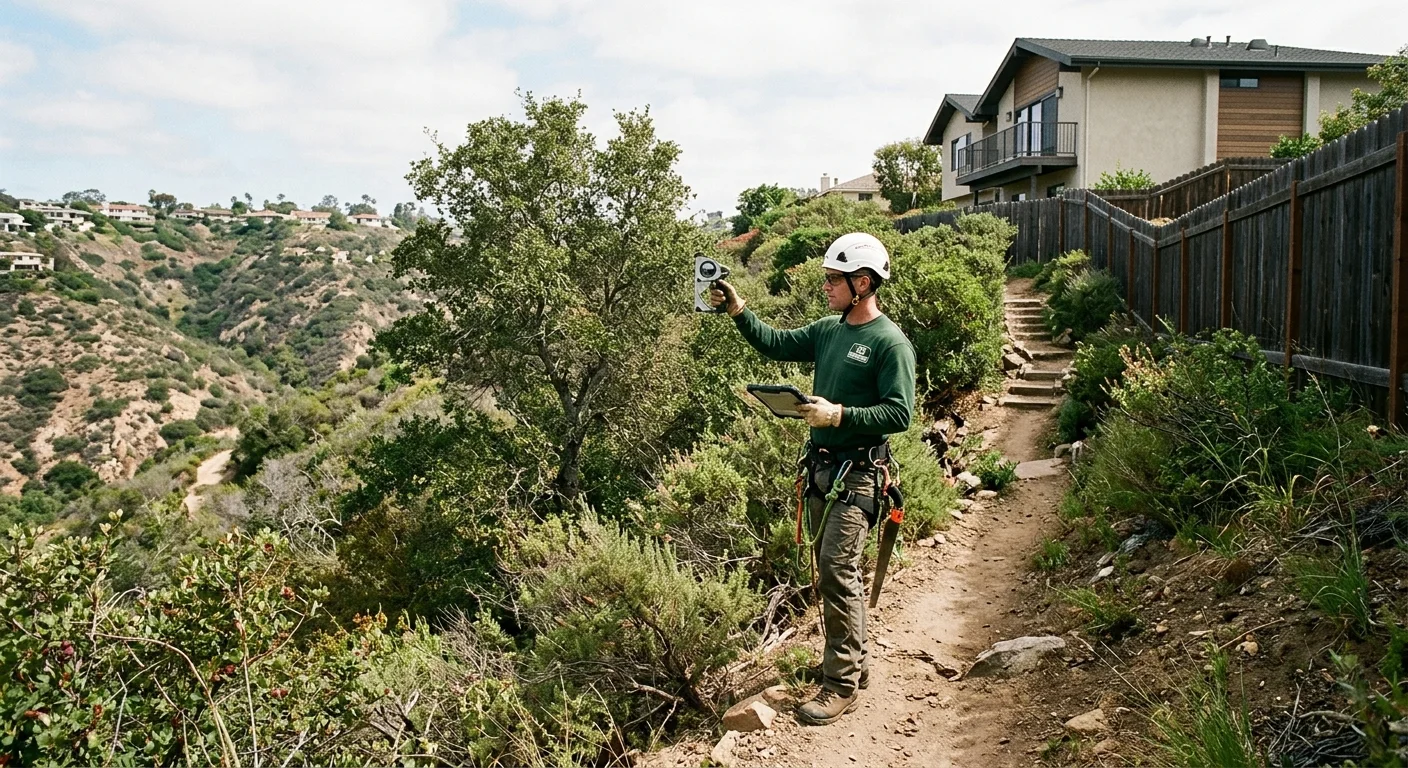
Tree and brush removal on a canyon lot needs one coordinated scope. That scope should separate individual tree decisions, brush clearing, access, hauling, and the finished ground. Planning those parts together lets you compare proposals without treating every plant as the same job.
Separate tree work from brush and debris clearing
Start by dividing the property into distinct work categories. Mature trees need individual decisions. Brush, vines, fallen limbs, leaf litter, and old cut material belong in separate clearing categories.
This distinction matters on canyon-edge lots. One area might hold a coast live oak beside tangled brush. Another could include a eucalyptus, a queen palm, or smaller volunteer growth near a fence. A proposal labeled only “clear vegetation” doesn’t say what happens to each feature.
Mark every tree that needs its own review. The written scope should say whether each tree stays, gets pruned, or is being considered for removal. Then describe the brush zones on their own. Note whether vegetation will be cut, removed, or left in a defined condition.
Keep loose debris separate too. Existing piles, fallen branches, old lumber, and dumped material shouldn’t disappear inside a broad brush line item. Ask the company to identify what’s included and what isn’t.
Combined projects often involve both land clearing and defensible space work and an individual tree removal assessment. Those services can overlap on the same lot. They aren’t interchangeable.
Map slopes, fences, structures, and access from a safe place
A simple site map gives every company the same starting point. It doesn’t need survey-level detail. It should show the house, detached structures, fences, gates, trees, brush zones, slope changes, and the planned hauling route.
Tierrasanta and Scripps Ranch are City of San Diego community planning areas, not separate tree-permit cities. Start at the street. Trace the route from the access point to each work area. Mark narrow gates, stairs, retaining walls, patios, and planted areas that should stay untouched. If a neighboring parcel sits beside the route, mark that boundary as you understand it. A fence is not a surveyed line.
Build that map from places that are already safe: the street, a stable path, a deck, or a window. Record trees with a digital sketch or notes from that point. Don’t scramble the canyon under hanging limbs to tag a hazard tree, inspect roots, or set a cut line. A digital sketch is a planning tool. It isn’t permission to cut.
Don’t assume the visible path is usable for every part of the job. Ask each independent company to put the access plan in writing. The plan should identify where cut material will travel, where it will be staged, and how it will reach the street or another agreed pickup point. Don’t specify machinery unless that company has assessed the site.
Draw the top, middle, and lower slope sections when you can. Connect each marked tree or brush area to a location on the map. Photos from several fixed, safe points can support that map. Give the same map and photos to every company you ask for a tree service match in San Diego.
Keep fire-clearance planning separate from appearance work. Our guide to brush clearance during Santa Ana wind season helps organize that discussion without assuming every canyon lot follows the same local standard.
Which fire rules apply to this parcel
California Public Resources Code 4291 is the state defensible-space rule for State Responsibility Areas. It isn’t the rule for every locally designated lot. Locally designated Very High Fire Hazard Severity Zones use Government Code 51182, with property-line limits, written consent from an adjacent owner where the statute requires it, and any stricter local rules. Confirm the address with the fire authority that actually covers it.
CAL FIRE’s Ready for Wildfire defensible-space page describes Zone 1 as within 30 feet of structures, or to the property line if that’s closer. Zone 2 runs 30 to 100 feet, or to the property line. Treat the first five feet as Zone 0 guidance, not a current statewide order to remove every living plant. The Board of Forestry approved a final Zone 0 draft on August 19, 2026. As of September 5, 2026, the Office of Administrative Law listed that emergency filing under review. Ask the responsible fire department what this address requires now. Local rules can already apply.
On unincorporated land, native vegetation clearing can need County review. PDS-800 treats clearing as destruction or removal of natural vegetation, including brushing and grubbing. Existing dwellings, previously improved acreage, MSCP/PAMA status, vacant land, and easements affect whether review applies. Fire clearing is limited by property boundaries and the fire district’s written requirements. Recorded open-space easement conditions still apply. PDS-261 is the companion clearing and grading review form. Identify the parcel, native cover, easements, and planned disturbance, then have PDS and the fire district confirm the requirements. A fire-clearing note isn’t permission to work on a neighbor’s land.
A postal city name doesn’t settle jurisdiction. Use the parcel or APN to confirm which city or County office governs the lot. Then confirm public versus private ownership and who may authorize the work. Unincorporated parcels go through County PDS.
Identify vegetation that needs an individual assessment
Not everything inside a clearing boundary should get the same instruction. Label mature trees, trees with visible decline, native oaks, Torrey pines, and vegetation near utility conductors for individual review.
Coast live oaks deserve close attention in this county. UC ANR records goldspotted oak borer on coast live oak, California black oak, canyon live oak, and, rarely, Engelmann oak. UC IPM treats D-shaped exit holes as a characteristic sign and treats crown thinning or bark staining as nonspecific. Those clues aren’t a diagnosis from the path. Don’t move suspect oak wood as ordinary debris. Arrange professional handling before the wood leaves the site, and check the actual disposal rules that apply.
Torrey pines on public lots or lands in the City of San Diego are protected from cutting, injury, or destruction. That City rule doesn’t automatically cover every private Torrey pine. Del Mar and Torrey Pines State Natural Reserve have their own processes. Confirm the parcel and the controlling authority before work begins.
In the City of San Diego, a tree in the parkway or another public right-of-way isn’t a private canyon-lot call. Street-tree trimming, removal, planting, and root pruning go through the City’s no-fee permit request after City inspection. Report City-maintained trees through Get It Done. A private contractor’s availability isn’t authority to remove a street tree. Start at the City’s street tree maintenance page.
Birds add a scheduling check, not a calendar permission slip. CDFW describes February through August as typical for many species, with nesting possible in other months depending on species and location. When birds could be nesting, the agency’s guidance is a consulting biologist’s survey before vegetation removal. A biologist may set a protective buffer, or work may wait until nesting is complete. Don’t move a nest. Don’t disturb it to inspect it. Legal protections apply to occupied nests year-round.
If someone is hurt, or a tree threatens life or injury, call 911 first. Trees near energized lines shouldn’t fold into ordinary brush clearing. Identify them on the map, then ask SDG&E who may handle that portion. Only authorized, trained personnel may work near those lines. For a standing conflict, stay away and call SDG&E from a safe place. If a line is down, stay away and call 911 and SDG&E at 1-800-411-7343 from a safe place. Follow SDG&E’s downed-line guidance.
DigAlert before powered grubbing, roots, or stumps
Powered grubbing, root work, and stump grinding are excavation. DigAlert covers San Diego County. Premark the work, contact 811, and wait for every member response. Member marks usually run to the meter. They don’t show depth. They don’t locate every private irrigation line, sewer lateral, or other private facility. Arrange a separate private locate for those. A qualified excavator exposes conflicting utilities before powered work. Markers never prove a line is deep enough to grind over. The homeowner exception is narrow: your own private property, no permit, and no powered equipment.
Define hauling and the final site condition
“Remove the brush” leaves too much unanswered. The proposal should describe where material goes and what the property will look like afterward.
List each material category separately. These may include logs, branches, brush, chips, stumps, surface roots, loose leaves, and preexisting debris. Then assign a finished condition to each one. You might want logs hauled away, chips left in a designated area, or an old debris pile excluded. Record the choice.
Don’t assume hauling is included because cutting is included. Ask whether loading, transport, and receiving-facility charges appear in the written amount. The receiving facility sets its current acceptance terms. Ask the company to name the facility and confirm what it will accept before clearing starts.
Stumps need a separate decision. A proposal should say whether each stump remains, is cut to an agreed condition, is ground, or needs another assessment. Don’t let “tree removal” serve as the only stump instruction.
The finished site should also address boundaries. State which living vegetation stays. Mark planted slope areas, screening plants, or brush outside the work zone. If bare ground concerns you, ask what follow-up planning belongs outside the tree and brush scope. Don’t assume clearing includes grading, drainage, planting, or erosion work.
For budgeting questions, compare written scopes. Our guide to San Diego land-clearing cost factors walks through access, hauling, and finish questions the quote should answer.
Verify the written scope before clearing begins
Walk the property with the written scope before authorizing work, from places that are already safe. Match each marked tree, brush zone, access route, and hauling instruction to the map. If a line can be read two ways, revise it.
The scope should identify the independent company doing the work. For regulated tree work, verify the contractor through the CSLB license lookup. California tree work uses the C-49 Tree and Palm classification, and existing C-61/D-49 licenses issued before January 1, 2024 may still be active. Look up the classification that matches this job instead of assuming every legitimate company must display C-49.
Licensing is required for a tree-work contract of $1,000 or more, counting labor, materials, and other items together. The exemption below that amount applies only to casual, minor, or inconsequential work. It doesn’t apply if a building permit is required, the company advertises as a contractor, employs others, or splits jobs to stay under the line.
The CSLB record shows classification, status, expiration, bond, and workers’ compensation. Current Business and Professions Code section 7125 allows a qualifying no-employee exemption for some classifications. It excludes D-49 and several other listed classes. It doesn’t currently list C-49. Confirm how this company actually staffs the job, and resolve any gap with CSLB or the insurer. Don’t treat a customer-facing certificate as a substitute for the policy.
An ISA Certified Arborist credential is different from a contractor license. It belongs to a person. Ask who will assess the trees that need individual review, and check ISA’s credential directory. Participation is voluntary, so a missing listing doesn’t disprove a credential. The person can share a digital certificate. That check doesn’t mean every matched company holds the credential.
Finally, compare exclusions. Confirm who handles permit checks, utility coordination, biological review, hauling, and disputed property boundaries.
Frequently asked questions
Does PRC 4291 apply to every canyon lot?
No. PRC 4291 covers State Responsibility Areas. Locally designated Very High Fire Hazard Severity Zones follow Government Code 51182 and local fire rules. Confirm the address with the fire authority that covers it.
Do I need a permit to clear brush on my slope?
It depends on the parcel, whether vegetation is native, whether the tree is public, and whether an easement or habitat overlay applies. City street trees follow that city’s process. On a city parcel, ask that city’s planning department and the fire authority that covers the address. On unincorporated land, ask County PDS and the fire district before the cut.
Who handles a tree touching a power line?
Stay away and call SDG&E for a standing conflict. If a line is down, call 911 and SDG&E at 1-800-411-7343. Ordinary brush clearing doesn’t include energized-line work.
What should a written canyon-lot scope include?
Named trees and their planned treatment, brush zones, access and staging, DigAlert responsibility for powered ground work, hauling and receiving-facility terms, stump instructions, and the finished condition of each area.
Combined tree and brush removal belongs with a licensed independent tree company when the scope includes regulated tree work or trees that need individual assessment. If someone is hurt or a tree threatens life, call 911 first. For a standing tree-and-line conflict, stay away and call SDG&E. If a line is down, stay away and call 911 and SDG&E at 1-800-411-7343 from a safe place. Those calls don’t authorize anyone to approach. For ordinary canyon-lot work that doesn’t involve a line or an injury, call Branch Pro San Diego at (858) 400-4423. We’ll connect you with a licensed, insured independent tree company. You hire and pay that company directly.