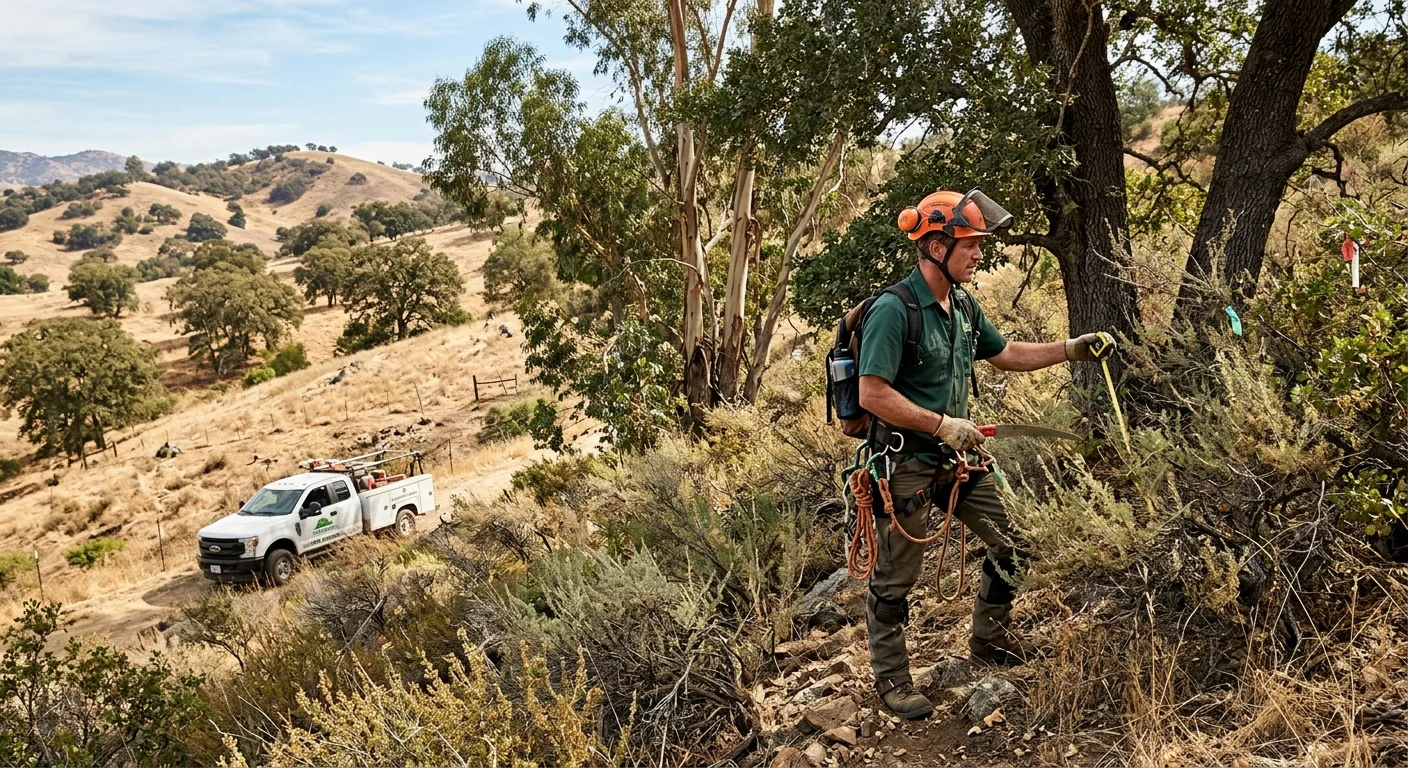
Late summer is a practical time to assess brush clearance before Santa Ana winds return. The goal is to separate brush cutting, tree work, access needs, and debris removal before hiring anyone. East County properties need a plan shaped around each slope, road, fence, and tree.
What to inspect along slopes, fences, and access roads
Begin with a property walk from stable, accessible ground. Don’t enter dense brush or climb a steep slope for a closer look. Photograph each work area and mark it on a simple property sketch. Stay off those slopes during high winds.
Treat each area as a separate part of the brush clearance scope:
- Along slopes, note brush density and visible cut material. Record where workers could enter and how debris could leave.
- Beside fences, look for vines, shrubs, fallen branches, and piled material. Mark any section that can’t be reached from either side.
- Along access roads, identify brush and low limbs that narrow the usable corridor. Include gates, tight turns, and turnaround areas in your photos.
- Near structures, separate vegetation touching the building from growth farther away.
- Around standing trees, mark deadwood, low limbs, trunk defects, and brush beneath the canopy.
Alpine, Ramona, and Jamul are unincorporated communities. A mailing address does not settle planning or fire jurisdiction. Start with CAL FIRE’s current wildfire preparation resources, then confirm written requirements with the fire authority for that parcel. Ask County Planning and Development Services about native vegetation, easements, and any clearing review that applies to the actual APN.
California Public Resources Code 4291 requires defensible space around structures in State Responsibility Areas. The requirement extends 100 feet or to the property line, whichever is closer. Locally designated Very High Fire Hazard Severity Zones follow Government Code 51182, with property-line limits and other parcel-specific qualifiers. That is not every locally regulated parcel by default. Some local jurisdictions may apply stricter rules.
Zone 1 is the area within 30 feet of structures, or to the property line if that is closer. Zone 2 runs from 30 to 100 feet, or to the property line. Numeric spacing depends on vegetation and slope. Ask the responsible fire department what branch-to-roof or chimney clearance applies to the parcel. Don’t use one countywide limb distance as the scope.
The first five feet around a structure is described as an ember-resistant zone. Ready for Wildfire says a statewide Zone 0 rule is not legally required yet. The Board of Forestry approved a final draft on August 19, 2026. As of September 5, 2026, the Office of Administrative Law listed that package under review. Local fire authorities may already have their own rules. City of San Diego guidance that allows maintained trees in that first five feet applies to City parcels, not to every East County lot. Don’t treat the first five feet as a present statewide order to remove all plants.
Those distinctions don’t produce one identical plan for every East County parcel. Confirm the address map, easements, and the fire district’s written requirements before anyone cuts.
How tree work and brush clearing create different scopes
Brush clearing usually focuses on low vegetation, small growth, accumulated material, and site access. Tree work deals with standing trunks, attached limbs, tree condition, and the space around a canopy. Combining everything under one vague proposal makes it harder to compare companies.
A written scope for land clearing and defensible space should identify what gets cut, what stays, and what happens to the debris. It should also distinguish brush cutting from tree and brush removal. Ask whether the proposal includes hauling, chipping, stacking, or leaving material on site. Don’t assume those tasks are included.
Standing trees need their own decisions. A eucalyptus limb above a road isn’t the same task as brush beside a fence. A declining coast live oak also needs more evaluation than a patch of low growth. Ask the pro to list each tree separately when pruning or removal enters the project.
California tree contracting generally requires an active C-49 Tree and Palm license or an active legacy C-61/D-49 when the contract is $1,000 or more in the aggregate. That total includes labor, materials, and all other items. The minor-work exemption is only for casual, minor, or inconsequential work under that amount, with no building permit. It does not apply if the person advertises as a contractor, employs someone else to do the work, or splits jobs to stay under the limit. Work that needs a building permit needs a license regardless of cost.
Branch Pro San Diego is a referral service. We match homeowners with licensed, independent local tree companies. The customer hires and pays the selected professional directly. We don’t perform brush clearing, tree trimming, or hauling.
Ask for a written quote that names each work area, the tree work included, debris handling, access limits, and exclusions. Compare those line items, not a round number on a card. For the site factors that can shape an East County proposal, read our guide to defensible-space costs in East County.
Where deadwood and low limbs need separate decisions
Deadwood and low live limbs can appear in the same work area, but they shouldn’t receive an automatic shared prescription. Their condition, attachment, location, and surrounding targets differ.
Start with what’s directly visible from the ground. Note dead branches above a driveway, gate, roof, fence, or work corridor. Photograph cracks, broken attachments, hanging limbs, and thinning crowns. Don’t pull on suspended material or stand beneath it.
Low live branches require a different discussion. Some may interfere with access or required spacing. Others may be part of a tree’s established structure. The proposal should identify which limbs are being considered and why. It shouldn’t authorize broad cutting across every tree without an individual assessment. Our fire-safe tree trimming checklist helps separate those tree tasks from general brush cutting.
August vegetation removal can overlap nesting. Occupied nests and eggs are protected whenever they are present. California Department of Fish and Wildlife describes February through August as typical for many species. Nesting can occur year-round in some places. When birds could be nesting, CDFW recommends a consulting biologist’s survey before vegetation removal. The biologist may set a protective buffer, or work can wait until nesting is complete. Don’t move or inspect a nest yourself. No calendar date proves a nest is inactive.
If a standing tree is in conflict with a power line, contact SDG&E first. Don’t approach the lines or move ladders and long tools into that area. If a line is down, stay away. Call 911 and SDG&E at 1-800-411-7343 from a safe place. A phone call never authorizes you to walk closer. Immediate danger also goes to 911.
Ask the company how trees, brush, active nests, and debris will be handled before work starts. That conversation often reveals whether one company can cover the full scope.
How Alpine, Ramona, and Jamul properties differ
Community names alone don’t determine a brush clearance plan. The actual slope, road access, vegetation, structures, and standing trees control the work. Use these East County comparisons as planning scenarios, not citywide assumptions.
Alpine
For an Alpine property on a hillside, access can shape every other decision. Mark where workers can approach the slope and where cut brush can be collected. A narrow gate or fenced side yard may split one visible brush area into separate work zones.
Scattered oaks also need their own inspection. Goldspotted oak borer is established in San Diego County and has been found in additional southern California counties. Signs listed by UC Agriculture and Natural Resources include crown thinning, bark staining, woodpecker damage, and D-shaped emergence holes. Crown thinning or staining alone is not a diagnosis. Those signs warrant a tree assessment instead of automatic brush cutting around the trunk.
Ramona
On a Ramona property with a long rural road, inspect the full corridor from the property entrance to the work area. Note low limbs, brush against fencing, gate width, tight turns, and places where debris handling could obstruct access.
If coast live oaks, California black oaks, or canyon live oaks are present, keep suspected decline separate from routine clearing. Drought stress predisposes trees to attacks by boring insects. That doesn’t mean every hole confirms beetles, and a beetle attack doesn’t mean every tree will die. Keep suspected oak wood on the property and arrange professional handling. Check the actual disposal rules before anyone hauls it away.
Jamul
For a Jamul property with dense brush and scattered eucalyptus, divide the site by access and task. Brush beside a structure, vegetation on a slope, and limbs above a road shouldn’t become one undifferentiated line item.
Photograph each area from more than one angle. Then ask the pro to explain which sections need land clearing services and which require tree work. That distinction produces a clearer proposal and reduces assumptions about disposal.
What to verify before hiring a land-clearing pro
Start with a written scope that matches the property walk. It should name each work area and distinguish brush, standing trees, debris, access, and exclusions.
Confirm these points before accepting a proposal:
- The exact brush areas included in the work
- Which trees or limbs are included
- How cut material will be handled
- Whether fences, gates, slopes, or access roads limit the work
- Who will address active nests or suspected tree decline
- Which clearance standard the company used for your address, and which fire authority they checked
Verify contractor credentials independently through the CSLB license lookup. The database shows license classification, current status, expiration date, bonding or security status, and workers’ compensation status. For tree service work, look for an active C-49 or an active legacy D-49 that fits the scope. A job title on a card is not proof. Check the actual person and the classification on the license.
Ask CSLB and the insurer what workers’ compensation coverage is on file for that license. Current law lists D-49 among classifications that cannot use a no-employee exemption. It does not list C-49 in that same exclusion. Confirm the actual workforce and the coverage record rather than assuming every C-49 must show coverage, or that none does. An active California contractor license also requires a $25,000 license bond, or a cashier’s check deposited in lieu of that bond. Check that record on the same lookup. A customer-facing certificate of insurance is a separate document from filings that name CSLB as certificate holder.
An ISA Certified Arborist credential isn’t a California contractor license. It’s a professional certification that belongs to an individual. It doesn’t replace C-49 or legacy D-49 when state licensing requirements apply. You can review the credential through ISA’s tree-care resources. An ISA directory listing can be omitted, so an absent listing doesn’t settle the question. Ask the person for a current digital certificate if that credential matters to you. It does not prove the credentials of every professional we connect you with.
Finally, confirm the rule behind any claimed fire-clearance distance. PRC 4291 and Government Code 51182 apply only to the designations they cover. They don’t create one extra clearance distance or inspection procedure across Alpine, Ramona, and Jamul. Ask the authority responsible for your parcel about current local requirements before approving the final scope.
When to call us
If people are in immediate danger, call 911. If a line is down, stay away. From a safe place, call 911 and SDG&E at 1-800-411-7343. If a standing tree is in conflict with a power line, call SDG&E first and wait for utility direction.
Call us when the scene is safe for ordinary private work, and brush clearance still includes standing trees, heavy limbs, or suspected oak decline outside the utility’s control. Call us at (858) 400-4423 and we’ll connect you with a licensed local tree company.