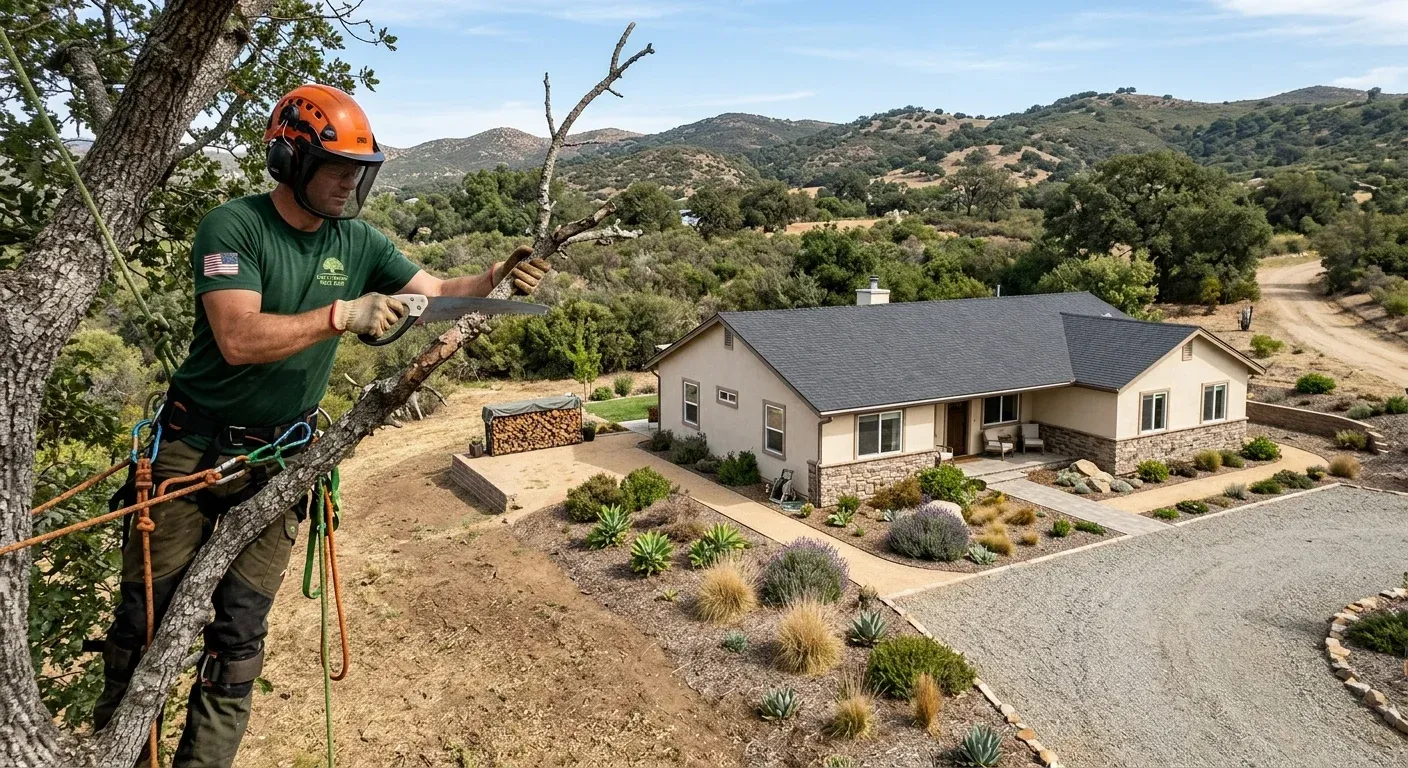
Fire-safe tree work in San Diego starts with the parcel. Confirm who the fire authority is. Confirm which zone language applies. Then inspect the vegetation you actually have, name the cut, name where debris goes, and recheck the same rules when the job is done.
If a line is down, stay away. Call 911 and SDG&E at 1-800-411-7343 from a safe place. Report it even if you can’t tell whether it’s live. If a standing tree or limb is into overhead lines, call SDG&E first: downed-power-line guidance. Injuries and immediate danger go to 911. Don’t climb onto a roof or into a gutter to clear debris. Ground-reachable cleanup only.
1. Who is the fire authority on this parcel?
A mailing city isn’t enough. Rancho Bernardo is inside the City of San Diego, which points residents to City Fire-Rescue. Poway has its own department and fire-hazard-severity-zone map. Unincorporated communities run through County planning and the local fire district. Postal address, water district, and fire-station proximity don’t settle planning jurisdiction.
Identify whether the tree is on private land, in an easement, in a right-of-way, or on City or County property. A City street tree follows that city’s inspection and permit path. A private crew’s availability isn’t authority to cut it. For City of San Diego street trees, start at sandiego.gov/trees/maintenance.
2. Which zone language actually applies?
Ask the fire department which map and which statute it is using for that address. California PRC 4291 is the 100-foot defensible-space rule in State Responsibility Areas. Government Code 51182 covers existing homes in locally designated Very High Fire Hazard Severity Zones.
Both tracks stop at the property line unless you have written consent to work on the neighbor’s land. Recorded easements and open-space conditions still apply. City of San Diego’s defensible-space guide tells owners to check easements and MHPA or open-space adjacency before working on City land.
CAL FIRE’s Ready for Wildfire page describes Zone 1 as within 30 feet of structures, or to the property line, whichever is closer. Zone 2 runs 30 to 100 feet, or to the property line. The Board of Forestry zone page labels Zone 1 as 5 to 30 feet after Zone 0. Use those pages, then confirm the local department’s current handout for your address.
Zone 0 is the first five feet. Ready for Wildfire describes it as the ember-resistant zone and says it isn’t legally required yet statewide. The Board of Forestry approved a final draft on August 19, 2026. That package still had to complete OAL review and state filing before becoming law. As of September 5, 2026, OAL listed the Zone 0 filing as under review. Confirm current status and any local start date with your fire authority. Local obligations still apply while the state filing is under review.
City of San Diego’s current guide allows maintained trees in that first five feet. That’s local guidance for City parcels. It isn’t permission to ignore dead litter, woodpiles, or a tree the City or your fire department has already flagged.
Spacing depends on vegetation and slope. Use the fire authority’s current written standard for this address, or have a qualified professional apply that standard on site.
More background: defensible space tree requirements in San Diego.
3. What is the vegetation doing, not just the species name?
Walk the ground you can reach safely. Note dead leaves, needles, hanging deadwood, and shrubs that touch lower limbs. Note proximity to walls, decks, and vents. Condition and placement matter more than a headline species.
A dense, neglected tree next to the house is a different problem than a maintained tree farther out. Clearing dead material and interrupting ladder fuel, where the fire authority actually wants that, is the useful work.
Time the work to the fire authority’s written objective, current fire weather, and the tree’s condition. Hazard wood can be a job in any month. Cosmetic thinning isn’t fire clearance.
If birds could be nesting, CDFW describes February through August as typical for many species, with nesting possible at other times. That’s guidance, not a permit exemption. A consulting biologist can survey and set a buffer based on the nest and the work, or the work can wait until nesting is complete. Don’t move nests.
4. What cut is the objective?
Write the objective before anyone starts a saw: remove named dead or broken wood, reduce a specific limb to a lateral, or carry out a clearance the fire authority put in writing. Protect the branch collar. Don’t order flush cuts. Don’t skin trunks. Don’t raise every crown as a default.
ISA’s mature-tree pruning brochure treats about 25 percent as a general upper guide, and less on mature trees. It isn’t an annual fire quota. Large cuts, elevated work, and powered equipment belong with a qualified tree professional. Interior stripping sold as lacing isn’t a fireproofing method.
Topping to stubs can stress a tree and grow weakly attached sprouts, per ISA’s topping brochure. Use a planned reduction or a written clearance instead of topping.
For broader brush and grade work, see land clearing and defensible space. Clearing still has to match parcel, easement, and fire-district limits.
5. Where does the debris go?
Cuttings left in the cleared zone can still hold fuel. Ask the crew to name placement or hauling in the written quote, and to state who handles it, depending on the zone. City collection rules differ. Don’t assume a county bin, a municipal drop-off, or a chip-in-place plan will take this load.
Don’t spread chips against the house. Don’t treat wet chips as fireproof. If chips stay on site, agree on location, depth, and who is responsible for them.
Don’t build a burn pile as home fire-safety disposal. The San Diego County Air Pollution Control District explains that local fire authorities issue burn permits for a specific place, time, material, and quantity. The district doesn’t issue that permit. A permissive air-quality day isn’t permission. In San Miguel Fire & Rescue’s jurisdiction, permitted burning has been suspended effective May 1, 2026. Confirm your own district. Don’t assume a permit is available.
6. What do you recheck?
From the ground, recheck the same zones you can reach safely. Confirm dead material you asked to have removed is gone, and that agreed haul-off happened. Stay on your parcel unless you already have written consent for neighboring land or an easement. If the fire department asked for a specific clearance, ask that department whether the result matches. If you need a written account of the work, agree on that report with the provider before the job.
Branch Pro San Diego is a referral service. We don’t perform the work, pull permits, or inspect for the fire department. The independent pros we connect you with are licensed and insured. You hire and pay them directly. Check a C-49 or valid legacy C-61/D-49 on CSLB license search. ISA certification belongs to an individual, not to this brand.
Frequently asked questions
Do I have to remove every plant in the first five feet?
Not as a current statewide rule, and not under City of San Diego’s current guide, which allows maintained trees there. Confirm the address with your fire authority. Dead litter and stored combustibles are still worth clearing where you can do it from the ground.
Is Zone 0 the law in San Diego County right now?
The Board approved a final draft on August 19, 2026. As of September 5, 2026, OAL listed that package as under review. Ask your fire department for the rule that applies today, including any local standard that’s already stricter.
How far should I limb up trees?
Ready for Wildfire ties spacing to vegetation and slope. Use the fire authority’s current instruction for the parcel, or have a qualified professional apply it from the ground.
Can I burn the cuttings?
Don’t treat burning as the disposal plan. Local fire authorities control burn permits. Some districts have suspended them. Name a hauler and a destination in the quote instead.
Who do I call if a tree is on a power line?
If a line is down, stay away. Call 911 and SDG&E at 1-800-411-7343 from a safe place. If a standing tree or limb is into overhead lines, call SDG&E first. Injuries and immediate danger go to 911.
If the site is clear of lines and you want a licensed independent crew for a defined fire-clearance trim, call Branch Pro San Diego at (858) 400-4423.