Yes, emergency tree removal in San Diego typically costs more at night and on weekends than the same job scheduled during a normal weekday. The premium reflects overtime crews, immediate mobilization, and higher-risk conditions, not padding. Call (858) 400-4423 for a same-day quote so you know the real number before a crew rolls out.
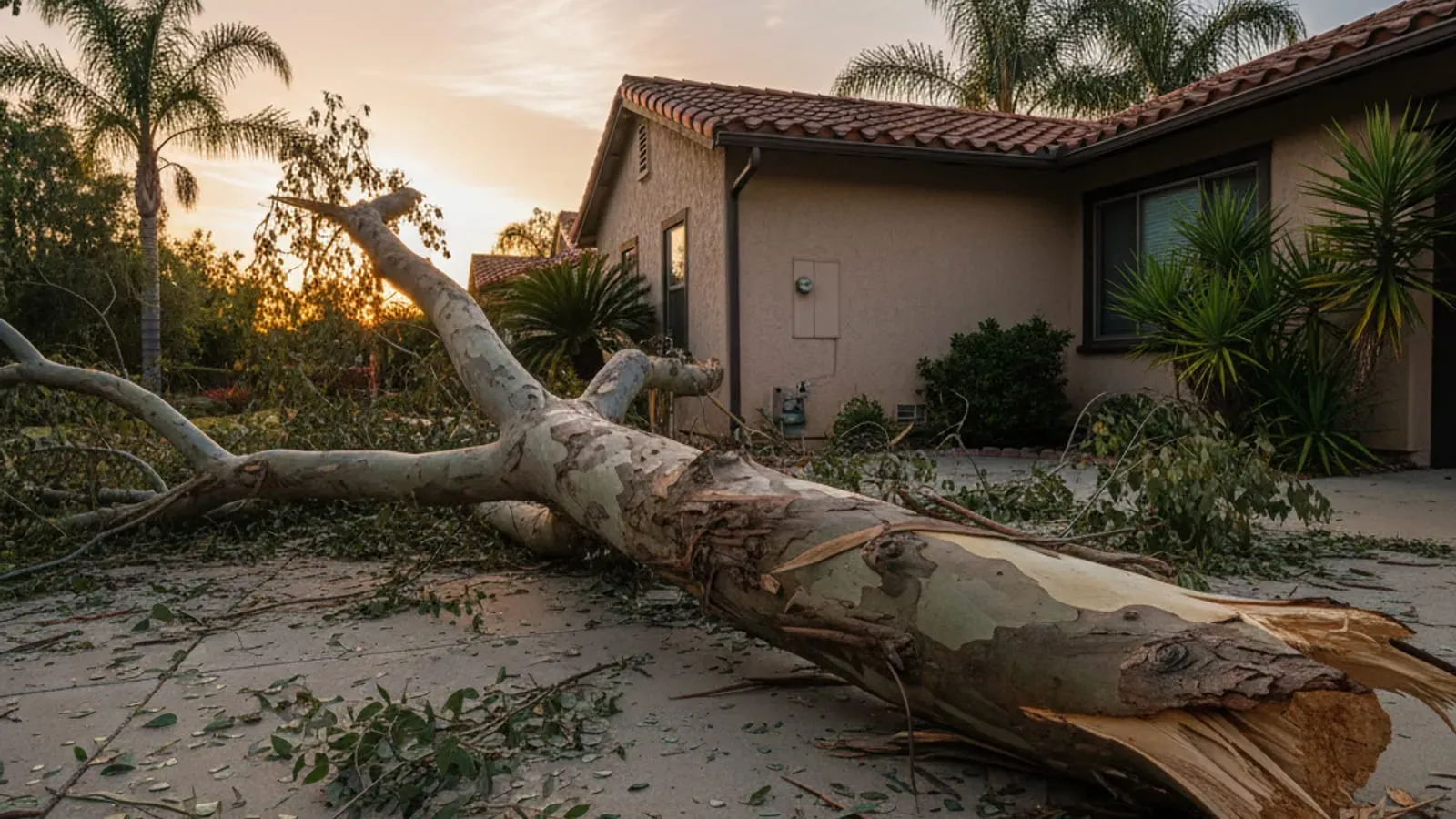
Yes, after-hours tree removal usually costs more
Any time a job has to happen outside normal business hours, on a weekend, or on a holiday, expect to pay more than you would for the same work scheduled during the week. That’s true for tree service the same way it’s true for plumbers, electricians, and towing companies. A crew called out at 2 a.m. for a tree on a roof isn’t working a normal shift, and the cost reflects that.
The honest range: expect a meaningful premium over a scheduled daytime job, commonly somewhere in the range of 25% to 100% more, depending on the time, the weather, and how dangerous the tree actually is. A tree leaning against a fence at 6 p.m. on a Tuesday is a different job than a tree through a roof at 3 a.m. during a Santa Ana wind event with power lines involved. The second one sits at the high end of that range.
What actually drives the after-hours premium
The premium isn’t one flat multiplier. A handful of specific factors stack on top of each other to set the real price.
Time of day, weekends, and holidays
Crews working nights, weekends, or holidays are being paid overtime or holiday rates, and that gets built into the quote. A call at 10 p.m. on a Saturday costs more to staff than the same call at 10 a.m. on a Wednesday.
Storm and wind conditions
Santa Ana wind events and winter storms are when most emergency calls come in, and they’re also the conditions that make the work harder and slower. Wet ground, unstable soil, and gusty wind all slow a crew down and add risk, which adds cost.
Whether the tree is on a structure or vehicle
A tree resting on a house, garage, or car changes the job completely. Crews have to rig cuts carefully to avoid dropping more weight onto the structure, which takes more time and more hands than a straightforward removal in open yard space.
Power line proximity
If a tree is touching or near power lines, the job often can’t move forward until SDG&E has been called to de-energize the line. That coordination adds time and sometimes requires the crew to wait on-site until it’s safe to work, which factors into the price. Our guide on trees near power lines in San Diego covers this in more depth.
Crane requirements and access
Some emergency removals need a crane, especially when a tree is too large or too awkwardly positioned to rig down safely by hand at night. Bringing a crane out on short notice, especially after hours, adds real cost on top of the emergency premium itself. We cover when that’s actually necessary in our post on when crane-assisted tree removal is necessary.
How this compares to standard removal pricing
Standard, scheduled tree removal in San Diego County runs across a wide range depending on tree size, species, location, and access, and we break that full pricing picture down in our 2026 tree removal pricing guide. Think of the emergency premium as a percentage added on top of that baseline, not a separate pricing system. A tree that would run a certain amount on a scheduled Tuesday morning will run more for the same crew to handle at midnight on a Saturday.
When paying the premium is worth it
If a tree is actively on your house, blocking your only way out of the driveway, or resting on power lines, the after-hours premium is worth paying. Waiting overnight on a genuine hazard risks more damage, and in the case of power lines, it risks someone getting hurt. Our emergency tree removal guide covers what to expect when you call for a true emergency.
If the tree also caused damage to a structure, it’s worth understanding what your policy actually covers before the crew arrives. Our post on whether insurance covers tree removal in San Diego walks through what’s typically included and what isn’t.
When you can wait for daylight and save money
Not every leaning or damaged tree is a true emergency. If a tree is leaning but stable, isn’t touching a structure or power line, and isn’t blocking access to your home, it’s usually safe to have it assessed and scheduled for daylight hours instead of calling for immediate after-hours service. That alone can save you the premium entirely. Our guide on leaning trees in San Diego walks through how to tell the difference between a tree that needs to come down tonight and one that can wait until tomorrow.
Frequently asked questions
Is emergency tree removal always more expensive than scheduled removal?
In almost every case, yes. Overtime labor, immediate mobilization, and higher-risk working conditions all add cost compared to a job scheduled during normal business hours.
How much more does after-hours tree removal cost in San Diego?
It varies by job, but expect a premium commonly in the range of 25% to 100% over a scheduled daytime removal, with the high end reserved for true middle-of-the-night, high-hazard jobs involving structures or power lines.
Does homeowners insurance cover the emergency premium?
Sometimes, but coverage is usually limited to tree removal that resulted from covered damage to a structure, and even then it’s often capped at a few hundred to about a thousand dollars. Check with your carrier before assuming the premium is covered.
Can I wait until morning if a tree is leaning but not down?
Often yes, as long as it isn’t touching a structure, power line, or blocking access, and it doesn’t appear to be actively failing. Have it assessed as soon as possible either way.
What should I have ready when I call for emergency tree removal?
Your address, a description of what the tree is resting on or near, whether power lines are involved, and photos if it’s safe to take them. Call (858) 400-4423 and we’ll walk you through the rest.